
Vandaag of morgen in huis

Kwaliteit gegarandeerd

Welkomstaanbiedingen ontgrendelen: GRATIS bezorging | Tot 80% korting | Gratis 30 dagen JoyPlus-proefperiode
Download de app
A ratchet wrench set may seem simple to choose at first glance: pick a case with plenty of parts and you’re ready to go. In practice, it’s mainly the combination of drive size, ratchet mechanism and supplied sockets that determines whether you’ll use the set regularly. An oversized set can take up unnecessary space, while a compact set may be missing important sizes.
As a Joybuy Product Recommendation Officer, I therefore start by checking verifiable product specifications. This helps ensure you’re not paying simply for a high part count or broad marketing claims.
A set with 100 or more parts sounds appealing, but check what it actually contains. Some sets count adapters, bits and storage clips. For car or motorbike maintenance, the most important items are the right metric sockets, deep sockets, extension bars and drive sizes.
A socket set containing only small 1/4-inch sockets is suitable for light assembly, bike repairs and household jobs. For larger bolts on a car, you’ll generally also need 3/8-inch or 1/2-inch.
A 72-tooth ratchet generally has a small working angle. Product information for various sets refers to a movement of around 5 degrees. This is practical in a cramped engine bay, as you don’t need to move the handle as far.
This does not automatically mean that every 72-tooth ratchet is suitable for very high loads. Always check the stated maximum load or maximum torque. For controlled tightening of critical connections, use a separate torque wrench and follow the vehicle or machine manufacturer’s instructions.
Cr-V steel, or chrome vanadium steel, is widely used for sockets and hand tools. Heat treatment and a chrome finish can contribute to wear resistance and protection against corrosion. However, correct use remains important: do not use a ratchet as an impact tool and do not attach an extra pipe to the handle to create more force.
When a brand mentions properties such as durability or corrosion resistance, I treat these as information from the brand’s product description. Practical suitability also depends on load, maintenance and storage.
The drive size determines which sockets and accessories will fit:
With a metric socket set, pay attention to the actual size range. A set from 4 to 13 mm is useful for small connections, but it does not cover every size found on cars. Also check whether the sockets are six- or twelve-point. Six-point sockets generally fit the bolt head securely; twelve-point sockets can be useful when accessibility is important.
A ratchet with a reversing lever allows you to change the direction of rotation without removing the socket. A quick-release mechanism makes it easier to change sockets quickly. This is particularly useful when using several sizes during a job.
A flexible head offers extra reach, but check whether the head can be locked and how much movement is specified. A flexible ratchet wrench is useful in hard-to-reach places, while a fixed head may feel more stable when working in a straight line.
As well as the sockets, look for:
Clean and dry your tools after use. According to the product information for some sets, applying a small amount of oil to the ratchet mechanism can help with maintenance. Before use, check the components for cracks, distortion or a poorly functioning selector switch.
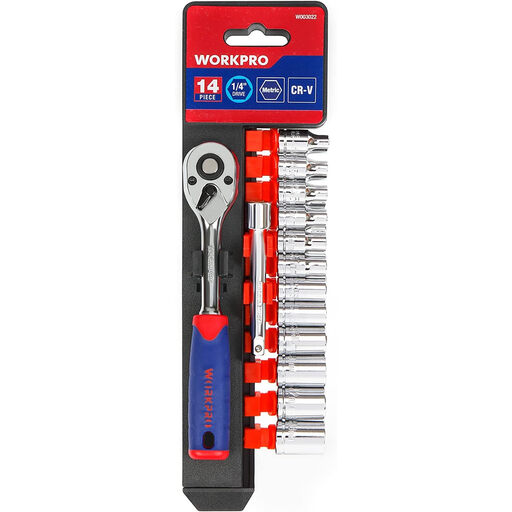
Why it suits this profile: The 1/4-inch ratchet and 4 to 13 mm metric sockets provide a straightforward foundation for household repairs, bike work and light assembly.
The number of 14 components is clearly specified. The set does not hide its contents behind a high accessory count.
Cr-V steel, 72-tooth ratchet, quick-release button and a 76 mm extension bar.
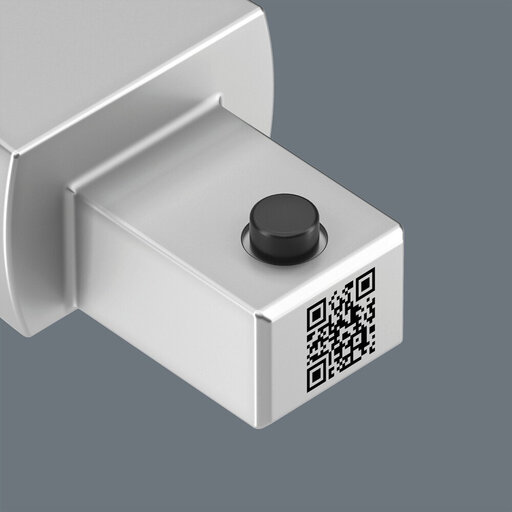
Why it suits this profile: This adjustable wrench is intended for users looking for a specific solution and wanting to combine it with Click-Torque X or XP torque wrenches.
The adjustable jaw makes the size selection explicit; however, check compatibility with the torque wrench you use beforehand.
9x12 mm drive, self-adjusting parallel jaws and a stated return angle of 30 degrees.
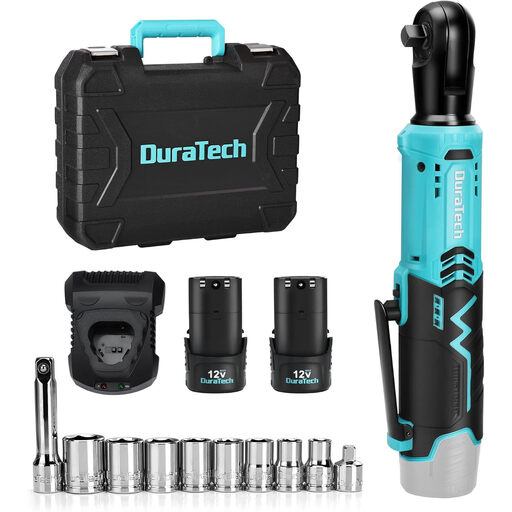
Why it suits this profile: An electric ratchet wrench is a good choice for frequent assembly work where speed and access to difficult-to-reach places are important.
The specifications list the drive, batteries, supplied sockets and maximum torque of 65 Nm. For precise final tightening, use a torque wrench.
12 V, 3/8-inch drive, two 2.0 Ah batteries, LED light and a storage case.
For a tool set for cars or motorbikes, a set with several drive sizes may make more sense than buying individual tools. According to the product information, the DURATECH 108-piece set contains 1/4- and 1/2-inch ratchets, sockets, bits, universal joints and extension bars. The WORKPRO 172-piece set adds 3/8-inch tools, deep sockets, spark plug sockets and Torx sockets, among other items.
A large case is particularly worthwhile if you regularly work on cars, motorbikes, bikes and household appliances. For occasional jobs, a compact ratchet set with sockets may be easier to store and carry.
We’ve put together a complete, up-to-date list of products that fully meet these strict selection criteria and the applicable European safety regulations.
For general car maintenance, 3/8 inch and 1/2 inch are often practical drive sizes. The required socket size depends on the bolt. Check the sizes in the vehicle handbook or choose a set with a broad metric range.
A ratchet wrench can be used to loosen or hand-tighten wheel bolts, but the final tightening torque must be set with a suitable torque wrench, following the car manufacturer’s instructions.
Its lifespan depends on the material, load, maintenance and storage. Cr-V steel, a properly functioning ratchet mechanism and a dry storage location can help under normal use. Always use the correct socket size and replace any components that are damaged or distorted.
