
Vandaag of morgen in huis

Kwaliteit gegarandeerd

Welkomstaanbiedingen ontgrendelen: GRATIS bezorging | Tot 80% korting | Gratis 30 dagen JoyPlus-proefperiode
Download de app
A ratchet wrench set can save you a great deal of time when carrying out car maintenance, bicycle repairs, assembly work and household jobs. However, a large case packed with components is not automatically the right choice. Some sets contain sizes you rarely use, while important accessories are missing. Terms such as “90 teeth” and “professional” are also often mentioned without explaining what they mean in practice.
Pay particular attention to these three common pitfalls:
The drive size determines which sockets and accessories you can use:
A 3/8-inch ratchet handle is a practical mid-size option for many DIY enthusiasts. Anyone working on cars will often choose a combination of 1/4, 3/8 and 1/2 inch. A ratchet socket set with multiple drive sizes means you will not need to buy separate handles and adapters later.
The number of teeth directly affects the movement required to turn a bolt further. A ratchet with 72 or 90 teeth may, according to the product description, operate with a small operating angle. A 72-tooth mechanism, for example, is often specified as having an angle of around 5 degrees; some 90-tooth ratchets have an angle of 4 degrees.
This is useful in confined spaces, such as around an engine block or beneath a dashboard. It does not automatically mean that the ratchet is suitable for every heavy-duty application. Also check the drive size, handle and information about permitted use.
Many models in this selection use chrome vanadium steel, often abbreviated to Cr-V. This is a common material for hand tools. Also look for:
A ratchet wrench with storage case is easier to keep organised in a workshop or car boot. For loose wrenches, a pouch may be more practical. With a ratcheting combination wrench or a flexible ratchet wrench, the size, hinge construction and direction of rotation are more important than the number of components alone.
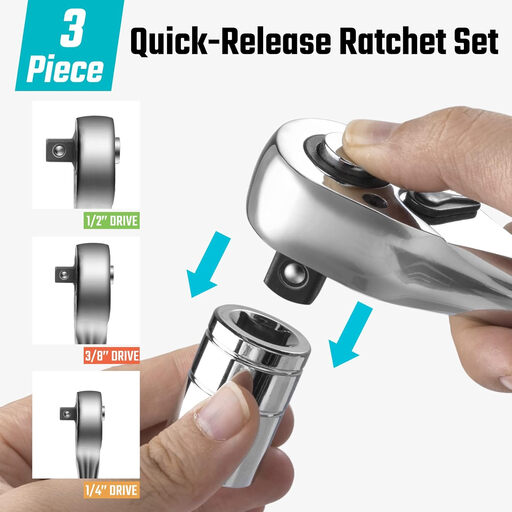
Why it suits this profile: The three drive sizes cover light jobs and many common tasks involving cars, bicycles and household repairs. The set comes in a storage case.
You are not limited to a single drive size. According to the product information, the 72-tooth version is designed for a smaller movement, while the sizes are clearly separated.
Three ratchets, 72 teeth, quick release and a water-resistant storage case.
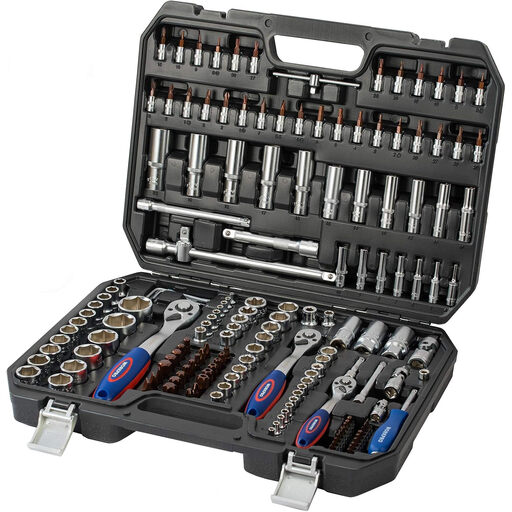
Why it suits this profile: This comprehensive set is designed for users who want one case for car, motorbike, bicycle and household maintenance.
The contents are specified by drive size and measurement. Check in advance that the included SAE and metric components are suitable for your vehicle and the job at hand.
172 components, 1/4-, 3/8- and 1/2-inch ratchets, deep sockets, bits, extension bars and universal joints.
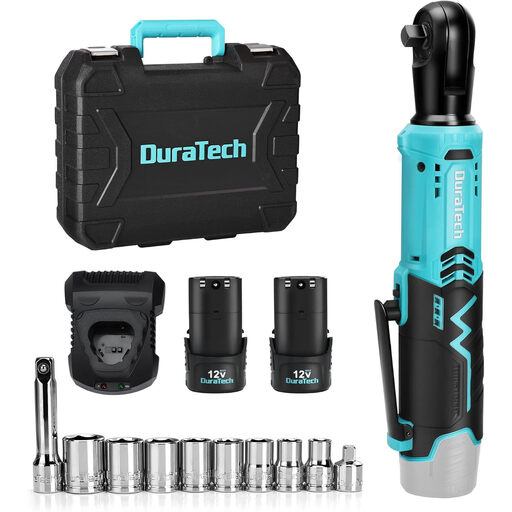
Why it suits this profile: An electric ratchet wrench is useful when you need to loosen or tighten many fasteners in succession, for example during car and motorbike maintenance.
The specifications list a 3/8-inch drive, two batteries, a charger and a storage box. Do not use the machine as a substitute for a torque wrench.
12 V, up to 65 Nm according to the product information, LED lighting, two 2.0 Ah batteries and eight sockets.
A manual ratchet gives you direct control and does not require a battery. This makes it suitable for occasional maintenance and tasks where you want to feel the tightening torque precisely by hand. An electric model mainly saves time when carrying out repetitive tasks, but batteries have a limited operating time and need to be recharged.
For confined fasteners, a ratcheting combination wrench may be more practical than a socket set. A flexible ratchet wrench with an adjustable head can offer extra reach, but check that the hinge is sturdy enough for your application. According to the product description, a self-adjusting ratchet wrench adapts to different sizes; use it within the specified size limits.
We have compiled a complete, up-to-date list of products that fully meet these strict selection criteria and the applicable European safety regulations.
For many jobs, a 3/8-inch ratchet is a useful mid-size option. For small bolts and limited space, you will often use 1/4 inch. Larger fasteners may require 1/2 inch. Always check the socket size and the space around the bolt.
Not necessarily. The number of teeth mainly indicates the operating angle. Strength also depends on the material, construction, drive size and permitted use. Do not use a ratchet with an extension pipe to apply extra force to a seized bolt if the manufacturer does not permit this.
Its service life depends on the load, storage and maintenance. Wipe away grease and dirt after use, store the components in a dry place and use the correct socket size for each bolt. With heavy professional use, it is advisable to inspect the ratchet head and quick-release mechanism regularly.
