
当日/次日达

品质保障

开启新人专享福利: 全场免邮 | 低至 2 折 | 免费试用 30 天 JoyPlus 会员
下载 Joybuy
A ratchet wrench can save you a lot of time when maintaining cars, building machinery and tackling household repairs. However, not every model is right for every job. A compact ratchet handle with a small drive size is handy in tight spaces, while a larger socket ratchet can transfer more force.
Most disappointing purchases come down to three common pitfalls:
The drive size determines which sockets fit and gives you an initial indication of what the tool is designed for:
Always check the maximum torque in the product information. For example, the DURATECH 3-in-1 ratchet handle has separate values listed: according to the product description, the maximum torque is 84 Nm for 1/4 inch, 304,5 Nm for 3/8 inch and 350 Nm for 1/2 inch. Do not exceed the stated value. For controlled tightening, use a suitable torque wrench.
The number of teeth affects how much room the handle needs for the mechanism to engage again. According to the product information, different models have:
A smaller working arc is useful when you have little room to move the handle back and forth. This can be the case with fasteners in an engine bay or behind a machine panel. However, the number of teeth is no substitute for checking the construction, drive size and permitted load.
Many models in this selection are made from chrome vanadium steel; according to the product information, some ratchet heads are also made from chrome molybdenum. A polished chrome finish can make the tool easier to clean after contact with oil or dirt.
Also look out for:
A flexible ratchet spanner set works differently from a socket ratchet. The former combines an open-ended or ring end with a ratchet mechanism; the latter uses separate sockets on a square drive.
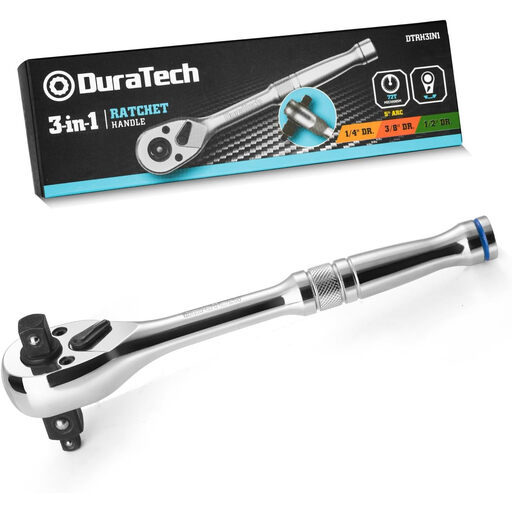
Why it suits this profile: One ratchet handle offers 1/4-, 3/8- and 1/2-inch drive options, making it a handy choice if you work with different socket sizes and don’t yet have a comprehensive toolbox.
The drive sizes are clearly specified, and the product information lists separate maximum torque values. This means you can’t simply treat the ratchet as a single all-purpose size.
72 teeth, a stated 5-degree working arc and a reversing lever that lets you change direction without removing the socket.
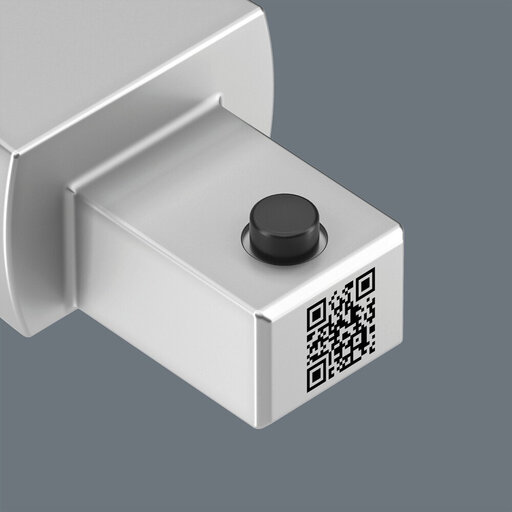
Why it suits this profile: This adjustable ratchet wrench is designed for users who need an adjustable jaw and want to use it with Click-Torque X and XP torque wrenches.
The adjustable jaw and 9x12 mm connection are clearly specified. Check in advance that this connection is compatible with your torque wrench.
Self-adjusting jaws, a stated return angle of 30 degrees and an adjustable range for different sizes.
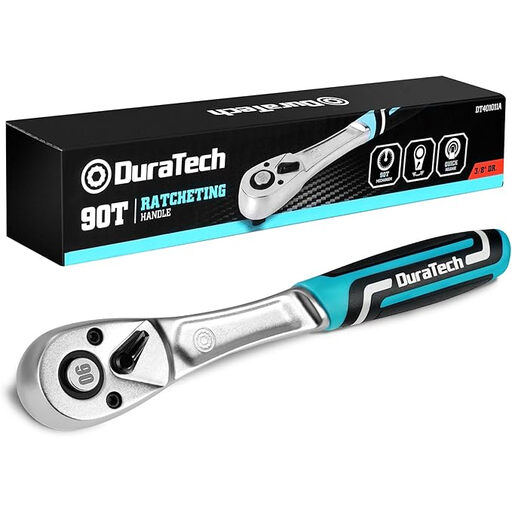
Why it suits this profile: A 3/8-inch ratchet with a small working arc is handy for mechanics and DIYers who often work on fasteners in tight spaces.
The product information specifies the 3/8-inch drive, 90 teeth and 4-degree working arc. It also has a quick-release button for changing sockets.
Chrome vanadium steel, reversible direction and an ergonomic handle, according to the product description.
We’ve put together a full, up-to-date list of products that meet these strict selection criteria and the applicable European safety regulations.
For many car maintenance jobs, a 3/8-inch ratchet wrench is a practical all-round size. A 1/4-inch model may be more useful for small fasteners. Use a 1/2-inch model when the sockets and fasteners are larger and the product information specifies a suitable torque. Also check which sockets you already own.
Either may be suitable. According to the product information provided, a 72-tooth ratchet typically has a working arc of 5 degrees, while a 90-tooth ratchet can work at around 4 degrees. In a very tight space, the smaller arc gives you more room to move the handle. Also consider the handle length and the shape of the ratchet head.
After use, wipe away oil, dust and metal particles with a dry cloth. Store the tool in a dry place, and don’t use a ratchet to wrench a seized bolt loose with an extension tube unless the manufacturer explicitly allows it. Check regularly that the reversing lever, quick-release button and socket connection all work smoothly.
