
Livraison le jour même et le lendemain

Qualité garantie

Débloquez vos offres de bienvenue: Livraison GRATUITE | Jusqu'à -80 % | 30 jours d'essai gratuits à JoyPlus
Téléchargez l'application
A ratchet wrench saves time during assembly and repair work, especially when you have little room to swing the handle. However, it is easy to buy a model that is incompatible with your sockets, cannot handle enough force or is awkward to use in a confined engine bay.
For Dutch DIY enthusiasts, car mechanics, motorbike mechanics and maintenance technicians, three pitfalls are particularly important: marketing claims without clear specifications, choosing the wrong drive size and confusing a ratchet with a torque wrench.
A ratchet with more teeth generally has a smaller return swing angle. This is useful in confined spaces, but the number of teeth does not tell you everything about overall quality. Also check the material, drive size, release mechanism and ratchet-head design.
A 90-tooth ratchet with a stated working angle of 4° can be practical for fasteners where you can barely move the handle. For heavy loosening work, the construction and the way you apply force to the handle are also important.
An electric ratchet wrench works efficiently for many repetitive assembly and disassembly tasks. However, the tool does not automatically replace a torque wrench. The maximum torque, battery capacity and available space around the bolt determine whether the model is suitable.
For connections with a specified tightening torque, use a suitable torque wrench. Tighten the fastener into position by hand first, and mainly use power tools to save time. Always check the manufacturer's instructions and specifications.
A case with lots of components may seem like good value, but it can sometimes contain sizes you rarely use. Check whether the socket set includes metric sockets, which drive sizes are available and whether it contains extensions, adapters and a ratchet.
For general maintenance, a ratchet set with 1/4", 3/8" and 1/2" drives can be practical. For bicycle repairs and precision assembly work, a smaller drive is often more suitable than a heavy 1/2-inch ratchet.
The drive size determines which sockets fit the ratchet wrench.
A 3/8 inch ratchet wrench is a practical middle ground for many users. However, check that your existing sockets have the same connection. An adapter can help, but it does not change the maximum torque or the mechanical properties of the ratchet.
A ratchet with 72 or 90 teeth requires less movement to turn a fastener further. A small working angle is particularly useful in confined spaces. A compact or teardrop-shaped head can also help you work around obstacles.
Also pay attention to the switch between anticlockwise and clockwise rotation. An easily accessible switch means you do not have to remove the socket repeatedly. A quick-release button makes changing sockets easier, but check that the socket remains securely attached during use.
Chrome vanadium steel is widely used for hand tools because of its combination of hardness and wear resistance. A matt or polished chrome finish can make cleaning easier after contact with oil and grease. This does not mean that the tool is maintenance-free.
Wipe the ratchet wrench clean after use, store it in a dry place and do not use it as a hammer. Do not use a ratchet as a substitute for a breaker bar either. For accurate tightening, also check whether a digital torque wrench or mechanical torque wrench covers the required range.
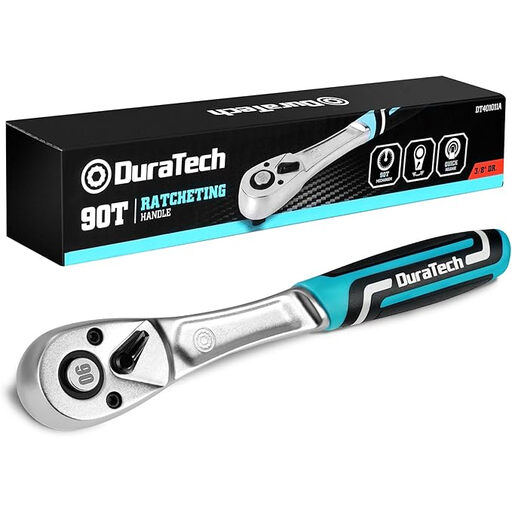
Why it suits this profile: This manual 3/8-inch ratchet is suitable as a first addition to a tool set for car maintenance, household jobs and light assembly work.
The product description specifies the drive size, 90 teeth, a 4° working angle, a quick-release button and a switch for clockwise and anticlockwise rotation.
Chrome vanadium steel, 8-inch length, 90 teeth and a rubber handle according to the product specifications.
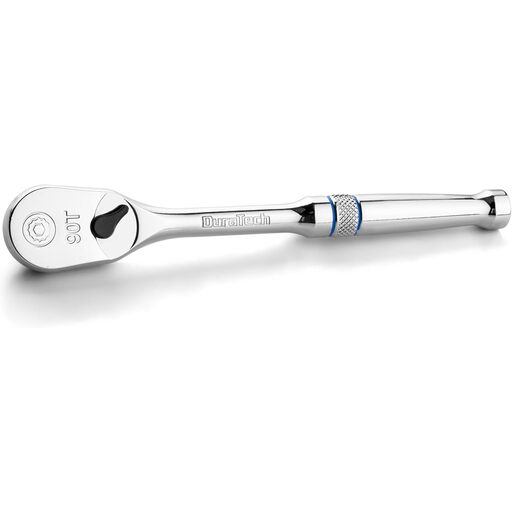
Why it suits this profile: A good choice for users looking for a 3/8-inch hand ratchet for regular work on cars, light commercial vehicles or workshop projects.
The fully enclosed ratchet head is described as protecting against the ingress of dirt and grit.
90 teeth, a stated working angle of 4°, a fully polished chrome finish and a switch for both directions of rotation.
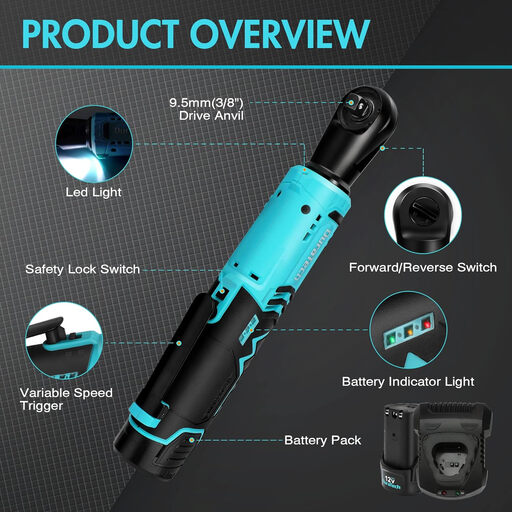
Why it suits this profile: This electric ratchet wrench is ideal for users who install or remove many bolts consecutively during car, motorbike or workshop maintenance.
The specifications list a 3/8-inch connection, forward and reverse functions, LED lighting and a battery indicator. This makes the key usage parameters clear in advance.
Stated torque of 65 Nm, two 2.0 Ah batteries, eight sockets, an extension, adapter and storage case.
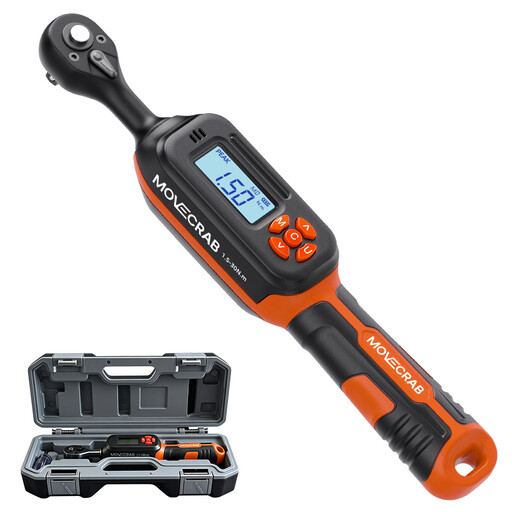
Why it suits this profile: Suitable for anyone who wants to set tightening torques during bicycle, motorbike or car maintenance and prefers a digital readout.
The stated range of 4,2 to 85 Nm makes the intended application clear. According to the product description, it features a display, ten preset settings and sound, light and vibration alerts.
Measurements in Nm, ft-lb, in-lb and kgf-cm; the description also states an accuracy of ±2% and storage capacity for 500 measurement records.
A ratchet is usually used with a socket or ratchet set. For bolts that can be accessed directly from the outside, an open-ended spanner set or combination spanner set is more convenient. A flexible ratchet wrench with a swivelling head can be useful when a fixed handle does not line up properly.
The DURATECH 12-piece combination spanner set includes metric sizes from 6 to 22 mm and states compliance with DIN 3113. According to the product information, the 8-piece double ring spanner set has a 75° offset and sizes from 6/7 to 20/22 mm. For general jobs, a larger DIY tool set with several drive sizes may be more practical than buying individual pieces.
We have put together a complete, up-to-date list of products that fully meet these strict selection criteria and the applicable European safety regulations.
For many jobs, a 3/8 inch ratchet wrench is a useful middle size. Pair it with metric sockets and an extension. For larger wheel or chassis connections, a 1/2-inch version may be more suitable. Always check the size of the fasteners and the required torque.
No. An electric ratchet wrench is designed to speed up assembly and disassembly. A torque wrench is designed to achieve a set tightening torque. When the vehicle, motorbike or component manufacturer specifies a tightening torque, use a suitable mechanical or digital torque wrench.
Its service life depends on the load, frequency of use, storage and maintenance. Do not drop the ratchet, use it as an impact tool or overload it. Clean off oil and dirt after use and store the tool in a dry place. A ratchet that runs stiffly or slips under load should not be used again until the cause has been checked.
