
Vandaag of morgen in huis

Kwaliteit gegarandeerd

Welkomstaanbiedingen ontgrendelen: GRATIS bezorging | Tot 80% korting | Gratis 30 dagen JoyPlus-proefperiode
Download de app
Whether you're working on a car, assembling machinery, or putting together furniture, a bolt or nut in a hard-to-reach spot can make a simple job unnecessarily frustrating. In these moments, a good ratchet wrench isn't a luxury—it's an essential tool. But with so many options, from a compact manual ratchet to a powerful cordless ratchet wrench, it can be tough to decide which one you really need.
This guide is here to help. We'll cut through the marketing jargon and focus on the specifications that truly matter, so you can make an informed decision that fits your projects.
Before we look at specific models, here are a few key points to help steer you in the right direction.
The first choice is the power source. A traditional manual ratchet gives you maximum control and feedback when tightening. They are compact, reliable, and have no battery that can run out.
An electric ratchet wrench, often called a cordless ratchet wrench, on the other hand, offers speed and convenience. Especially for jobs with many bolts and nuts, like working on an engine block, it saves significant time and effort. You break the bolt loose manually and let the cordless ratchet do the fast turning.
Ratchets come in different drive sizes, indicated in inches. The three most common are:
Additionally, a flex-head ratchet can be a game-changer. It allows you to tilt the head to reach bolts at an awkward angle, something impossible with a standard ratchet.
Do you already have a collection of sockets? Then a single ratchet is often sufficient. However, if you're just starting out or want to expand your tool collection, a ratchet set is a practical choice. These sets often include multiple ratchets in different sizes and an assortment of matching sockets, so you can get to work right away.
Based on functionality and application, we've highlighted a few popular choices for you.

Why It Stands Out: This cordless ratchet wrench combines the convenience of a power tool with a slim design, specifically for tight spaces.
This ratchet is designed for speed and efficiency. With a maximum torque of 45 Nm, it's powerful enough for most common tasks. The variable speed trigger gives you control: press lightly for slow rotation, press firmly for more speed. The built-in LED light is a practical addition for dark corners under the hood or behind machinery.
Advantages:
Who Is It For? Ideal for auto mechanics and DIYers who regularly perform repetitive fastening jobs and want to save time.
Check out the EAFC 12V Cordless Ratchet Wrench
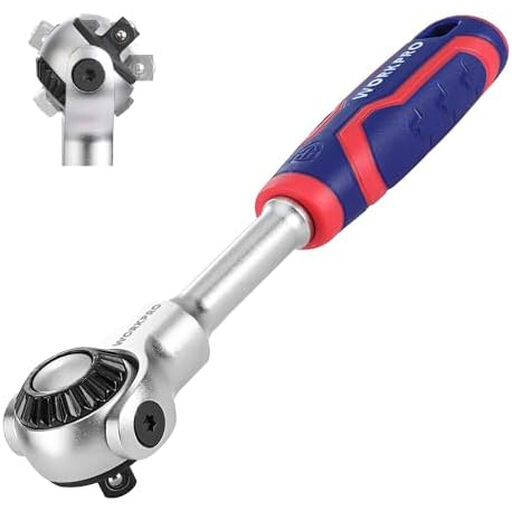
Why It Stands Out: The flex-head, which can pivot 270 degrees, makes this tool exceptionally useful for hard-to-reach fasteners.
This is a prime example of a tool that solves one problem extremely well: working at an angle. The 270° pivoting head combined with the 1/4" drive makes it perfect for precision work in engine bays, dashboards, or when assembling complex equipment. The 72-tooth mechanism ensures you can tighten a bolt with a small swing arc of just 5 degrees.
Advantages:
Who Is It For? For the mechanic or DIYer who often works in tight, awkward spaces and needs a reliable manual solution.
Check out the WORKPRO 1/4" Flex-Head Ratchet
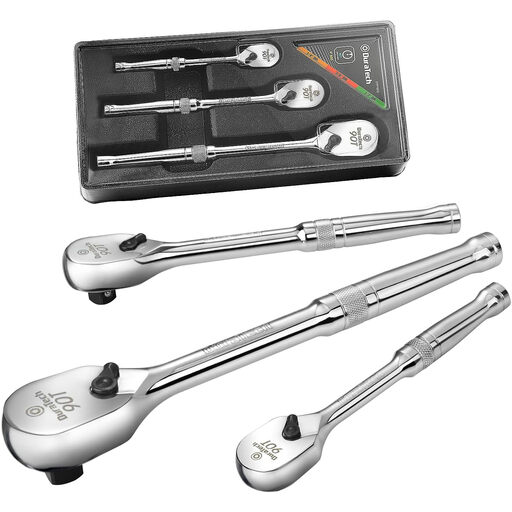
Why It Stands Out: This ratchet set provides the three most common drive sizes in one convenient storage case, ready for virtually any job.
Why choose when you can have them all? This set includes a 1/4", 3/8", and 1/2" ratchet, preparing you for everything from precision work to heavy-duty applications. All three ratchets feature a 90-tooth mechanism, which means a swing arc of just 4 degrees is all you need. The fully sealed ratchet head is designed to keep out dust and debris, which improves its longevity.
Advantages:
Who Is It For? Perfect for anyone looking for a complete and reliable starter set, from the beginner DIYer to the professional mechanic looking to supplement their toolbox.
Check out the DURATECH 3-Piece Ratchet Set
Looking for a different size, a specific brand, or other specialized tools? A good ratchet is often just one part of a larger toolbox. Check out our full range for more options.
Discover more in the Sheet Metal Tools category
The number of teeth in the ratchet mechanism determines the "swing arc." This is the minimum angle you need to move the handle to engage the next tooth. A 72-tooth ratchet has a 5-degree swing arc. A 90-tooth ratchet has an even smaller 4-degree arc. The smaller the arc, the easier it is to tighten a bolt in a very confined space where you can barely move the handle.
An electric ratchet wrench is especially useful for speed and reducing fatigue. Think of tasks where you need to loosen or tighten many bolts in a row, such as dismantling engine parts or assembling a steel structure. For the final torque application or for breaking loose a stubborn bolt, you still use manual force.
For general automotive tools and maintenance, a 3/8" ratchet is the most versatile and commonly used size. It can handle most jobs around the engine, brakes, and suspension. A 1/4" is useful for interior work and small bolts, while a 1/2" is necessary for heavier components like lug nuts and subframe bolts. A set with all three sizes is therefore an excellent investment.
