
Vandaag of morgen in huis

Kwaliteit gegarandeerd

Welkomstaanbiedingen ontgrendelen: GRATIS bezorging | Tot 80% korting | Gratis 30 dagen JoyPlus-proefperiode
Download de app
A ratchet tool set can make many jobs much easier. With the right socket, bit or spanner, you can tighten and loosen fasteners without removing the ratchet fully from the bolt each time. However, a large case is not automatically a suitable purchase. The number of components, drive size and available metric sizes determine whether you will use the set regularly in practice.
This buying guide helps DIY enthusiasts, motorists, installers and mechanics distinguish marketing claims from verifiable product specifications.
A set with 100 or more components sounds appealing, but many of them may be adapters, duplicate bits or sizes you rarely use. Always check the contents list. For bicycles, cars, furniture and household assembly in the UK, metric sizes are usually the starting point.
A practical socket set with ratchet might include sockets from around 8 to 19 mm for many standard jobs. For vehicle maintenance, larger sockets, spark plug sockets, Torx sockets and extension bars may also be useful.
Ratchet handles are often described as a 1/4-inch ratchet, 3/8-inch ratchet or 1/2-inch ratchet. This refers to the square socket connection, not the size of the bolt.
An adapter can combine sizes, but it does not automatically change the ratchet’s load capacity. For heavily seized bolts, use the appropriate drive size and follow the manufacturer’s instructions.
In an engine bay, meter cupboard or furniture assembly, room to manoeuvre is often limited. The ratchet mechanism determines how far you need to move the handle before the socket engages again. According to the product description, a product with 72 or 90 teeth has a small return angle. This can be practical in confined spaces, but it says nothing by itself about maximum torque or service life.
Also consider the head shape, whether it has a quick-release function and the length of the handle. A long ratchet provides greater leverage, while a compact ratchet is easier to fit between components.
Many sets use chrome vanadium steel (Cr-V) for their sockets and ratchets. This is a widely used material for hand tools. As well as the material, look at the heat treatment, surface finish and corrosion protection, such as a polished or chrome-plated coating.
The term “S2 steel” usually refers to bits. Check whether the specification applies to the bits, the sockets or both. Do not use hand tools as impact tools unless this is explicitly permitted.
A metric spanner set is a sensible choice for much maintenance work in the UK. If you work on an older machine, American car or specific motorbike, SAE or imperial sizes may be required. Check that the sizes are clearly marked on the sockets and inside the case. A set containing metric sockets only is not a substitute for a ratchet set with imperial sizes.
A tool set with storage case is useful when every component has its own designated place. A tool roll is lighter and takes up less space, but generally offers less protection against knocks. Check that the fastenings are sturdy and that loose adapters cannot fall out of the case when you carry it.
For small assembly jobs, a ratchet screwdriver set may be more practical than a complete socket set. This type of set uses bits and is particularly suitable for screws in furniture, electronics, bicycles and carrying out light repairs.
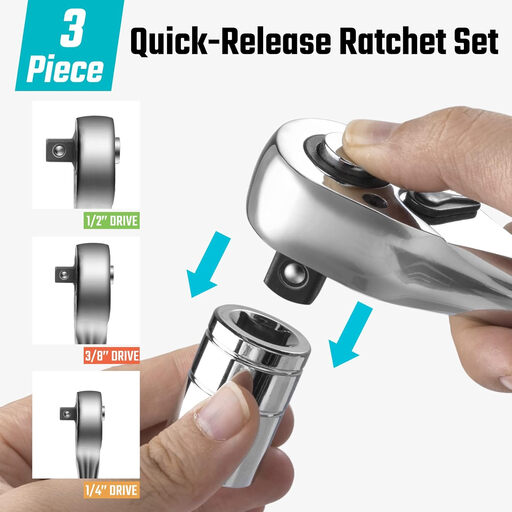
Why it suits this profile: The three drive sizes provide a straightforward foundation for household maintenance, bicycle repairs and light work on cars.
You are not buying a large collection of components you may never use, but three clearly specified 72-tooth ratchets with quick release, according to the product description.
1/4, 3/8 and 1/2-inch connections; 72-tooth mechanism; storage case included.
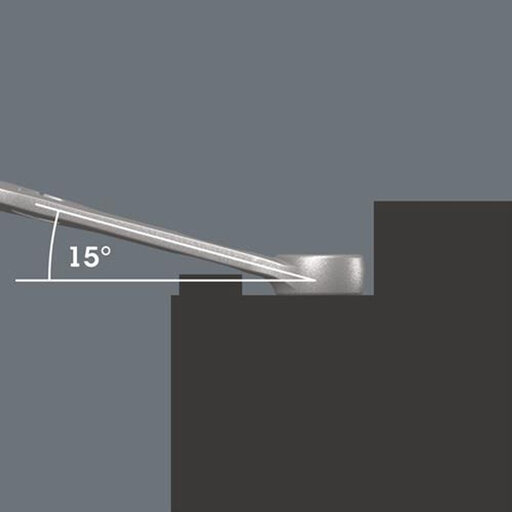
Why it suits this profile: This compact set is designed for jobs involving combination spanners in confined installation spaces, rather than offering a broad collection of accessories.
The set contains just four specified sizes, from 8 to 13 mm. This makes it clear in advance what you can and cannot use it for.
Sizes 8–13 mm; 15-degree offset; designed for confined spaces; storage clip.
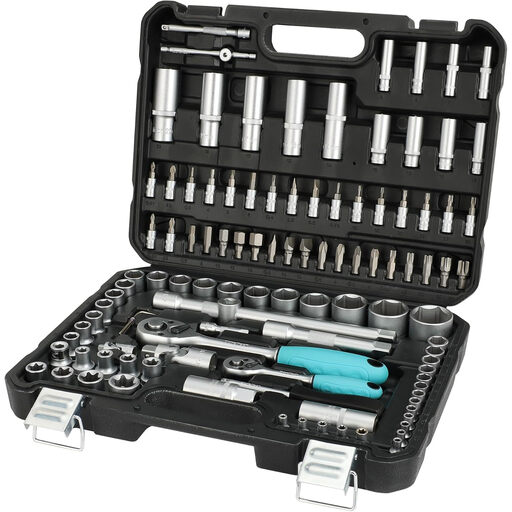
Why it suits this profile: For car and motorbike enthusiasts who need a range of socket sizes, bits and extension bars, this set offers a broad combination in one case.
The drives, accessories and storage positions are listed separately in the product information. You can therefore check the contents before buying.
1/4 and 1/2-inch ratchets; Cr-V sockets; S2 bits; universal couplings and extension bars; sturdy moulded case.
We have put together a complete, up-to-date list of products that fully meet these strict selection criteria and the applicable European safety regulations.
For home repairs and assembly, a DIY tool set with a 1/4-inch ratchet, bits and a few metric sockets is often sufficient. For a car tool set, 3/8 and 1/2 inch are more important, as are extension bars, deep sockets and Torx sizes.
If you mainly work with nuts, you could also consider ratchet combination spanners. According to the product information, a 10-piece set from DURATECH includes sizes from 6 to 18 mm, a 72-tooth mechanism and a tool roll. For very confined spaces, a flexible head can be useful; a 12-piece version specifies a flex head with a range of 180 degrees. However, check that the moving head is suitable for the force and position required for your job.
A professional tool set does not have to be the largest set available. For daily use, a suitable range of sizes, clear markings, a reliable ratchet mechanism and replaceable or readily available accessories matter more than the number of components alone.
For many jobs on passenger cars, a 3/8-inch ratchet is a practical mid-size option. A 1/4-inch ratchet is useful for small fasteners and confined spaces. A 1/2-inch ratchet is often used for larger bolts and greater leverage. Always consider the socket size and the recommended application.
That depends on how you intend to use it. A large set makes sense if you regularly work on cars, motorbikes or machinery and need different drives and bit profiles. For occasional household jobs, a compact set may offer better value. Compare the sizes you actually need with the contents of the case.
Wipe away oil, dirt and moisture after use and store the tools somewhere dry. Do not use a ratchet as a hammer or extend the handle with a random piece of tubing. For bolts that require a specified tightening torque, use a suitable torque wrench; an ordinary ratchet is not a measuring instrument.
