
Vandaag of morgen in huis

Kwaliteit gegarandeerd

Welkomstaanbiedingen ontgrendelen: GRATIS bezorging | Tot 80% korting | Gratis 30 dagen JoyPlus-proefperiode
Download de app
A ratchet spanner set may seem straightforward at first: choose a set of spanners, check the price and place your order. In practice, the drive size, dimensions and ratchet mechanism can make a big difference. Choose the wrong set and you could find that important sizes are missing, the ratchet won’t fit into tight spaces or an electric ratchet isn’t suitable for the job.
This guide helps DIY enthusiasts, car mechanics, maintenance engineers and industry professionals compare options objectively.
A set with lots of pieces isn’t automatically practical. First check which sizes and drive types are actually included. For many jobs on cars and machinery, metric sizes such as 8 to 19 mm are useful. A set made up mainly of imperial sizes may be less useful in the Netherlands.
Also consider the difference between:
A ratchet with 72 or 90 teeth typically has a small return angle. This is handy when you don’t have much room to move the handle. However, this doesn’t in itself tell you how much force the ratchet can safely transfer. Check the material, drive size and stated specifications too.
A 3/8 inch ratchet is a versatile size for light to medium-duty jobs. For larger fasteners, a 1/2 inch drive may be more practical. Use a suitable torque wrench to tighten fasteners to the specified torque.
A flexible ratchet spanner can give you better access around pipes, engine components and machine frames. However, the joint must remain stable while you turn it. For an electric ratchet, battery capacity, maximum stated torque, charging time and the sockets supplied matter more than speed alone.
An electric ratchet is mainly designed to tighten or loosen bolts and nuts quickly. You may still need to apply force by hand to loosen fasteners that are stuck.
The drive size determines which sockets will fit. Common sizes include:
Check that the set includes metric sockets if you work on Dutch and European vehicles or machinery. An adapter can expand compatibility, but it won’t change the ratchet’s original strength or intended use.
According to the product specifications, a 72-tooth mechanism has a working angle of around 5 degrees. For a 90-tooth ratchet, this may be around 4 degrees. A smaller angle means you need to move the handle less before the mechanism engages again.
This is useful in hard-to-reach places, but a fine-toothed mechanism still needs to be used correctly. For example, avoid using extensions that aren’t designed for the ratchet in question.
Many of the ratchet spanners in this selection are made from chrome vanadium steel. This material is commonly used for hand tools because it combines hardness with wear resistance. A chrome-plated or polished finish can make cleaning off oil and grease after a job easier.
Also look for:
Specifications such as material, tooth count, drive size and included accessories are verifiable product details. Claims about lifespan or performance should be treated as information from the brand, not as a guarantee for every working environment.
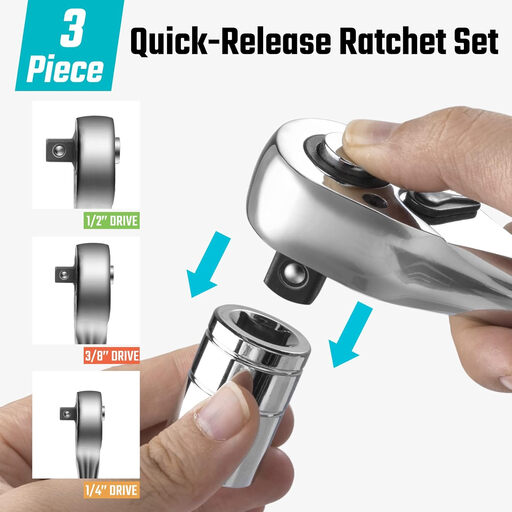
Why it suits this profile: Three drive sizes give beginners a practical starting point for jobs around the home, on bikes and for light car maintenance.
With 1/4, 3/8 and 1/2 inch drives included, the set helps reduce the risk of choosing the wrong connection. The storage case helps keep all the pieces together.
72 teeth, a stated working angle of 5 degrees, quick release and a polished chrome finish.
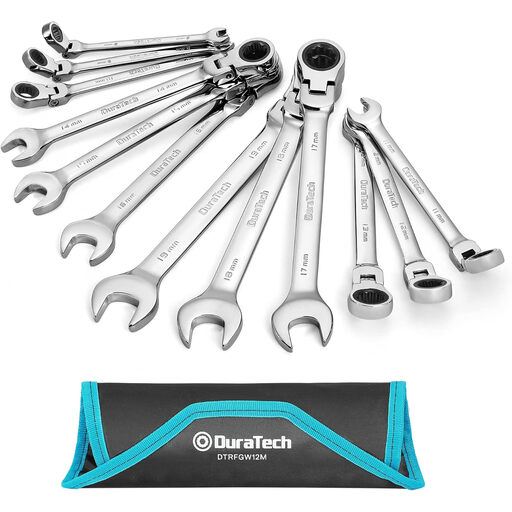
Why it suits this profile: For people who regularly work on cars, installations or machinery and want a compact set with a wide range of metric sizes.
Sizes from 8 to 19 mm are clearly marked. The flexible head is designed for fasteners that are difficult to reach with a fixed spanner.
180-degree flex head, 72 teeth, a 5-degree working angle and chrome vanadium steel, according to the product description.
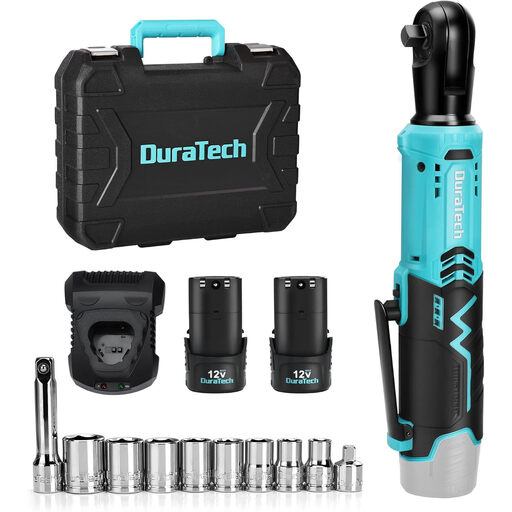
Why it suits this profile: An option for maintenance engineers and automotive users who often need to loosen or tighten several fasteners in narrow, poorly lit spaces.
The product description lists two 2.0 Ah batteries, a charger, 8 sockets, an adapter and a storage box. This makes it clear what’s included before you buy.
3/8 inch drive, a stated maximum torque of 65 Nm, LED lighting and a left-right function.
If you already have a socket set, buying a single ratchet may be more efficient than getting a complete set. The DURATECH ratchet has 90 teeth, a stated working angle of 4 degrees, quick release and a 3/8 inch square drive. It’s designed for use where space is limited. Check in advance that your existing sockets have the same drive size.
Clean the ratchet after use and remove any grease or metal particles from the mechanism. Store the components in a dry place, in a case or tool roll. Don’t use a ratchet as a substitute for an impact tool, and check before buying that the stated torque is suitable for the job.
Power tools also come with running costs. Batteries have a limited lifespan and need to be charged and stored correctly. A set with two batteries can be handy: you can use one while the other is charging.
We’ve put together a complete, up-to-date list of products that meet these strict selection criteria and the applicable European safety regulations.
For many general jobs, a 3/8 inch ratchet is a practical choice, especially when used with metric sockets. A 1/4 inch ratchet may be better for smaller fasteners, while larger bolts may need a 1/2 inch ratchet. Always check the fastener size and the specified tightening torque.
Not always. An electric ratchet is mainly designed to help you work faster. A stuck bolt may need more breakaway torque than the stated maximum. Don’t use an extra lever without checking that the tool is suitable for it.
Its lifespan depends on the load, maintenance, storage and use of suitable sockets. Chrome vanadium steel and a well-maintained finish are relevant product specifications, but they don’t guarantee a particular lifespan. Clean the set after use, avoid overloading it and replace any components that show play or damage.
