
Vandaag of morgen in huis

Kwaliteit gegarandeerd

Welkomstaanbiedingen ontgrendelen: GRATIS bezorging | Tot 80% korting | Gratis 30 dagen JoyPlus-proefperiode
Download de app
A ratchet spanner set may seem straightforward at first: choose a range of metric sizes, check the material and place your order. In practice, sets vary considerably in their size range, fit, ratchet mechanism and storage. A cheap set can prove awkward if you regularly work on a car, motorbike, bicycle or installation.
The most common buying mistakes come down to three pitfalls:
First, check which sizes you actually use. For general maintenance, a metric spanner set with common sizes such as 8, 10, 13, 17 and 19 mm is a practical starting point. A comprehensive combination spanner set may also include intermediate sizes.
When choosing ratchets and sockets, pay attention to the drive size:
An open-ended spanner set is useful when you need quick access to a nut. A combination spanner set has an enclosed ring end for a more secure grip. A standard ring spanner isn’t always suitable for pipework: a flare nut spanner has an opening so it can fit around a pipe.
The number of teeth doesn’t tell you everything, but it does give you an idea of how much room you need to move the handle. According to the product descriptions for the models mentioned, a ratchet with 72 teeth often has a working angle of around 5 degrees. A return angle of 4 degrees is specified for a 90-tooth ratchet.
This is particularly useful in confined spaces. A ratchet with fewer teeth can still be suitable if you have enough room to move the handle back and forth. Also check whether the ratchet is reversible and has a quick-release function.
For impact work, only use sockets designed for the job. A standard ratchet or socket isn’t automatically suitable for use with an impact wrench.
Many hand tools in this category are made from chrome vanadium steel (Cr-V). This material is often heat-treated and finished with a chrome plating or polish. According to the product description, a matt finish can make dirt and grease less noticeable, while a smooth finish is easier to wipe clean.
A standards reference can help you compare products, but it doesn’t replace checking the dimensions and product details. For example, the DURATECH combination spanner set below lists DIN 3113. The double ring spanner set lists DIN 838. Also look for:
The following selection is based on verifiable product information, such as sizes, drive, ratchet mechanism, material and storage options. Claims about durability or ease of use are presented as brand product information, not as independently verified performance.
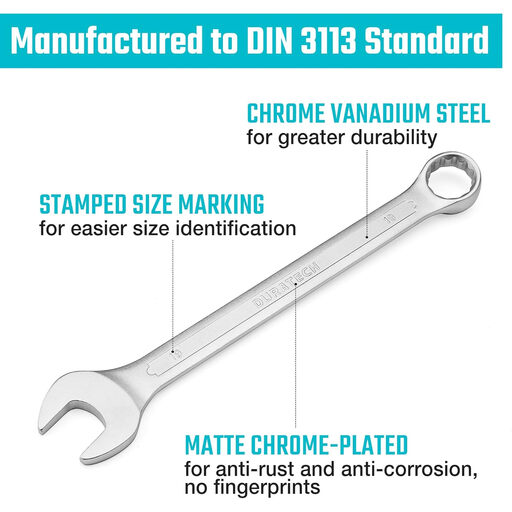
Why it suits this type of user: The set contains 12 commonly used metric sizes from 6 to 22 mm, making it suitable for household maintenance, DIY projects and a first tool kit.
The sizes are marked on both sides of the spanners, and the set comes with an organiser. This makes it easier to find the right size.
Cr-V steel, a 15-degree offset at the ring end, a 12-point profile and a DIN 3113 reference in the product description.
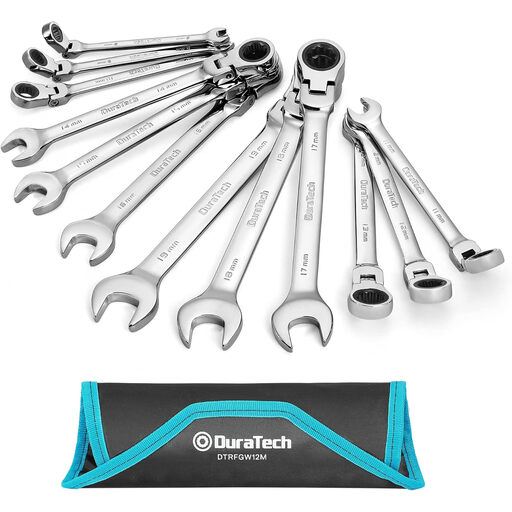
Why it suits this type of user: If you often work on cars, machinery or assembly projects, a flexible head gives you extra reach when a fixed spanner won’t fit comfortably.
The 180-degree flex head is designed for hard-to-reach places. The product description also specifies a 72-tooth ratchet mechanism.
Sizes from 8 to 19 mm, Cr-V steel, a 5-degree working angle according to the product description, and a roll-up storage pouch.
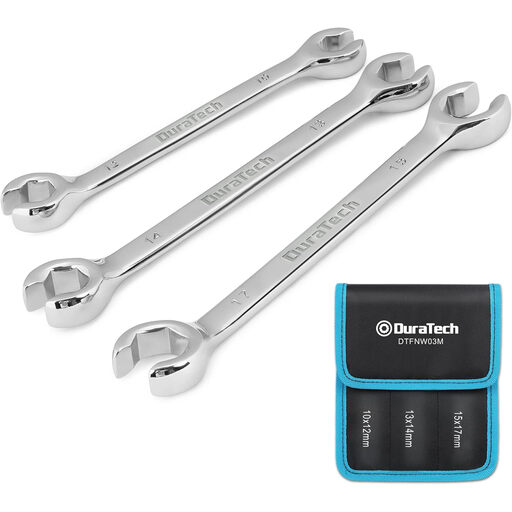
Why it suits this type of user: This compact set is designed for work on brake pipes and pipe connections in cars, motorbikes and installations.
The flare nut opening is specifically designed to fit around pipe nuts. Check in advance that the three included size combinations are suitable for your application.
10x12, 13x14 and 15x17 mm, 15-degree offsets at the ends and a storage pouch according to the product description.
We’ve put together a complete, up-to-date list of products that meet these strict selection criteria and applicable European safety regulations.
A ratchet spanner set won’t cover every job. For controlled tightening, a torque wrench or digital torque adapter is a better choice. The MoveCrab set specifies a range of 5 to 220 Nm; before use, always check that this range matches the value specified for your vehicle or machine.
An impact wrench can be useful for quickly loosening seized bolts. Use suitable impact-rated sockets and follow the manufacturer’s safety instructions. An adjustable spanner is versatile enough for different sizes, but it needs to be set correctly to help prevent damage to the nut.
For general car maintenance, a 3/8-inch ratchet with metric sockets and a size range of 8 to 19 mm is often a practical starting point. Wheel bolts and larger fittings may require a 1/2-inch drive. Always check the sizes required for your car and the specified tightening torques.
Wipe off oil, dirt and moisture after use. Store the spanners somewhere dry in the supplied bag, case or organiser. Don’t leave a ratchet under tension for long periods, and regularly check the selector, teeth and socket retainer for wear.
No. A standard combination spanner has an open end and a fixed ring end. A ratchet combination spanner has a ratchet mechanism at one end, so you don’t need to lift the spanner as often. This can save time in confined spaces, but always check the maximum load and available spanner size.
