
Vandaag of morgen in huis

Kwaliteit gegarandeerd

Welkomstaanbiedingen ontgrendelen: GRATIS bezorging | Tot 80% korting | Gratis 30 dagen JoyPlus-proefperiode
Download de app
A ratchet spanner set may seem straightforward at first glance: choose a selection of metric spanners and get to work. In practice, the size range, ratchet mechanism and shape of the spanner make the biggest difference. A set that looks impressive in your toolbox can become awkward as soon as you work on an engine block, bicycle, pipework or machine.
These are common buying pitfalls for Dutch DIY enthusiasts, mechanics and maintenance technicians:
First, check which sizes you actually need. For general maintenance on cars, bicycles, furniture and machines, a metric spanner set is usually the logical choice in the Netherlands. A range from 8 to 19 mm covers many common applications, while 6 to 22 mm gives you more scope for larger fasteners.
Also pay attention to the selection of sizes. A 12-piece set containing every size from 8 to 19 mm is easy to understand, but a 6 to 22 mm set may skip some intermediate sizes. So do not just look at the number of spanners; check the individual sizes.
With ratchet combination spanners and a ratchet socket wrench, the sweep angle is important. A mechanism with 72 teeth and a sweep angle of approximately 5 degrees requires very little room to turn a bolt further. Some ratchets have 90 teeth and an angle of around 4 degrees, which is useful when fitting parts in an engine bay or between machine components.
A flexible head can improve access even further. The DURATECH flex-head ratchet spanner set features a 180-degree adjustable head. This can help when a fixed spanner head comes up against an edge, hose or another component. However, the head must remain firmly in the selected position; check this before applying force.
Many chrome vanadium steel spanners are suitable for general manual maintenance. According to the product descriptions of the DURATECH models mentioned, the spanners are forged, heat-treated and given a chrome finish. This information comes from the manufacturer or product description and does not guarantee that every set will perform identically under every load.
Also look out for:
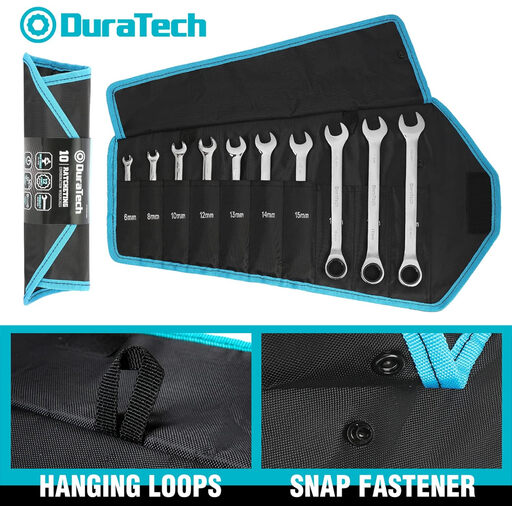
Why it suits this user profile: This combination spanner set is aimed at home use, small repairs and beginner car mechanics. The fixed sizes from 6 to 18 mm cover many everyday jobs.
According to the product description, the sizes are marked on both sides. This means you do not have to search by sight through a loose set.
According to the product description: 72 teeth, a 5-degree sweep angle, chrome vanadium steel and a storage pouch.
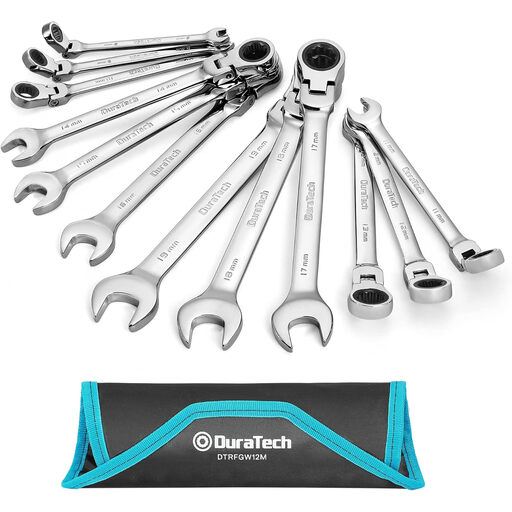
Why it suits this user profile: The flexible head is useful for anyone who regularly works in confined spaces, for example on cars, engines or industrial installations.
According to the product description, the 180-degree head and 72-tooth ratchet reduce the space required. Before buying, check that the head adjustment suits the way you work.
According to the product description: 12 sizes from 8 to 19 mm, heat-treated chrome vanadium steel and a roll-up case with size markings.
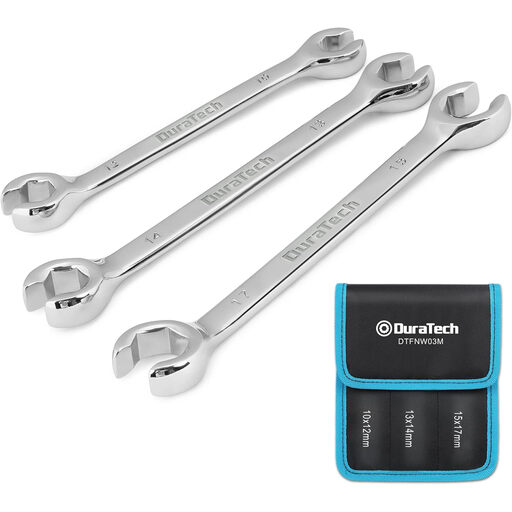
Why it suits this user profile: This set is designed for specialist work on brake lines and pipe connections. That makes it a useful addition to a general ratchet spanner set.
The flare-nut design largely surrounds the nut while the pipe passes through the opening. Use only the correct size and place the spanner squarely on the connection.
According to the product description: three spanners for 10–17 mm, a 15-degree offset and a storage pouch. The set is designed for brake-line and plumbing work.
An adjustable spanner is useful when you occasionally need to grip different sizes, for example when working on a tap, fitting or carrying out general maintenance. According to the product information, the WORKPRO 150 mm has a metric scale from 0 to 24 mm, a maximum jaw opening of 150 mm and a two-material handle.
For repeated work on the same size, a fixed spanner is usually more practical. A ring spanner set or offset double ring spanner set provides a fixed fit around the nut. The DURATECH set with a 75-degree offset includes combinations ranging from 6 x 7 mm to 20 x 22 mm. An S-shaped spanner can provide extra reach in confined spaces.
If you work on brake lines, an ordinary open-ended spanner is less suitable. Choose a flare-nut set with the appropriate sizes instead. For general car maintenance, a combination of ratchet spanners, a ratchet socket wrench and several ring spanners is often more versatile than one large universal set.
We have put together a complete, up-to-date list of products that fully meet these strict selection criteria and the applicable European safety regulations.
For many jobs, 8, 10, 13, 15, 17 and 19 mm are commonly needed. Always check the fasteners on your car or machine. A set from 8–19 mm is compact; a set starting at 6 mm offers more variety for smaller components.
Not necessarily. Suitability depends on the ratchet mechanism, material, fit and permitted load. Do not use a length of pipe to extend a ratchet spanner if the manufacturer advises against it. For seized bolts, a fixed ring spanner or correctly sized socket may provide a better fit.
Wipe off oil and dirt after use, dry the spanners and store them in the supplied pouch or organiser. Check ratchets for smooth operation and visible damage. Never use a spanner on a damaged or rounded bolt head; choose the correct size and position first.
