
Vandaag of morgen in huis

Kwaliteit gegarandeerd

Welkomstaanbiedingen ontgrendelen: GRATIS bezorging | Tot 80% korting | Gratis 30 dagen JoyPlus-proefperiode
Download de app
At first glance, choosing a ratchet spanner set seems simple: pick a few sizes, check the material and place your order. In reality, sets vary greatly in drive size, swing arc, finish and intended use. A set that's perfect for a bicycle or household repair might not be suitable for working on a car or industrial machinery.
As a Joybuy Product Recommendation Officer, I'm here to break down the key product specifications, so you can compare marketing claims with verifiable information. Pay close attention to these common pitfalls.
According to product descriptions, a 72-tooth ratchet has a working angle of about 5 degrees. A 90-tooth ratchet needs even less, at around 4 degrees. This is particularly useful when you have very little room to move the handle.
However, the number of teeth doesn't tell the whole story about its load capacity. You should also check:
A compact 3/8-inch ratchet spanner is handy in tight spaces, but it may not be strong enough for very stubborn bolts.
A ratcheting combination spanner set with sizes from 8 to 19 mm will cover many common metric bolts. However, for bikes, motorbikes and cars, you might need different sizes or sockets. Therefore, check whether you need:
A set with 1/4, 3/8 and 1/2-inch drives offers more flexibility, but it also takes up more space. Don't make your decision based on the number of pieces alone.
Chrome vanadium steel, often labelled as Cr-V, is very common in hand tools. The product descriptions for the featured DURATECH sets mention details like drop-forging, heat treatment, chrome finishing and corrosion resistance. This is verifiable product data, but it doesn't automatically tell you how a ratchet feels in your hand or how long it will last under every type of load.
Also, look at the practical finishing touches:
Never use a ratchet as a hammer and do not exceed the specified load.
For UK households, bikes, motorbikes and many European cars, metric ratchet spanners are usually the logical choice. A combination of 8, 10, 13, 15, 17 and 19 mm spanners will often come in handy for general assembly and maintenance. A set ranging from 8 to 19 mm provides more intermediate sizes for a more precise fit.
An open-ended spanner is useful for quickly getting onto a nut. The ring end typically provides more grip around the entire bolt head. A ratcheting spanner combines these functions but remains less versatile than a ratchet with separate sockets.
The drive size determines which sockets you can use and how much space the ratchet takes up.
An adapter can be used to combine different sizes, but make sure the connection is secure and fits properly. For precise tightening, a separate digital or mechanical torque wrench is a wiser choice than applying extra force to a standard ratchet.
According to their product descriptions, flex-head ratchet spanners can pivot up to 180 degrees. This can help with bolts located behind pipes, brackets or other obstacles. However, the head must remain stable while you're turning it. A flexible head is no substitute for a straight spanner when you need maximum control or force.
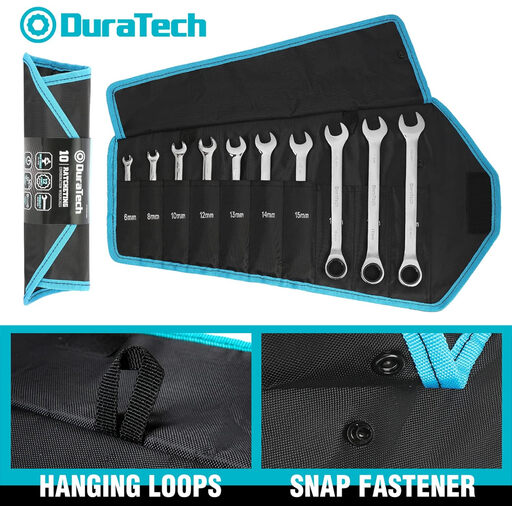
Why it's a good match: The set includes ten metric sizes for household repairs, DIY projects and simple jobs on a car.
According to the product description, the sizes are marked on both sides. The 72-tooth ratchet requires a swing arc of about 5 degrees.
Cr-V steel, 10 common sizes and a roll-up storage pouch.
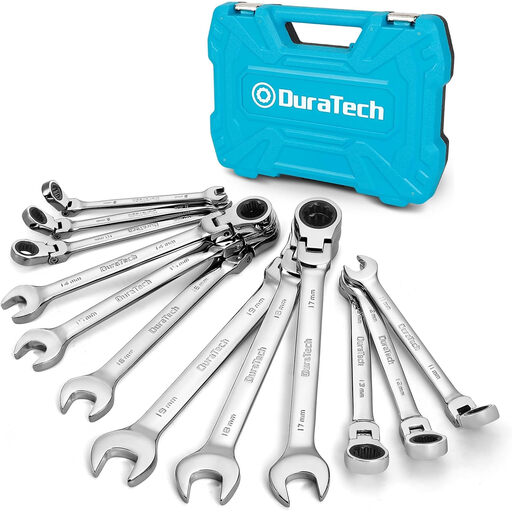
Why it's a good match: The flex-head and full 8-19 mm range are ideal for regular car, motorbike and maintenance work in tight spaces.
The choice isn't just based on tooth count: the set also specifies a 180-degree flex-head, 72 teeth and Cr-V steel.
12 metric sizes, a 5-degree swing arc and a storage pouch or case, according to the product listing.
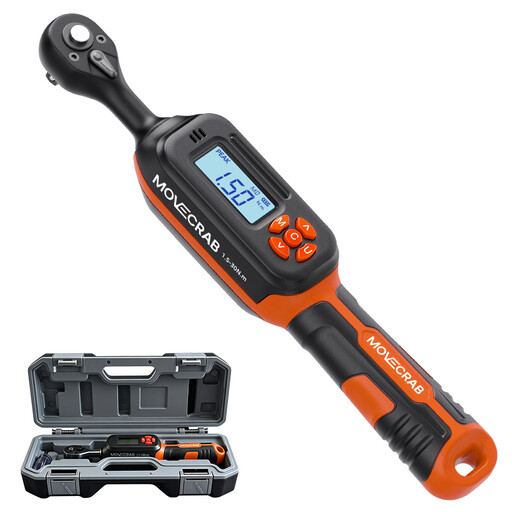
Why it's a good match: For bike, motorbike and car work where a prescribed torque setting is more important than just tightening quickly.
According to the product description, this model has a range of 4.2 to 85 Nm, a digital readout and alerts via vibration, sound and LED. Always check the manual and applicable specifications.
3/8-inch drive, multiple units of measurement, 10 presets, and track and peak modes, according to the product listing.
We've compiled a complete, up-to-date list of products that fully meet these strict selection criteria and comply with current European safety regulations.
A cordless ratchet is especially useful when you need to loosen or tighten many bolts in a row. The motor handles the repetitive turning, while you maintain control for the final tightening. A model like the DURATECH cordless ratchet set has, according to its product description, a 12V battery, a 3/8-inch drive, an LED light, two batteries and multiple sockets.
Pay attention to the maximum torque rating, battery capacity, charging time and weight. A cordless model is not a replacement for a digital torque wrench when a precise final torque is required. Also, check that the batteries, charger and sockets are actually included in the delivery.
The lifespan of a ratchet spanner set depends on the load it's subjected to, how it's stored and its maintenance. Wipe away oil and dirt after use and store the tools in a dry place in the provided pouch or case. Do not use an extension bar or cheater bar to apply extra force unless the manufacturer explicitly allows it.
Careful storage is especially important for a digital torque wrench. According to the product information for the Movecrab, overloading should be avoided, and the device must not be used as an impact tool or hammer. A battery-powered model also requires you to replace or recharge the batteries in a timely manner.
For general car maintenance, a combination of a 3/8-inch drive, metric sockets and sizes from around 8 to 19 mm is often practical. For larger wheel or suspension bolts, a 1/2-inch drive may be more suitable. Always check the prescribed sizes and torque settings for your specific vehicle.
According to product listings, a 72-tooth ratchet has a swing arc of approximately 5 degrees. This is useful in confined spaces. A 90-tooth ratchet may require slightly less movement, at around 4 degrees, but you should also consider the shape and length of the head and its overall accessibility.
Use a digital torque wrench whenever the manufacturer of a bike, motorbike, car or piece of machinery specifies a particular torque setting. A standard ratchet is designed for turning; a torque wrench is designed to check and apply a preset amount of torque. Never exceed the tool's specified range.
