
Vandaag of morgen in huis

Kwaliteit gegarandeerd

Welkomstaanbiedingen ontgrendelen: GRATIS bezorging | Tot 80% korting | Gratis 30 dagen JoyPlus-proefperiode
Download de app
A ratchet socket set may seem simple at first glance: choose a set with lots of components and you’re ready to go. In practice, it is mainly the combination of sizes, drives, materials and storage that determines whether your tools remain easy and comfortable to use. A cheap set with missing sizes or a stiff ratchet mechanism can therefore prove expensive in the long run.
This buying guide helps DIY enthusiasts, car and motorbike fans, and workshop technicians distinguish marketing claims from verifiable product specifications.
A set containing dozens or hundreds of components sounds appealing. However, some sets are mainly filled with bits, adapters or duplicate sizes. Always check:
For many jobs in the Netherlands, metric sizes are more important than a large quantity of SAE sockets. A metric socket set with clearly marked sizes is therefore often more practical than a larger, less organised collection.
According to the product specification, a 72-tooth ratchet often has a small working angle of around 5 degrees. This is useful in a cramped engine bay, as you do not need to move the handle as far. According to the product description, a 90-tooth ratchet may even have a working angle of around 4 degrees.
However, the number of teeth does not automatically indicate how strong the ratchet is. Also consider the drive size, the quality of the mechanism, the direction switch and the intended use. Do not use standard hand sockets with an impact wrench; special impact sockets are required for this purpose.
A flexible ratchet spanner with an adjustable head is useful for fasteners located behind hoses, brackets or bodywork. However, check whether the head locks securely and how much movement the design allows. A flexible head is primarily intended to improve accessibility, not to replace a torque wrench for connections that must be tightened to a specific torque.
Much hand tool equipment is made from chrome vanadium steel, often referred to as Cr-V. In the product descriptions of the sets mentioned, this material is associated with heat treatment, hardness and resistance to corrosion. A polished or chrome-plated finish also makes the surface easier to clean.
For impact work, such as loosening wheel nuts with an impact wrench, Cr-Mo impact sockets are often used. Chrome-molybdenum is a relevant material designation in this context. Always check whether a socket is explicitly described as suitable for impact use.
The drive size determines which sockets fit the ratchet and affects the balance between reach and power:
A car ratchet set with all three drive sizes offers greater flexibility. However, a smaller set with only 3/8 inch may be more convenient if you mainly carry out basic jobs.
A tool set with a storage case or roll-up bag prevents sockets and spanners from wandering around your toolbox. Look for:
A set that can be checked quickly also reduces the chance of using the wrong size on a bolt.
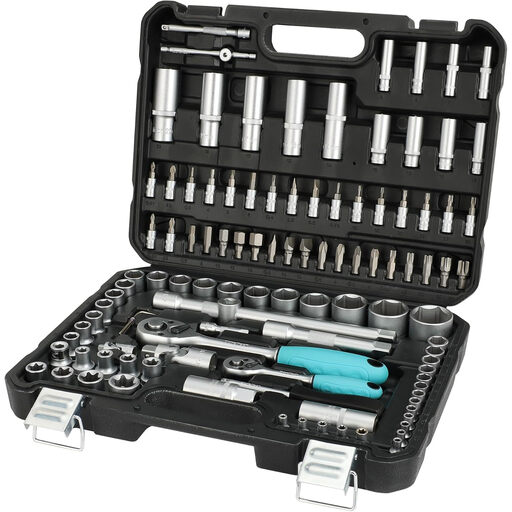
Why it suits this profile: This set combines 1/4 and 1/2 inch ratchets with sockets, bits, universal joints and extension bars. It is suitable for anyone who wants to tackle a range of jobs at home or on a car without having to buy additional individual components.
The product description lists the 108 components, drive sizes and included accessories separately. This makes it easier to check the contents than with a general claim about a large set.
Cr-V sockets, S2 bits, 72-tooth ratchets, quick release and a sturdy plastic storage case.
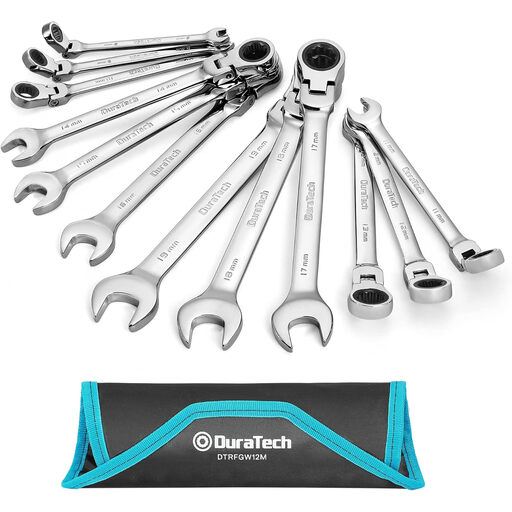
Why it suits this profile: This ratchet spanner set is designed for precision work around cars, motorbikes and machinery, especially where a socket and ratchet cannot fit easily between components.
According to the product description, the 180-degree flex head is designed for hard-to-reach fasteners. The sizes from 8 to 19 mm are listed individually.
Cr-V steel, 72-tooth mechanism, 5-degree working angle and a roll-up bag with size markings.
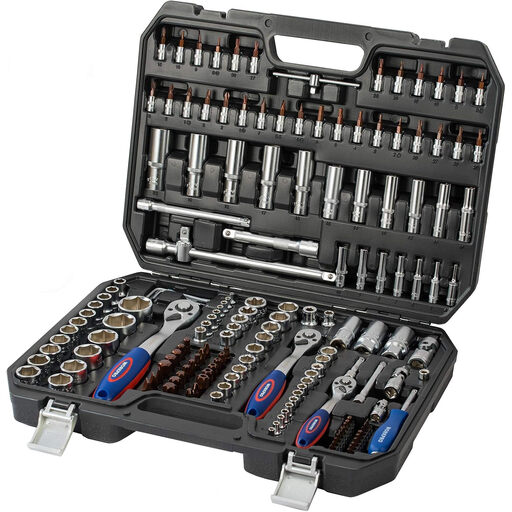
Why it suits this profile: For workshops and users working on cars, motorbikes, bicycles and machinery, this set offers multiple drive sizes, Torx sockets, deep sockets, spark plug sockets and bits.
The product list specifies the sizes and accessories for each drive size. This makes it clear in advance whether you need components such as E-Torx, extension bars and universal joints.
Three 72-tooth ratchets, Cr-V sockets, S2 bits, deep sockets, spark plug sockets and a marked storage case.
We have put together a complete, up-to-date list of products that fully meet these strict selection criteria and the applicable European safety regulations.
For general car maintenance, a set with 1/4, 3/8 and 1/2 inch drives is versatile. The 3/8-inch ratchet is useful for many medium-sized fasteners. For wheel nuts and heavy-duty connections, you need suitable 1/2-inch sockets. When working on wheels, always check whether the socket is suitable for hand use or for an impact wrench.
Not necessarily. A 72-tooth mechanism mainly provides a smaller working angle, which is useful in confined spaces. Strength also depends on the construction, material, drive size and the way you use the ratchet. Do not use a ratchet as an extension for additional leverage unless the manufacturer specifies that this is permitted.
Wipe oil, dirt and moisture off the tools after use. Store the components in a dry place in the supplied bag or case. For a ratchet mechanism, the product’s maintenance instructions may recommend applying a small amount of suitable oil to keep it operating smoothly. Also check the sockets, teeth and switches regularly for visible damage.
