
Vandaag of morgen in huis

Kwaliteit gegarandeerd

Welkomstaanbiedingen ontgrendelen: GRATIS bezorging | Tot 80% korting | Gratis 30 dagen JoyPlus-proefperiode
Download de app
A ratchet set may seem straightforward at first glance: choose a case with plenty of components and you are ready to get started. In practice, it is mainly the combination of drive size, socket sizes, materials and storage options that determines whether a set is suitable for your work. A set that is too small can quickly limit you, while a large socket set may contain components you hardly ever use.
For Dutch DIY enthusiasts, car lovers and maintenance technicians, there are also several common pitfalls to watch out for.
A high component count does not automatically mean that you are well equipped. Some sets include extensions, bits and adapters in the total, while containing only a few metric sockets. For car maintenance, sizes such as 10, 12, 13, 14, 15, 17 and 19 mm are often more useful than a case made up mainly of small bits.
Therefore, always check:
In an engine compartment, underneath a dashboard or around machinery, there may be very little room to swing a ratchet widely. A ratchet with a fine-tooth mechanism can be more convenient in these situations. According to the stated product specification, a 72-tooth ratchet has a working angle of approximately 5 degrees. A 90-tooth model is described as requiring movement of approximately 4 degrees.
This does not mean that every ratchet will work faster in all circumstances. The available space, handle length and tightness of the connection all affect ease of use.
Loose sockets can easily get lost in a toolbox. A set with a storage case or a roll pouch keeps the components together, but pay attention to the fastening and size markings. A compact case is practical for keeping in the car, while a larger case may contain more components but be less convenient to carry.
The drive size determines which sockets and accessories you can use:
If you regularly work on vehicles, you will often benefit from a combination of 1/4, 3/8 and 1/2 inch. For simple jobs around the home, a 1/4-inch socket set is usually easier to manage.
Many of the sets mentioned use chrome vanadium steel (Cr-V). According to the product descriptions, the components are hardened and feature a chrome-plated or polished finish. This can make cleaning easier and help protect against corrosion, but it does not in itself indicate what load a component can safely withstand.
Therefore, only use tools within their stated capacity. A ratchet is not a substitute for a torque wrench when a manufacturer or vehicle manufacturer specifies a particular tightening torque.
A traditional ratchet with sockets is flexible and works without a battery. A ratcheting spanner set with open-ended spanners is useful when working directly on a nut and there is little room around the connection. A ratcheting spanner with a flexible head can fit into confined spaces more effectively thanks to its adjustable head. However, you should check the angle and locking mechanism before use.
An electric ratchet wrench mainly saves time when loosening and tightening numerous connections. Final tightening must be carried out carefully, and the stated capacity must not be exceeded. Also check the battery life, charging time, included sockets and whether an adapter is provided.
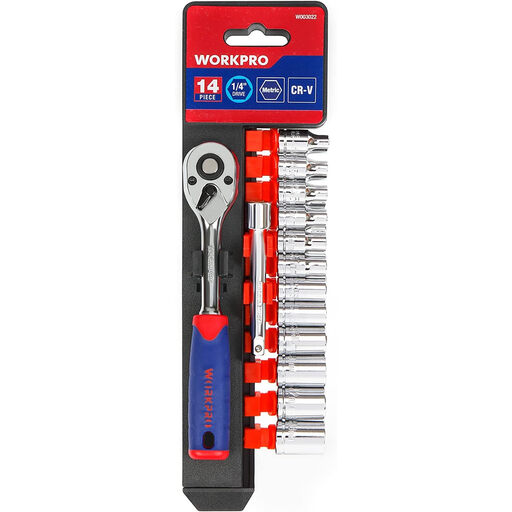
Why it suits this profile: This compact metric socket set is easy to manage for household repairs, simple car maintenance and DIY jobs.
The product description lists the included sizes from 4 to 13 mm, allowing you to check in advance whether this range suits your job.
1/4-inch drive, 72 teeth, quick-release button, 76 mm extension and a socket holder.
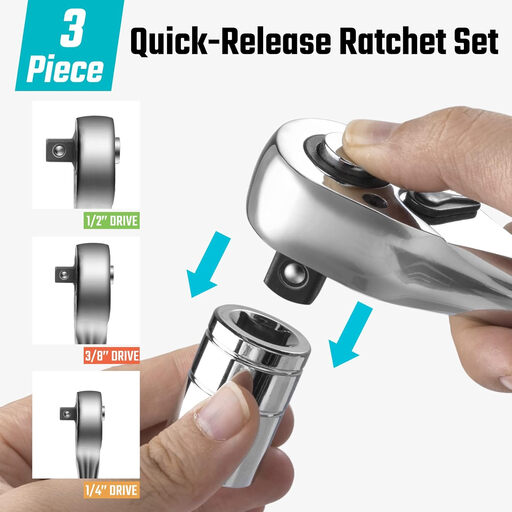
Why it suits this profile: If you already own sockets or carry out a range of different jobs, this set provides three common drive sizes in one package.
You are not simply paying for a high component count; instead, you are choosing three different drive sizes and a storage case.
72-tooth mechanism, 5° working angle, quick-release button and fully polished chrome finish, according to the product description.
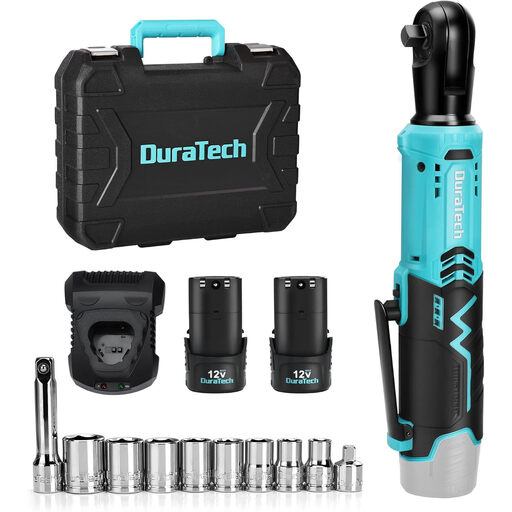
Why it suits this profile: It is ideal if you regularly loosen and tighten lots of bolts and want to make fewer manual movements in confined spaces.
The set clearly states the drive size, battery capacity, maximum torque and included sockets.
12 V, up to 65 Nm according to the product description, two 2.0 Ah batteries, LED light, charger and storage case.
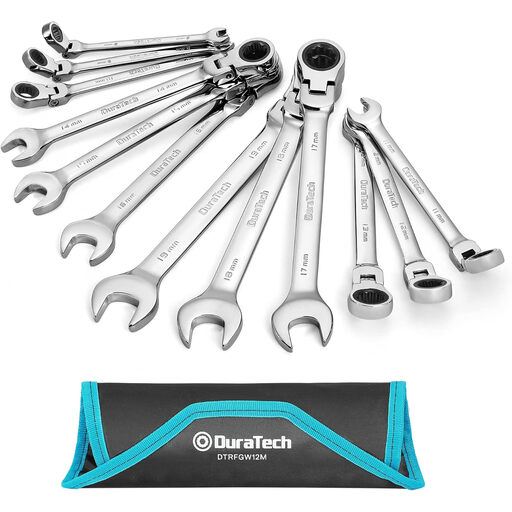
Why it suits this profile: The combination of ring and open-ended spanners is suitable for mechanics and DIY enthusiasts who often work around obstacles.
According to the product description, the flexible head can be adjusted by up to 180 degrees, and the sizes are marked on both sides of the handle.
12 metric sizes from 8 to 19 mm, 72 teeth, an approximately 5° working angle and a roll pouch with size markings.
We have compiled a complete, up-to-date list of products that fully meet these strict selection criteria and the applicable European safety regulations.
A ratchet set remains useful when you use the components correctly and store them neatly. Keep these basic rules in mind:
For general car maintenance, a combination of 1/4, 3/8 and 1/2 inch is practical. A 3/8-inch ratchet set often provides a useful starting point. Also check that the set contains metric sockets in the sizes used on your car.
Its service life depends on the material, load, maintenance and use. A Cr-V set with hardened components may be suitable for regular use, but choosing the wrong sockets, overloading the tool and exposing it to moisture will shorten its lifespan. The product description and technical capacity remain the deciding factors.
An electric ratchet wrench does not require fuel and can save time on repetitive work, but batteries have a limited lifespan and need to be recharged. For occasional jobs, a manual ratchet is often simpler. For daily assembly work, two batteries and a charger may be more practical.
