
If you make small batches
If you occasionally make coulis for a dessert, you may not want to use a large blender jug for such a small amount. Bosch Netherlands describes the MSM4W210 as coming with a measuring beaker for small quantities.


For small batches of raspberry coulis and limited storage space, a hand blender with a suitable beaker is an obvious choice. A mini blender is worth considering if you also regularly make smoothies or other sauces in a jug. Check the dimensions, included attachments and cleaning instructions for the exact version. To make seedless coulis, pass the sauce through a fine sieve after blending.
If you occasionally make coulis for a dessert, you may not want to use a large blender jug for such a small amount. Bosch Netherlands describes the MSM4W210 as coming with a measuring beaker for small quantities.
If space is tight, compare more than just the motor unit: consider the beaker, jug and separate attachments you’ll need to store, too. Both hand blenders and mini blenders can come with several components.
If you want to remove raspberry seeds from the sauce, factor sieving into your method. Emeril's coulis recipe describes blending and then sieving as separate steps.
Start with the portion size and the storage space available. Then decide whether you want to use the appliance for other recipes, too.
| What to consider | What should you check? | Who should pay particular attention? |
|---|---|---|
| Small batches | Check which beaker is included, the minimum fill level and whether the blending foot fits in your container. | Do I usually make only a little coulis? If so, I want to know whether I can blend it easily without using a large jug. Around 29% of consumers consider small batches their top priority. |
| Storage space | Measure your shelf or drawer and compare the dimensions of all the components in the version you’re considering. | If I’m short on space, I need to consider how many parts I’ll have to put away after use. Around 29% of consumers prioritise storage space. |
| Removing seeds | Allow for a fine sieve and consider whether you can easily spoon the sauce out of the beaker or jug. | If I want coulis without noticeable seeds, I’ll need to sieve it after blending. Around 24% of consumers say texture is their main priority. |
| Cleaning and other uses | Check the cleaning instructions for each component and which accessories are included with the version you’re considering. | If I want to use the appliance for smoothies or other sauces, I’ll weigh that up against the work involved in cleaning the parts. Around 18% of consumers prioritise ease of cleaning and versatility. |
Blending and removing seeds are two different steps. Emeril's coulis recipe calls for sieving after blending.
Choose an appliance that suits your portion size and available space, and plan separately how you’ll achieve the texture you want.
Sieving adds an extra preparation step and more washing up.
A hand blender may come with separate attachments, while a mini blender also has a jug and motor base. So the space you need depends on the complete set.
Compare everything included with the space available in your cupboard or drawer.
Remember to allow space for beakers, jugs, bottles and attachments, too.
Braun's product page gives conflicting wattages for the MQ50001M. Its claim about finer results refers to a comparison with another Braun model for almond milk, not a coulis test.
If in doubt, check the correct specification for the model. Don’t take that smoothness claim as proof that it will make seedless coulis.
The MSM4W210 is a hand blender supplied with a measuring beaker, making it worth considering if you want to prepare small quantities without a separate blender jug.
The MultiQuick 5 MQ50001M is a hand blender that Braun says comes with a measuring beaker and adjustable speeds.
Philips describes the HR2512/90 as a compact mini blender for smoothies and sauces.
Tefal describes the Blend Up BL190AF0 as a mini blender supplied with a 700 ml bottle.
This selection includes hand blenders for sauces and purées, as well as jug blenders for coulis and other recipes. You’ll still need to sieve the coulis separately to remove the seeds.
 No image available
The hand blender attachment is suitable for blending a sauce. For seedless coulis, you’ll need to pass it through a fine sieve afterwards.
The product name lists a chopper and whisk as part of the set.
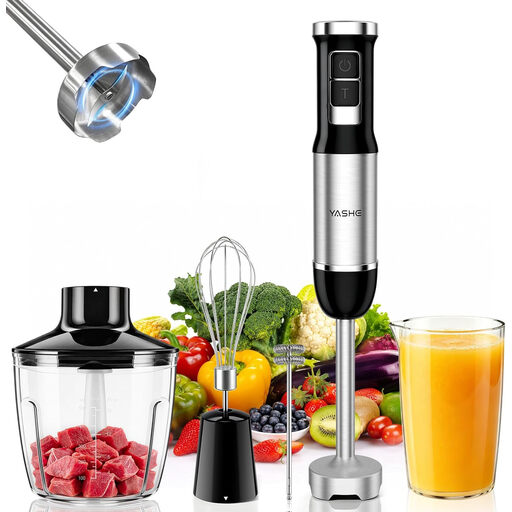 No image available
A hand blender to consider for sauces and purées. If you want to remove the seeds from your coulis, allow for a fine sieve.
The product name lists 6 speeds and a turbo function.
 No image available
A jug blender to consider if you want to make other recipes as well as coulis. Check that the complete set will fit in your available storage space.
The product name lists a 1.5 l jug and a power rating of 600 W.
 No image available
A mini blender to consider if you want to make coulis and other recipes in a jug. You’ll still need to sieve it to remove the seeds.
The product name lists a capacity of 0.6 l and a power rating of 350 W.
 No image available
This jug blender is an option to compare if you also want to blend coulis in a jug. For seedless sauce, you’ll need to sieve it separately.
The product name lists a 500 ml glass jug and a power rating of 250 W.
Don’t count on it: Emeril's coulis recipe describes blending and then sieving to remove the seeds. Use a fine sieve for this.
Follow the instructions for the exact model and check which removable parts are dishwasher-safe. Philips lists dishwasher-safe parts for the HR2512/90; Tefal lists removable blades and a cleaning brush for the BL190AF0. This doesn’t automatically apply to the motor unit or other models.
According to ACM ConsuWijzer, the retailer is responsible for the statutory guarantee if a purchase doesn’t meet what you could reasonably expect. A manufacturer's warranty doesn’t replace this right; the appropriate solution depends on the circumstances.
According to ACM ConsuWijzer, online purchases generally come with a statutory cooling-off period of up to 14 days after delivery. Check the terms for trying and returning the appliance before you use it.
Yes. The Netherlands Food and Consumer Product Safety Authority says CE marking is compulsory for electrical products and lists kitchen appliances as an example of electrical equipment. Check the marking and product-specific safety information for the item you’re buying. A product page in Dutch alone doesn’t confirm that an individual product meets the requirements.