
Creating numbered batches
You want to create several raffle tickets with different numbers and would benefit from a template you can check and a printer suited to your print run. Microsoft explains how to merge data from Excel in Word.


For mostly black-text raffle tickets and larger print runs, a monochrome laser printer is a good fit; if you regularly print colourful tickets, a colour printer with refillable ink tanks is a sensible choice. Check which paper and paper tray your design requires. You create the unique number sequence in your document: duplex printing does not automatically turn a printer into a numbering machine.
You want to create several raffle tickets with different numbers and would benefit from a template you can check and a printer suited to your print run. Microsoft explains how to merge data from Excel in Word.
You want to use colour or card-style paper. So check not only the colour function, but also the supported paper size and type, and the feed path.
You print at long intervals and want to factor in consumables and maintenance. The Consumers’ Association notes that ink can dry out if the printer is used infrequently.
First decide what you want your raffle tickets to look like and what paper you want to print them on. Then work out how you’ll create the number sequence and how much you typically print.
| What to consider | What should you check? | Who should pay particular attention? |
|---|---|---|
| Unique numbers | Create the number sequence in your document and check the template, cutting space and order with a test sheet. | If I want every raffle ticket to have a different number, I want to be able to check the sequence and positioning in advance. Around 40% of consumers prioritise numbering. |
| Black-and-white batches | Compare laser and ink consumption with how often you print; choose monochrome if you don’t need colour. | For repeated batches containing text only, I want a practical way to print without paying for colour as part of my choice. Around 30% of consumers mainly want to print black-and-white batches. |
| Colour and card paper | Check the exact paper size and type, the paper tray and any conditions for duplex printing. | If colour or a specific card size matters, I want to know whether my paper can be fed through the intended tray. Around 20% of consumers prioritise colour and card paper. |
| Irregular use | Weigh the purchase price and consumables against how much you actually print; don’t look only at the stated page yield. | If my printer sometimes sits unused for a long time, I want the type I choose to suit how I use it. Around 10% of consumers place the greatest importance on occasional printing. |
Duplex printing and variable data in a document are different functions. A printer won’t automatically give each ticket in a batch a unique number.
Create the number sequence in your file, print a test sheet first and check the numbers and their order before printing the full run.
An error in the file could mean you have to print your raffle tickets again.
A printer listing card sizes doesn’t mean that every thick card or combination of paper and duplex printing is suitable. Canon specifies particular card types and sizes for the PIXMA G3590.
Compare the paper you want to use with the model specifications for size, type and feed path.
Paper that isn’t suitable for your printer may not work for your design.
A stated ink yield doesn’t tell you exactly how many raffle tickets you can print with your design. An inkjet printer may also use ink for cleaning if it’s used infrequently.
Compare the right ink or toner with how often you print and how much colour your design uses.
Remember to factor in consumables and possible ink used for maintenance.
The HL-L2400DWE is a monochrome laser printer for raffle tickets containing mainly text and numbers.
The PIXMA G3590 is a colour ink-tank printer for designs where colour and supported media matter.
The Smart Tank 7005 is a colour ink-tank printer with print, scan and copy functions.
The EcoTank ET-2950 is a colour ink-tank printer with duplex printing, scanning and copying functions.
This selection includes monochrome laser printers for text-only raffle tickets, colour printers for coloured designs and a label printer for raffle tickets on labels.
 Image unavailable
Suitable for black-text raffle tickets on A4 paper and when you want duplex printing.
A4; monochrome laser printing; automatic duplex printing; Wi-Fi, Ethernet and USB.
 Image unavailable
An A4 laser printer to consider for black-text raffle tickets.
A4; laser printing; 1200 × 1200 DPI.
 Image unavailable
Suitable for colourful raffle tickets and if you also want to scan or copy.
Colour; automatic duplex printing; A4, A5, A6 and Hagaki; stated paper weights of 60–250 g/m²; refillable ink system.
 Image unavailable
A colour printer for A4 raffle tickets when duplex printing or a larger input capacity matters.
A4; colour; automatic duplex printing; 4800 × 1200 DPI; stated input capacity of up to 1,830 sheets. Weighs more than 15 kg; two-person lifting is recommended for safe setup.
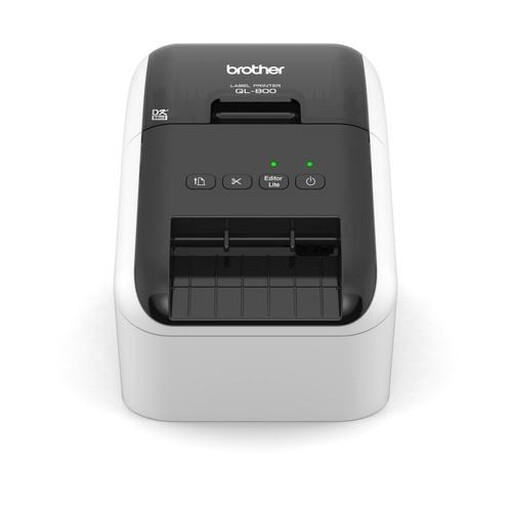 Image unavailable
Suitable only for a design where raffle tickets can be made as labels on DK tape.
Thermal label printer; black-and-red printing; labels up to 62 mm wide; wired USB connection. Uses DK tape.
Don’t assume it can unless this is confirmed for the specific model. For example, you can use a number column in Excel as the data source for Mail Merge in Word. Check the result and print a test sheet first.
No. A general duplex specification doesn’t mean that every thick card is suitable. Check the supported paper type and size, and the paper feed settings for the exact model and paper you want to use. Then test the alignment.
Compare the right ink or toner with how often you print and how much colour you use. The Consumers’ Association notes that cleaning can use extra ink if an inkjet printer is used infrequently. Brother says the HL-L2400DWE can also be used without the optional EcoPro subscription; check the latest terms if you’re considering a subscription.
That depends on how the game of chance is organised and its terms; printing the tickets doesn’t determine this. According to the Netherlands Gambling Authority, games of chance generally require a permit, with exceptions subject to conditions, such as games involving people who know each other or free entry. For a one-off lottery with paid tickets for a charitable cause, the Netherlands Gambling Authority states that a permit is required from the municipality if the total prize value is below € 4.500, and from the Netherlands Gambling Authority if it is € 4.500 or more. Whether a particular event falls under an exemption or requires a permit depends on the event’s terms.