
Vandaag of morgen in huis

Kwaliteit gegarandeerd

Welkomstaanbiedingen ontgrendelen: GRATIS bezorging | Tot 80% korting | Gratis 30 dagen JoyPlus-proefperiode
Download de app
A radio-controlled toy car may seem easy to choose at first. However, models can vary considerably in their drive system, controls, battery, age recommendation and the surfaces they can handle. A cheap car can quickly disappoint if it only works on a smooth floor, needs recharging after a short time or is difficult to control.
For parents, teenagers and collectors, these are the three main pitfalls to watch out for:
Start with the age recommendation on the product page and the warnings on the packaging. Models with small parts are not suitable for children below the recommended age. Some vehicles require direct adult supervision, particularly when used by young children.
An RC car for children aged around 3 and over should ideally have simple controls and a sturdy body. Children aged around 8 and over, as well as teenagers, may be more interested in features such as 4WD, drift tyres and gyro assistance. A collector’s model is a different category: it is often a push-along model with small parts and a higher age recommendation.
Also check:
A CE mark is not proof that a vehicle performs every desired function well. Consider it alongside the age information, instructions and product details.
4WD means four-wheel drive. It can help deliver even power and improve control while drifting, but the driving experience also depends on the tyres, motor, weight and surface. A smooth tiled floor is very different from carpet, tarmac or short grass.
When choosing an RC car for indoor and outdoor use, look for:
A 4WD RC drift car with two sets of tyres is more versatile on flat floors and roads. A stunt car with large omnidirectional wheels is better suited to moving sideways, spinning and driving upside down. Don’t expect a small 1:24 model to perform like a large off-road vehicle.
A higher battery voltage doesn’t tell you about running time on its own; the motor, capacity and driving style all play a part. For a GTR-style 4WD RC car, a running time of around 20 to 40 minutes per charge is stated. Treat this as product information, not a guarantee for every situation.
Before buying, check:
After using the car outdoors, let it cool down and remove any visible dirt before putting it away. Don’t drive it through water unless the manufacturer explicitly says it is suitable. LED lights make a toy car with LED lights easier to see at dusk, but they are not lights for safe use on public roads.
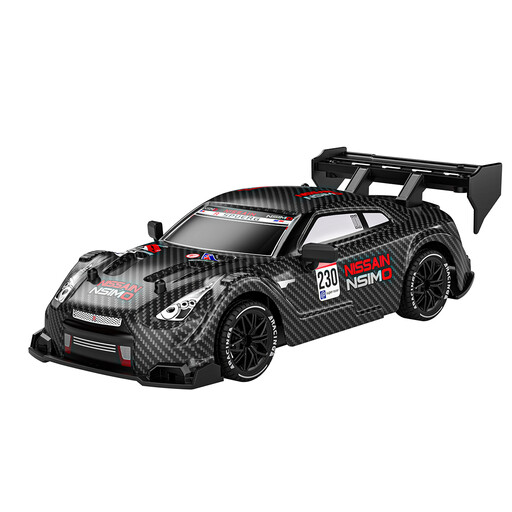
Why it suits this profile: This model combines 4WD, proportional 2.4G control and two sets of tyres. According to the product description, it’s suitable for tiled floors indoors and flat roads outdoors.
The product information lists a rechargeable lithium battery and a running time of around 20–40 minutes. Be sure to check which batteries the transmitter needs.
4WD, interchangeable drift and racing tyres, LED lights and USB charging.
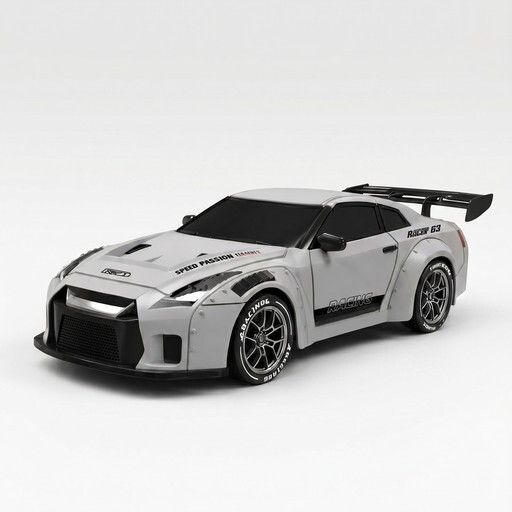
Why it suits this profile: The combination of proportional steering, adjustable gyro assistance, two speed settings and a 7.4V LiPo battery is a good fit for enthusiasts who value control.
The low-speed setting and adjustable gyro can make it easier to get to grips with than a car that only has a fast mode.
ABS body, suspension, 4WD, LED lights and interchangeable tyres for drifting or racing.
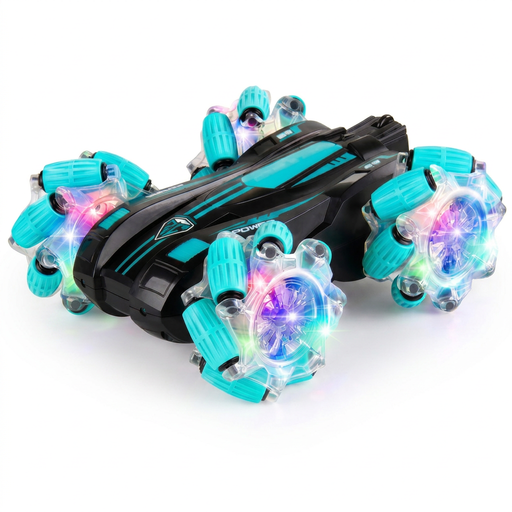
Why it suits this profile: This vehicle is designed for driving on both sides, 360° spins, sideways movement and LED wheels. It’s a good fit for children who are more interested in stunts than realistic racing.
The large Mecanum wheels and double-sided design are made for stunts and small obstacles. Be sure to check the recommended surface.
Double-sided driving, sideways drifting, 360° rotation, 4WD and colourful LED lights.

Why it suits this profile: The six-channel controls, tipping tray, rubber tyres and sound and light effects are great for imaginative play and parent-child play, rather than speed.
The functions are clearly described: driving, steering and raising the tray. Note the warning about small parts and the need for supervision when children aged 3 and over are playing.
Remote-controlled tipping tray, 2.4GHz signal, rubber tyres, LED lights and included 3.7V 500mAh battery.
We’ve put together a complete, up-to-date list of products that meet these strict selection criteria and the applicable European safety regulations.
Running time varies depending on the battery, motor, speed and surface. Product information for some 4WD models gives a running time of around 20 to 40 minutes per charge. If you’re using the car intensively, take a break to let it and the battery cool down. Store the battery according to the instructions and only use the supplied or recommended charging cable.
That depends on the product specifications. Some models are designed for tiled floors and flat roads, while others have larger wheels for grass or small obstacles. Check whether water resistance is explicitly mentioned. If it isn’t, dry, flat ground is the safer choice.
On top of the purchase price, you may need to pay for AA or AAA batteries for the remote control, replacement tyres and possibly an extra battery. A rechargeable RC car reduces the need for disposable batteries in the vehicle, but always check whether the transmitter itself needs batteries.
