
Vandaag of morgen in huis

Kwaliteit gegarandeerd

Welkomstaanbiedingen ontgrendelen: GRATIS bezorging | Tot 80% korting | Gratis 30 dagen JoyPlus-proefperiode
Download de app
A radio-controlled car can make a fun gift for children, teenagers and adults. However, a basic remote-controlled toy car, an RC drift car and a remote-controlled electric off-road vehicle can differ considerably in how they perform. A model that drives smoothly indoors may not perform well outdoors on grass or paving.
So don’t focus solely on speed, colour or spectacular product photos. The following points will help you avoid making the wrong purchase.
A high stated top speed may sound appealing, but it is not always suitable for young children or small spaces. A fast RC racing car can be difficult to control on a smooth floor. Check whether the remote control offers proportional steering, adjustable speed or a beginner mode.
Some models do not state their speed in the product information. In that case, don’t draw conclusions based solely on terms such as “high speed” or “racing”. Also consider the drive system, size and the type of surface the car is designed for.
A rechargeable RC car is practical, but its running time depends on the battery capacity, motor and driving style. A small battery may be suitable for short indoor play sessions, but less convenient for a long afternoon outdoors. Check:
Also look out for conflicting information. The product description should clearly state which battery the car uses and which batteries, if any, are still required for the controller.
A 4WD RC car with treaded tyres can offer more grip on grass, sand or a short-pile carpet than a model with smooth tyres. That does not automatically mean that the electronics are fully waterproof. According to the product descriptions of some models, the casing is water-resistant, but don’t use a car in deep puddles unless the manufacturer clearly permits this.
Also check the age recommendation. A model with small parts is not suitable for children under three. Toys containing small parts should be used under the direct supervision of an adult.
2WD powers two wheels and is often sufficient for flat floors. 4WD distributes power to all four wheels and can help with corners, slopes and rougher terrain. For an RC monster truck or remote-controlled off-road vehicle, ground clearance, suspension and tyre tread are also important.
Compact models with a tighter turning circle are useful indoors. Outdoor driving calls for a sturdy body, shock absorption and tyres that don’t lose traction easily.
A simple controller with forward, reverse, left and right controls is easy for beginners to understand. According to the product description, a model with 2.4GHz control can be used alongside several other cars without the signals normally interfering with one another. However, always check the included manual and the operating range.
For drifting, features such as an adjustable gyro, interchangeable tyres and proportional throttle and steering control are worth considering. An RC stunt car often uses different techniques, such as driving on both sides, moving sideways or turning 360°. Decide in advance whether you mainly want simple operation or greater control from the receiver.
A scale of 1:24 or 1:28 gives an indication of the size, but it doesn’t tell you everything about the actual dimensions. Also check the stated length and the space available for driving. ABS plastic is used in many toy models. Hobby-focused cars may also feature metal components, adjustable suspension or interchangeable tyres.
After driving on sand or grass, check the wheels and drive system. Remove any dirt before storing the car and charge lithium batteries according to the manufacturer’s instructions.
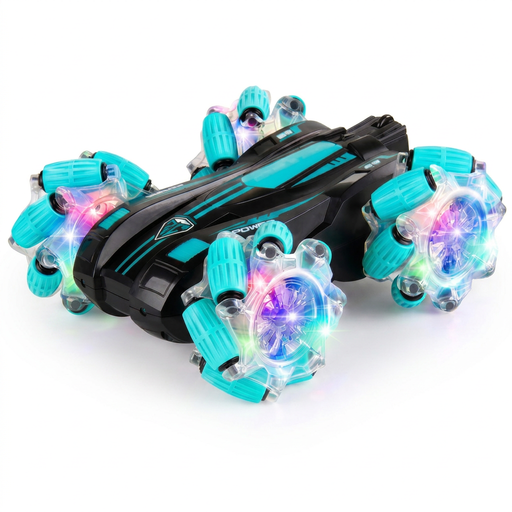
Why it suits this profile: This car is designed for children who want to do more than simply drive forwards and backwards. The double-sided function and automatic demonstration mode make it easy to get started with an RC car.
The product description lists 4WD, double-sided driving and large Mecanum wheels. This makes it less likely that an overturn will interrupt play. Check the exact charging and usage information before buying.
Sideways movement, 360° turns, LED wheels and driving on both sides, according to the product description.
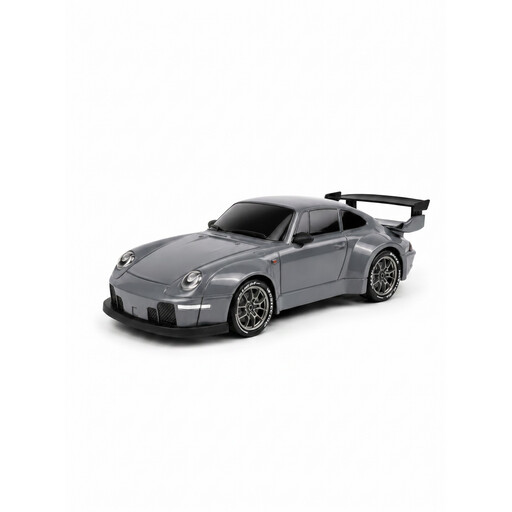
Why it suits this profile: This model is aimed at teenagers, adults and RC enthusiasts who want to practise drifting and gain more control over time.
The listed features include two speed modes, an adjustable gyro and two types of interchangeable tyres. This lets you adapt the handling to your skill level and the surface.
4WD drive, LED lighting, suspension, lithium battery and a choice of drift or racing tyres, according to the product information.
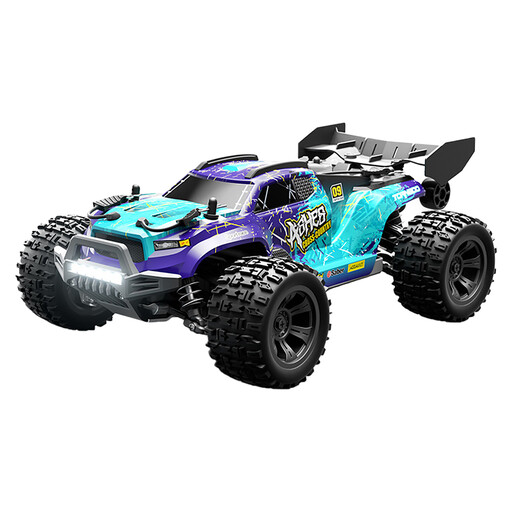
Why it suits this profile: Designed for more powerful use, this size is suitable for teenagers aged 14 and over and adults who want to drive outdoors on grass, sand or uneven terrain.
The product description lists 4WD, a metal chassis plate, treaded tyres and a 7.4V battery. Before use, check the limits of its water resistance and the conditions of the local terrain.
The stated features include 4WD, adjustable speed and steering, LED headlights, a USB charging cable and a body designed for off-road driving.
We’ve put together a complete, up-to-date list of products that fully meet these strict selection criteria and the applicable European safety regulations.
For children aged three and over, choose a model with simple buttons, moderate speed and a sturdy casing. Always check the age recommendation and warnings on the product page. Supervise children during play, particularly when the toy contains small parts.
This varies by model, battery and driving style. A 500mAh battery cannot be compared directly with a 1500mAh battery, as motor power and weight also play a part. Check the stated play time, charging time and whether a spare battery can be used.
That depends on the tyres, ground clearance and protection of the electronics. A 4WD RC car with treaded tyres is generally designed for a wider range of surfaces than a compact indoor car. Only use a model in water or mud when the product information clearly permits this. Afterwards, clean and dry the car according to the instructions.
