
Vandaag of morgen in huis

Kwaliteit gegarandeerd

Welkomstaanbiedingen ontgrendelen: GRATIS bezorging | Tot 80% korting | Gratis 30 dagen JoyPlus-proefperiode
Download de app
A radio-controlled car for children may seem easy to choose at first glance. However, bold claims about speed, off-road driving or water resistance can lead to a disappointing purchase. A model that runs smoothly on tiles may struggle outdoors on grass. A vehicle with lots of features may also be too complicated for a young child.
The Joybuy Product Recommendation Officer therefore selects products based on verifiable features: recommended age, dimensions, drivetrain, battery, remote control and intended use. This allows you to compare an RC car for children, a construction vehicle or an off-road vehicle based on practical considerations rather than appearance alone.
A fast remote-controlled car is not automatically suitable for young children. A speed that is enjoyable for a teenager can be difficult to control in the living room. Check whether the transmitter has speed control and whether the vehicle is intended for the user's age group.
For a product intended for children aged 3 and over, simple functions such as forwards, backwards and left/right are often sufficient. For older children and adults, proportional control, adjustable steering sensitivity and a pistol-grip transmitter may be more relevant.
Water resistance does not always mean that a vehicle can be fully submerged. Check whether the product information mentions an IP rating, waterproof housing or simply splash resistance. Do not use a standard RC car in a swimming pool unless there are clear instructions allowing this.
An amphibious RC car with sealed electronics and screw wheels is a more logical choice for use in water. Even then, it is best to drive only in shallow water and clean and dry the vehicle after use.
Lights, sounds, water jets and a tipping bed make play more engaging, but also check what is included in the box. A rechargeable battery may be included, while the batteries for the remote control may need to be purchased separately. Also pay attention to charging time, play time, spare parts and the vehicle's dimensions.
Always check the recommended age on the product page and packaging. Several models in this selection are intended for children aged 3 and over, while a more powerful 4WD RC car is also offered for teenagers aged 14 and over. Small parts may pose a choking hazard. Take adult supervision into account, particularly for younger children.
Also check whether the packaging and instructions include information about the manufacturer, EU responsible person, battery use and warnings. A CE marking should be visible and verifiable on the product or packaging; do not rely solely on an image in an advert.
For indoor use on a flat floor, two-wheel drive is often sufficient. If you want to drive outdoors on grass, sand, gravel or a short-pile carpet, 4WD and tyres with a clearly defined tread are more suitable. An RC off-road vehicle with large, non-slip tyres can handle uneven surfaces better, but is usually less compact and sometimes faster.
Pay attention to ground clearance, wheel size and weight. A large vehicle such as a container truck measuring approximately 45 cm needs more room to play than a 1:24 scale model. So check in advance that there is enough space indoors and outdoors.
A built-in lithium battery with a USB cable is practical for regular play. Check the voltage and capacity, for example 3.7 V and 500 mAh for a construction vehicle. A transmitter often uses separate AA batteries, which are not always included.
A 2.4GHz remote control is useful when several children are playing at the same time. According to the product descriptions, the models mentioned are designed to operate alongside multiple vehicles without signal conflicts. Treat this as a product specification and still check the stated range and conditions of use before buying.
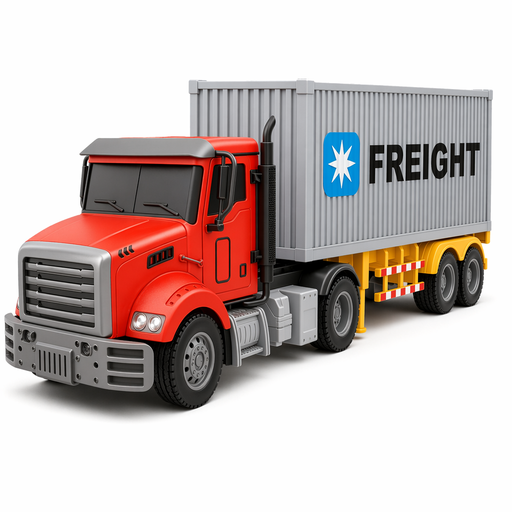
Why it suits this profile: A large, easy-to-understand model with simple controls for children aged 3 and over and families who want to play together.
The product description states the dimensions, a 3.7V 350mAh battery, USB cable and a range of up to approximately 30 metres. This means the key usage details are clear in advance.
Drive forwards, backwards and left/right; cab and container can be detached; headlights and warning lights are built in.
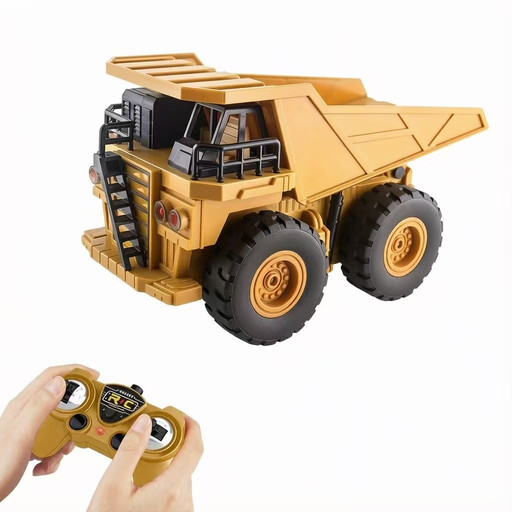
Why it suits this profile: Aimed at children who are interested in building sites, loading and unloading, and want to do more than simply drive around.
The product information lists the six channels, lifting tipper bed, rubber tyres and included battery separately. This allows you to compare the features directly with the intended play area.
Tipper bed moves up and down; 2.4GHz transmitter; LED headlights and rear lights; 3.7V 500mAh battery and USB cable included.
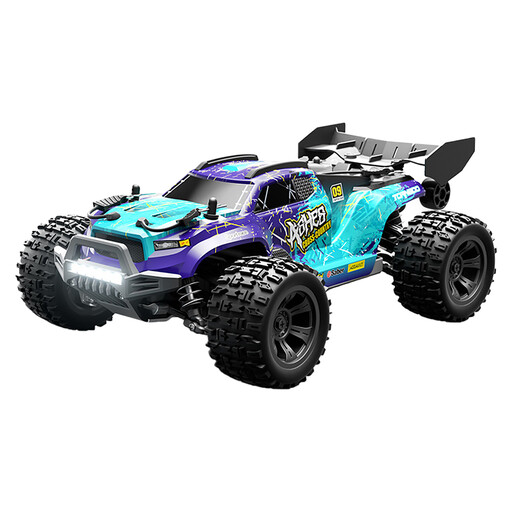
Why it suits this profile: Intended for teenagers aged 14 and over and adults who want to drive outdoors on grass, sand, gravel or other rough surfaces.
The listed specifications include 4WD, a 7.4V 1500mAh battery, adjustable steering functions and a metal chassis plate. This gives you a clearer indication of its intended use than a generic remote-controlled toy car.
Four-wheel drive; deep tread on the tyres; LED lighting; spare parts, USB cable and instructions included.
We have put together a complete, up-to-date list of products that fully meet these strict selection criteria and the applicable European safety regulations.
That depends on the product. According to the product information, some models are suitable from age 3, while powerful off-road vehicles are offered for older users. Always check the age recommendation, small parts and supervision advice. Do not allow young children to handle lithium batteries, charging cables or loose batteries without supervision.
Play time depends on battery capacity, motor power, surface and driving style. A 500 mAh battery is different from a 1500 mAh model, but capacity alone does not predict exactly how long you will be able to drive. Also look at the included charger, charging time and whether a replacement battery is available. Charge lithium batteries according to the instructions and store them in a dry place away from heat.
Only when the manufacturer clearly allows it. “Water-resistant” may refer to splash protection or brief use on a damp surface. An amphibious RC car is designed for land and shallow water, but the instructions remain important in this case too. Clean the vehicle after use, remove any sand and allow it to dry completely before reconnecting the battery.
