
Vandaag of morgen in huis

Kwaliteit gegarandeerd

Welkomstaanbiedingen ontgrendelen: GRATIS bezorging | Tot 80% korting | Gratis 30 dagen JoyPlus-proefperiode
Download de app
A radio-controlled car for children may seem easy to choose at first glance. However, RC cars for children can differ considerably in terms of controls, battery life, surfaces and recommended age. A model that is fun to use on a smooth living-room floor may perform less well outdoors on grass or gravel. Accessories, batteries and safety warnings can also affect the actual cost of use.
With this guide, you can compare an RC car for children based on verifiable product specifications. This makes it easier to find a suitable remote-controlled car for indoor use, outdoor driving, stunts or calm imaginative play.
An eye-catching body, LED lighting or a bold racing design says little about how easy the car is to control. For young children, a low speed, clear buttons and stable steering are often more important. Check whether the car has multiple speed settings and whether the remote control is suitable for small hands.
A drift RC car is generally designed for smooth floors, tiles or a flat track. An RC off-road vehicle, on the other hand, needs treaded tyres, suspension and sometimes four-wheel drive for grass, sand or gravel. A model designed for indoor use may get stuck more easily outdoors or be exposed to dirt and moisture.
Not every remote control uses a rechargeable battery. Some models do not include AA or AAA batteries. Also check the charging cable supplied, battery voltage and any spare parts. A car with a built-in battery is convenient, but check that the charger and connection are clearly specified.
Also pay attention to the age warning. Several models in this selection are suitable from the age of 3, but contain small parts. Use them according to the product information and supervise young children.
A simple remote-control toy car configuration usually supports forward, reverse, left and right. Additional channels can add features such as a tipping bed, sideways driving or a transformation function.
A 2.4GHz connection is described in the product information as a system that allows multiple vehicles to be driven at the same time without direct signal conflicts. This is useful when racing with brothers, sisters or friends. Always check the actual product description, though; a wireless connection does not replace supervision.
For indoor use, compact tyres and a low speed are often sufficient. If you want to drive outdoors, look for:
Watch out for conflicting information. If a product title states 2WD, for example, but the description says 4WD, it is sensible to check the current specifications or contact customer service before buying.
A supplied lithium battery means you do not have to buy separate batteries for the car straight away. The remote control may still require AA or AAA batteries. A 220 mAh battery and a 500 mAh battery are not directly comparable: play time also depends on motor power, speed, surface and use of the lights.
Store batteries according to the instructions, charge them using the supplied cable and stop using them if there is visible damage. Also check the CE marking, age limit and warnings. A CE marking is not proof that a product is suitable for every situation; the instructions for use and recommended age remain important.
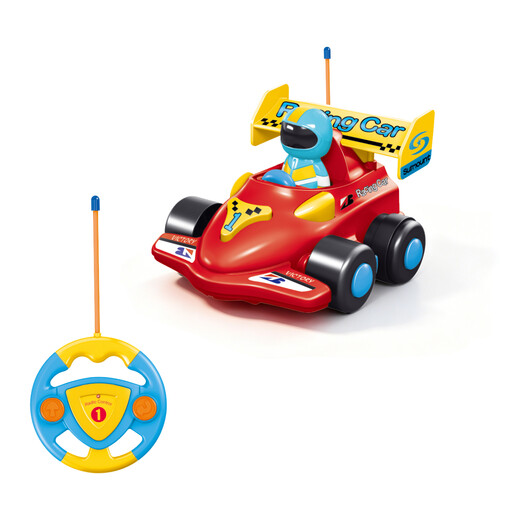
Why it suits this profile: The simple forward, reverse and steering functions are suitable for children playing with radio-controlled toys for the first time. Its compact shape makes it suitable for indoor use.
The controls are limited to basic functions, so there is less confusion than with a model offering numerous stunt modes. Please note: 3 AA batteries for the car are not included.
According to the product description, the car has lights, sound effects and a sturdy construction. The stated product dimensions are 20.6 × 10.6 × 30.2 cm.
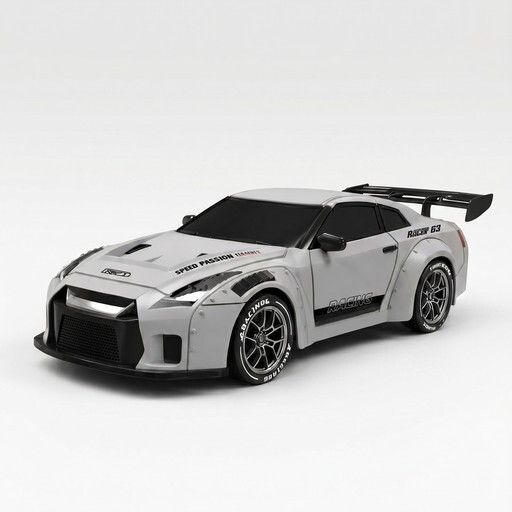
Why it suits this profile: This model is suitable for children who already have some steering experience and enjoy practising drifting, slaloms and short races on a smooth track.
The product description mentions two speed settings and an adjustable gyro system. This means you can start gently, but check before buying that the desired tyres and settings are included.
According to the product description, the car has 4WD, LED lighting, suspension and two types of interchangeable tyres.
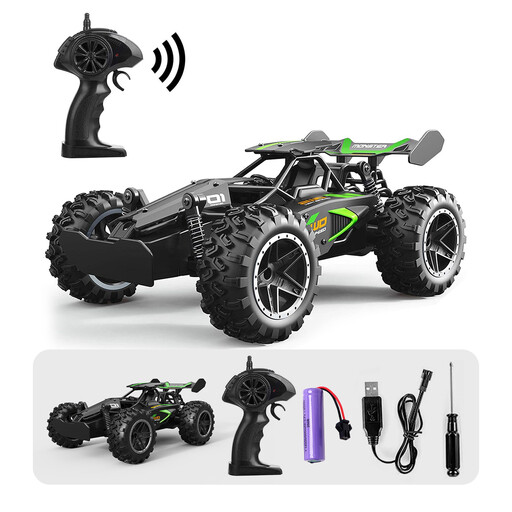
Why it suits this profile: This is a logical choice for children who want to drive outdoors on grass, gravel or an uneven garden path and are less interested in straight-line racing only.
The product description lists large tyres, suspension and a protective bumper. This is better suited to outdoor use than a low drift car, but avoid puddles and check the instructions.
According to the product description, the buggy has a rechargeable 3.7V battery, a 2.4GHz pistol-grip remote control and dimensions of 14 × 25 × 18 cm.
We have compiled a complete, up-to-date list of products that fully meet these strict selection criteria and the applicable European safety regulations.
That depends on the specific age recommendation, controls and whether the product contains small parts. Several models state a minimum age of 3 and warn of a choking hazard. Choose a model that the child can operate easily and use it under direct supervision where this is specified in the product information.
Play time varies depending on the battery, motor, speed, surface and use of lights or sound. A product page does not always state a fixed play time. Therefore, pay particular attention to the battery type, voltage, charging cable and whether a replacement battery or rechargeable battery can be used.
For indoor use, a compact size, low speed and simple controls are practical. Outdoors, treaded tyres, ground clearance, bumper protection and suspension are more important. A stunt car is suitable for flat surfaces and demonstrations; an off-road vehicle is better suited to grass, gravel and an uneven garden path.
