
Vandaag of morgen in huis

Kwaliteit gegarandeerd

Welkomstaanbiedingen ontgrendelen: GRATIS bezorging | Tot 80% korting | Gratis 30 dagen JoyPlus-proefperiode
Download de app
A radio-controlled car may seem easy to choose at first glance. However, models vary considerably in terms of control, terrain, battery life and recommended age. For example, a cheap remote-controlled car may look appealing but be awkward to use on carpet. A fast off-road RC car, on the other hand, may be too powerful for a young child.
The main pitfalls are usually not related to appearance, but to details that only become apparent during play.
LED lights, music and 360° stunts are attention-grabbers. However, not every RC stunt car performs well on grass, gravel or a deep-pile rug. So check the type of tyres, the drive system and the recommended terrain.
A 4WD RC car with independent wheel drive generally offers more grip than a model with rear-wheel drive only. This makes 4WD an attractive option for outdoor use, slopes and small obstacles. It does not automatically mean that the car is suitable for mud, deep puddles or rough terrain.
“Rechargeable” means that a battery can be recharged, but it does not tell you how much playtime you will get. Check the battery voltage and capacity, for example 3,7 V and 500 mAh or 7,4 V and 1.500 mAh. A higher capacity may provide more playtime, but actual battery life also depends on speed, terrain and driving style.
Also check what is included in the box. With some models, the rechargeable battery is included, but the remote control or wristwatch may still require AA or AAA batteries.
A product suitable for children aged 3 and over is not necessarily easy to control. A fast RC drift car with proportional steering may be interesting for a teenager, but frustrating for a young child. Always check the warnings about small parts too, and ensure that young children use the product under adult supervision.
According to the product descriptions of the selected models, various vehicles are intended for children aged 3, 6, 8 or 14 and over. Check the current age recommendation on the product page before buying.
A model with large, non-slip tyres and a deep tread is better suited to grass, sand or gravel than a low-slung racing car with smooth drift tyres.
A 2,4GHz remote control is practical when several children want to drive at the same time. According to the product information for these models, multiple vehicles can be used together on this frequency without interfering with one another’s signals. This is a claim made in the product description; the play environment and distance may affect the experience.
Some stunt cars offer dual control: a traditional remote control and a motion-sensitive wristwatch. This can be fun for children who prefer to steer with arm movements. For precise cornering, button controls are often easier to manage.
A rechargeable radio-controlled car means you do not have to keep replacing the car’s batteries. Check:
For water models, “waterproof” does not mean that every type of use is safe, according to the product information. The vehicles mentioned are intended for shallow water; avoid deep puddles and follow the instructions.
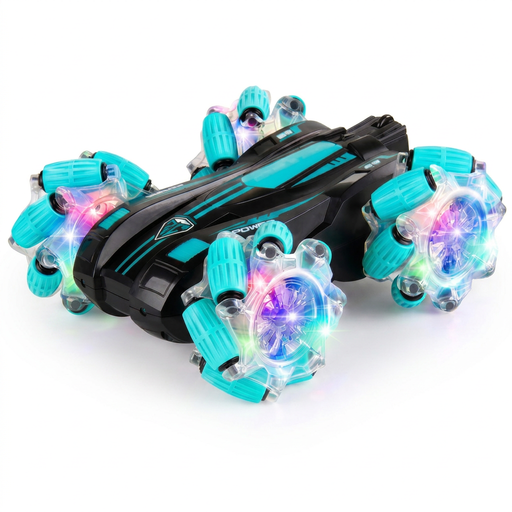
Why it suits this profile: A compact stunt car for children who mainly want to practise turning, tilting and driving indoors and on flat outdoor surfaces.
The product description mentions 4WD, double-sided driving and Mecanum wheels. According to the description, this means you should need to manually turn the car upright less often after it overturns.
360° rotation, sideways drifting, LED-lit wheels and a rechargeable battery, according to the product information.
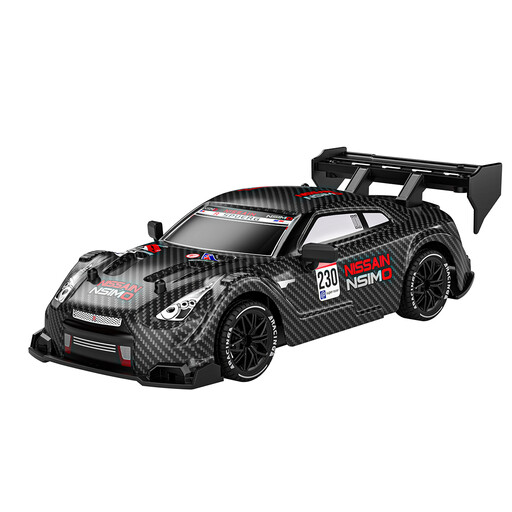
Why it suits this profile: Designed for children aged 8 and over, teenagers and enthusiasts who want to feel the difference between racing and controlled drifting.
The product description mentions two sets of tyres: one for drifting and one for racing. This means the car is not limited to just one style of play.
4WD, USB-rechargeable lithium battery, LED lighting and a stated run time of approximately 20–40 minutes.
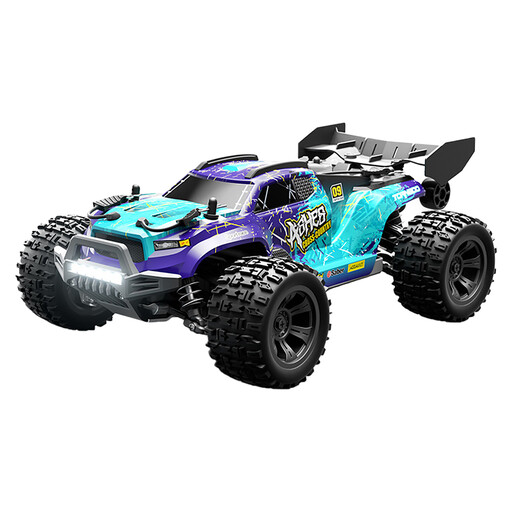
Why it suits this profile: For teenagers and users aged 14 and over who want to drive outdoors on grass, sand, gravel and other uneven surfaces.
The product information mentions large all-terrain tyres, 4WD and a reinforced aluminium chassis. This makes it better suited to intensive outdoor use than a small indoor racing car.
7,4 V 1.500 mAh battery, 2,4GHz pistol-grip transmitter, LED headlights and a stated top speed of up to 40 km/h, according to the product description.
We have put together a complete, up-to-date list of products that fully meet these strict selection criteria and the applicable European safety regulations.
First, charge the battery according to the instructions and insert the required batteries into the remote control. Then, usually, switch on the car followed by the transmitter. Test forwards, backwards and steering on an open, flat surface. With a wristwatch model, you will also need to pair or calibrate the motion controls.
This depends on the battery capacity, speed, terrain and use of lights or sound. A product with a higher mAh rating may run for longer, but always check the stated playtime on the product page. A spare battery can be useful when it is not possible to recharge the car during play.
The electricity costs of USB charging are generally minimal. The main costs to consider are potential battery replacement, extra batteries for the remote control, spare tyres and maintenance. With an amphibious RC car, thorough drying after use is important to keep the electronics and connections in good condition.
