
Drivers practising braking points
Want to practise consistent braking inputs over repeated laps and adjust brake resistance to suit their seating setup. Sim-Lab and Fanatec describe load cell pedals as measuring braking force.


For practising braking points, a load cell brake is worth considering if you can mount the pedals securely and adjust the brake to suit. Sim-Lab explains that this type of brake measures pedal force rather than relying mainly on pedal position. First, choose pedals that are compatible with your platform and wheel, and suit your seating setup: a high sensor rating won’t make a flexible mount more stable or predict a faster lap time. A simpler set may be enough for practising acceleration and braking, as long as it connects to your existing equipment.
Want to practise consistent braking inputs over repeated laps and adjust brake resistance to suit their seating setup. Sim-Lab and Fanatec describe load cell pedals as measuring braking force.
Want to stop the pedals shifting or a stiff brake causing the mount to flex. Compare placing the pedals on the floor with fixing them to a sturdy pedal plate or cockpit. Fanatec describes the mounting options for the CSL Pedals; Heusinkveld says the Sprint needs a very rigid base.
Want to make sure the pedals will actually connect to their own PC or console and wheel base. Connectivity varies by pedal model: for console use, Thrustmaster says the T-LCM must connect to a compatible Thrustmaster wheel base.
Start by checking connectivity and how sturdy your seating setup is. Then decide whether a load cell brake and adjustable pedals suit the way you want to practise.
| What to consider | What should you check? | Who is this important for? |
|---|---|---|
| Consistent braking | Check whether the brake measures pedal position or force, which resistance settings are adjustable and how to calibrate the brake in your simulation. | If you want to practise braking points lap after lap, you’ll want a braking input that suits your setup. Around 33% of consumers prioritise consistent braking above all else. |
| Secure mounting | Check the mounting options, available space and the strength of the pedal plate; also consider where your seat is positioned. | When braking from a loose seating setup, you don’t want the pedals or plate to move. Around 27% of consumers put secure mounting first. |
| Connectivity with your wheel and platform | Check your exact wheel base, platform, cable routing and the connection instructions for your pedal model. | If you already have a wheel, you’ll want to know in advance whether the pedals work with your PC or console. Around 27% of consumers make connectivity their main requirement. |
| Pedal position and expandability | Compare the adjustable spacing, height and angle, and check whether the set includes two or three pedals. | If you want to adjust your foot position or use a clutch, check which pedals and adjustment options are included with that model. Around 13% of consumers prioritise adjustability or expandability. |
A strong spring doesn’t automatically mean the brake uses a load cell. Fanatec describes the standard CSL brake as using a Hall sensor; the Load Cell Kit is a separate upgrade.
Check the full model name and what’s included in the box, not just the description of the brake resistance.
You may need to buy a separate Load Cell Kit to upgrade; using the standard CSL Pedals independently with a PC also requires a suitable USB solution.
For the Sprint, Heusinkveld distinguishes between a 120 kg load cell rating and a maximum actual force of 65 kg on the brake pedal. These are different figures and aren’t equivalent measures of braking force.
Only compare figures that measure the same thing, and check that your pedal plate or cockpit is sturdy enough according to the mounting instructions.
The Sprint needs to be mounted on a very rigid base, so you may need a sturdier pedal plate or cockpit.
A USB connection for PC use doesn’t prove that the same pedal set will connect directly to a console. For T-LCM console use, Thrustmaster specifies an RJ12 connection to a compatible Thrustmaster wheel base; the standard CSL Pedals don’t have a standalone PC USB connection without an upgrade.
Before choosing a set, check that your platform, wheel base, pedal model and cable routing all work together.
Fanatec offers both an upgradeable two-pedal option and a separate three-pedal load cell set.
The T-LCM is a three-pedal load cell set with separate adjustment options.
According to MOZA, the SR-P is a load cell set with a direct USB connection to a PC.
According to Logitech, the PRO Racing Pedals are a modular three-pedal set.
According to Heusinkveld, the Sprint is an adjustable PC pedal set that needs to be mounted on a very rigid base.
The Joybuy options below are wheel and pedal sets for practising acceleration and braking in a seated racing simulation.
 No image available
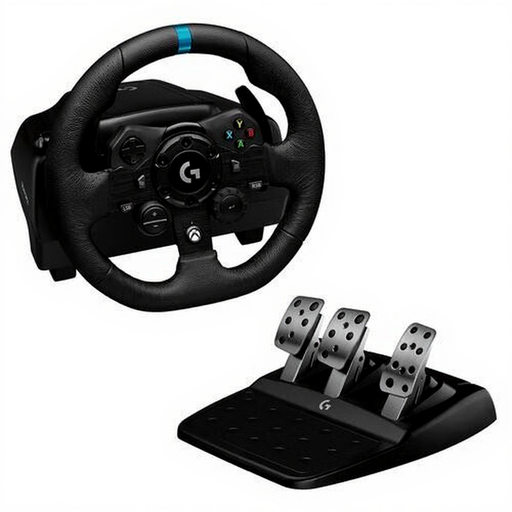
The set includes pedals with a pressure-sensitive brake pedal, described as progressive, for practising acceleration and braking.
Wheel with pedals for PC, Xbox One, Xbox Series S and Xbox Series X.
The product description lists a programmable dual clutch.
 No image available
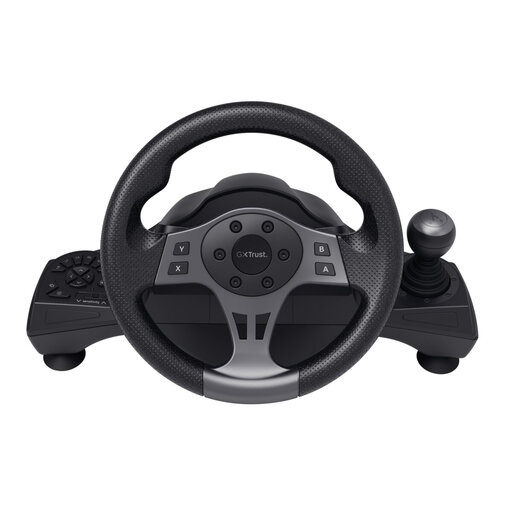
This PC wheel set includes separate accelerator and brake pedals and, according to the product description, can be secured with desk clamps.
The wheel has 270° of rotation; the description lists vibration feedback, not motorised force feedback.
 No image available
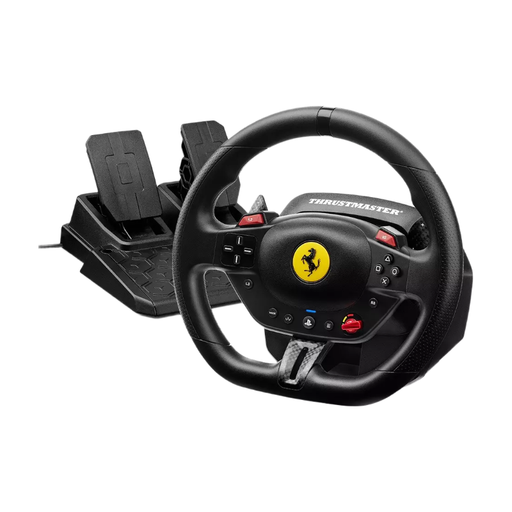
The wheel set is described as including pedals and is designed for Xbox and PC.
The wheel has 240° of rotation; the product description lists three driving-assistance profiles selected using a Manettino dial.
According to the description, the wheel clamp fits desks and tables up to 4,5 cm thick.
No, not necessarily. According to Sim-Lab, a load cell brake measures force rather than just pedal position. It’s worth considering if you want to practise the same braking input and can mount the pedals securely; a sensor rating doesn’t predict lap times.
Don’t use both cables at the same time. For a console, Thrustmaster specifies an RJ12 connection to a compatible Thrustmaster wheel base; on a PC, use the appropriate USB or RJ12 connection.
Calibrate the connected pedals in iRacing. For load cell pedals, iRacing Support recommends a Brake Force Factor of 0,00 in its guide; first check that this setting is suitable for your type of brake.
According to the Netherlands Enterprise Agency (Rijksoverheid), when you buy online from a business, you’re entitled to a 14-day cooling-off period in many cases, with some exceptions. If a product is faulty, the seller is your point of contact for a remedy under the applicable rules; this is separate from any manufacturer’s warranty.