
Analyst who enters lots of figures
You regularly enter lending figures or dates by hand and want to disturb others as little as possible. A quiet model with a separate number pad could suit the way you work.


If you often enter lending figures or dates by hand, a quiet full-size keyboard with a number pad can be practical. If you mainly work with text and filters, and only enter figures occasionally, a more compact model may leave you with more space beside your mouse. Check how the exact model feels to type on in a similar setting, as well as its keyboard layout and whether your device supports Bluetooth, a USB receiver or a cable. ‘Quiet’ doesn’t guarantee that typing will be inaudible in every study space.
You regularly enter lending figures or dates by hand and want to disturb others as little as possible. A quiet model with a separate number pad could suit the way you work.
You take your keyboard with you and mainly work with text, filters or the occasional figure. A compact size and a connection that suits your device may matter more than a separate number pad.
You spend a long time at a screen and want to position your keyboard and mouse comfortably. A more compact keyboard can free up space beside your mouse, but it isn’t a treatment for any symptoms.
Choose this if: you often enter lending figures or dates by hand and have a permanent spot for a larger keyboard.
Bear in mind: the number pad takes up space on the mouse side. With a wireless model, you’ll also need an available port for the receiver.
Choose this if: you mainly navigate spreadsheets, type notes or move between study spaces.
Bear in mind: there’s no separate number pad for entering lots of figures. RTINGS describes the Pebble Keys 2 K380s as very quiet to type on in an independent review, but its smaller key spacing may take some getting used to.
Choose this if: you have a permanent workspace, don’t want to use a wireless connection and don’t need a separate number pad.
Bear in mind: you’ll need a cable and a compatible port. CHERRY’s descriptions of quiet typing aren’t sound measurements taken in your space.
| What to consider | What to look for | Who is this important for? |
|---|---|---|
| Typing noise | Try typing on the exact model, ideally in conditions similar to your study space. A manufacturer’s description isn’t a sound measurement. | If I work in a quiet shared space, I want to disturb others as little as possible. Around 33% of consumers put typing noise first. |
| Entering figures | Think about how often you enter lending figures and dates by hand, and check whether the model has a separate number pad. | If I often enter a series of figures, I want to be able to do so easily. Around 27% of consumers prioritise entering figures. |
| Workspace set-up | Compare the keyboard’s width with the space for your mouse and the rest of your workspace. | During long analysis sessions, I want to position my keyboard and mouse comfortably. Around 20% of consumers prioritise workspace comfort. |
| Portability and connection | For the exact model, check the Bluetooth or USB connection, available ports, layout and whether a receiver is included. | If I move between study spaces, the keyboard needs to connect to my device. Around 20% of consumers prioritise portability and connectivity. |
Trust and CHERRY describe their keyboards as quiet, but product descriptions like these don’t provide comparable noise levels for your study space.
Try the exact model in a setting similar to your own to assess its noise and typing feel.
Compact models don’t have a separate number pad, while analysing lending figures may involve a lot of manual data entry.
First, work out which tasks you do most often and how much space a full-size keyboard would take up.
If you later find that you enter lots of figures, you may need a separate numeric keypad.
Models can connect via Bluetooth, a USB receiver or a cable. There are also different physical keyboard layouts.
Check your device’s ports, the layout of the version you’ve chosen, and whether a receiver is included if needed.
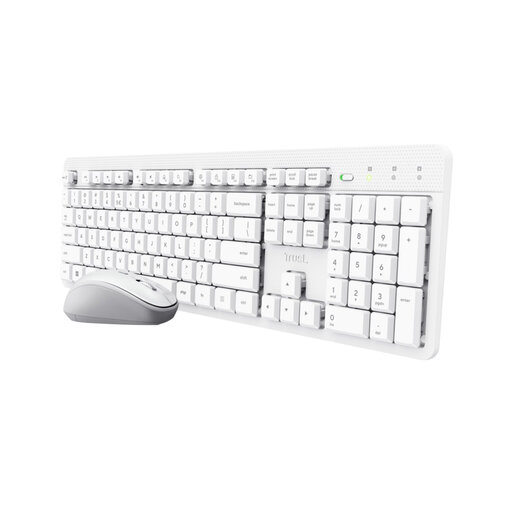
The Ody II is a wireless keyboard that Trust describes as quiet. A Dutch product page lists a number pad for the full-size version.
The compact Pebble Keys 2 K380s is designed for use in different locations. Logitech says the larger MX Keys S has, among other things, programmable keys.
According to CHERRY, both the STREAM KEYBOARD and the compact, wired STREAM KEYBOARD TKL use an SX scissor mechanism.
The wired S-board 840 is a compact model for a permanent workspace where having room beside the keyboard is important.
These product picks suit the task of analysing lending figures: from full-size models with a number pad to more compact keyboards for working with text and moving between study spaces.
 No image available
The product name describes a wireless set with quiet keys. Check that the layout and connection suit your device.
The version described has a US/QWERTY layout and uses a USB receiver.
 No image available
The product name describes a full-size layout with 108 keys and Silent Tactile Switches; this isn’t a sound measurement in your study space.
According to the product name, this version has a US layout.
 No image available
The product name describes a keyboard and mouse set with RF wireless and Bluetooth connectivity. Check which connection your device supports.
The version described has no separate number pad and has a US layout.
 No image available
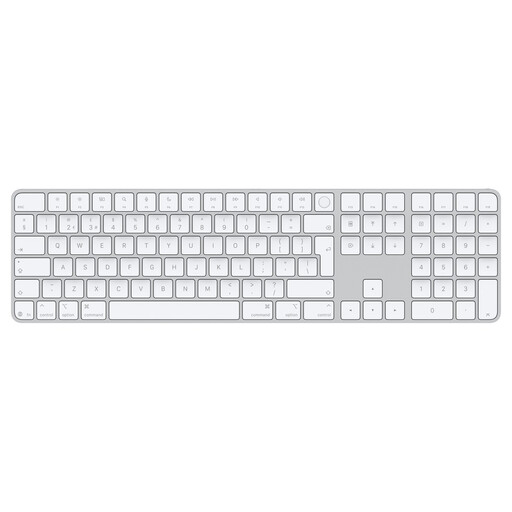
The full-size layout with a number pad is well suited to entering figures by hand.
The product name lists scissor-mechanism keys and a US/QWERTY layout.
 No image available
The number pad may suit you if you enter figures by hand frequently.
The product name lists Touch ID for Mac models with Apple silicon and a Dutch version with white keys. Check that your Mac meets this requirement.
No. A separate number pad can be useful, especially if you often enter a series of figures by hand. If you mainly type text or navigate spreadsheets, a compact model without a separate number pad can leave more space beside your mouse.
It varies by model: the Trust Ody II uses a USB receiver, while Logitech lists Bluetooth for the Pebble Keys 2 K380s. Before buying, check your device’s connection options and whether a receiver is included with the version you’re considering.
Check how the specific version is powered and follow the instructions for charging, replacing batteries and cleaning. A wired model doesn’t need a wireless connection; battery life claims aren’t a guarantee for every use case.
In the Netherlands, online purchases from a business generally come with a 14-day cooling-off period, subject to the relevant conditions. The Dutch government explains that you’re also entitled to a product that meets acceptable standards, and that the Netherlands has no fixed statutory two-year guarantee period. If a product is faulty, contact the seller.
Arboportaal states that for employees who work at a screen for more than two hours a day, the screen and keyboard must not be attached to each other. A laptop must therefore be usable with a separate screen or keyboard. This rule applies to the employee situation described and doesn’t automatically apply to every student or individual buyer.