
Coder in a quiet shared office
You type a lot of text and code alongside colleagues and want a quiet typing feel without giving up the keys you need for coding.


Start with the layout you need for coding and shortcuts, then choose a typing feel that works in a shared workspace. A compact, wired TKL keyboard saves desk space but has no number pad; wireless models with device switching or a split layout cater to other needs. Check the physical layout, connection type and any software requirements for the exact model.
You type a lot of text and code alongside colleagues and want a quiet typing feel without giving up the keys you need for coding.
You switch between computers or operating systems while testing and want a suitable layout with shortcuts close to hand.
You want to adjust your setup and hand position for long hours of screen work. A keyboard is no substitute for a suitable workstation setup or regular changes of position.
| What to consider | What should you check? | Who is this important for? |
|---|---|---|
| Noise in a shared space | Check the key mechanism on the exact model and, if possible, try the typing feel for yourself. | If I type a lot of code alongside colleagues, I want a typing feel that causes as little disruption as possible. Around 33% of consumers put quiet typing first. |
| Layout and shortcuts | Check the physical QWERTY variant, the keys you need and whether configuration software is allowed on your work computer. | If you want quick access to coding symbols and shortcuts, you can match the physical layout to your computer and development environment. Around 27% of consumers prioritise a coding-friendly layout and shortcuts. |
| Hand position and workspace | Consider whether the layout, room for your mouse and available desk space suit your workspace. | If I prioritise my hand position and workstation setup, I want a shape that suits my desk without relying on the keyboard to improve my health. Around 20% of consumers make working posture their first consideration. |
| Connection and desk space | Check the available ports, permitted wireless connections, number of devices and whether you use a number pad. | If you work across multiple devices or have limited desk space, consider whether a cable, receiver or wireless connection is the best fit. Around 20% of consumers prioritise connectivity and desk space. |
A manufacturer’s description of a keyboard’s sound doesn’t tell you whether its physical layout and keys suit your coding needs. A TKL keyboard, for example, has no number pad.
Check both the layout and the keys you use for coding on the exact model. Don’t treat words such as ‘whisper-quiet’ as a comparative sound measurement.
Features that require configuration software are only useful if you’re allowed to use that software on your work computer.
Check before choosing a keyboard for its customisable keys or automated actions.
A split layout can offer a different hand position, but product claims don’t prove that a keyboard prevents discomfort. Your workstation setup and varying your position still matter too.
Assess the layout in your own workspace. If you already have discomfort, review your workstation setup as well, and don’t assume a product description means the keyboard has a healing effect.
The STREAM KEYBOARD range includes a full-size keyboard and a wired TKL model with SX scissor switches. This may be useful if you’re choosing between a number pad and extra desk space.
The MX Keys S is a wireless keyboard for anyone who values customisable keys and switching between devices.
The Ody II is designed for straightforward wireless typing, while the Keyra has a split layout and is intended for use with multiple devices.
This selection is aimed at typing in a shared office: compact wired layouts and models described as quiet or dampened, alongside keyboards for number entry or use with multiple devices.
 No image available
A wired TKL model for a fixed workstation where a compact keyboard is preferred; the product description mentions quiet membrane switches.
US QWERTY layout; no number pad.
 No image available
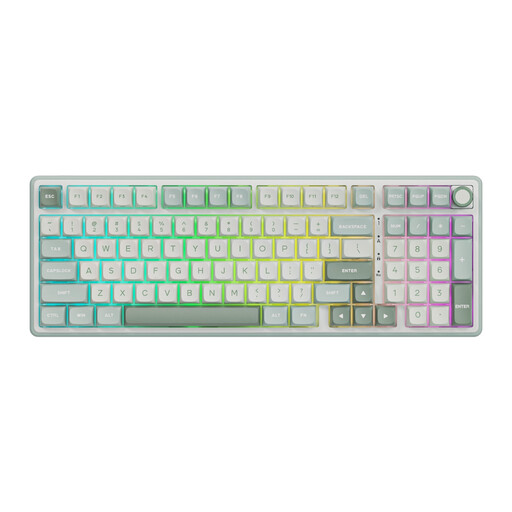
A wired mechanical keyboard for anyone who enters numbers as well as code; the product description mentions a dampened, softer typing experience, but no independent sound measurement.
Number pad, volume knob and Cream linear switches.
 No image available
The 75% layout is a compact option; the connection options described may suit you if you want to switch between devices. The manufacturer describes dampening layers, but this isn’t an independent sound measurement.
Bluetooth, 2.4G and USB-C; with function row and arrow keys.
 No image available
A full-size keyboard for anyone who wants a number pad and works with multiple devices. Trust describes the scissor keys as quiet.
Number pad, USB receiver and three Bluetooth channels; according to the product description, you can switch between up to four devices.
 No image available
A compact wired layout for a fixed workstation. The product description mentions dampening layers that are said to reduce noise; this isn’t an independent sound measurement.
75% layout, USB-C connection and volume control.
Choose the physical layout that gives you easy access to the coding symbols and shortcuts you need for your computer and development environment. Check the exact model before buying: the product name alone doesn’t tell you which key layout you’ll get.
According to the Dutch Arboportaal, if an employee works at a screen for more than two hours a day, the screen and keyboard must not be attached to each other. When working on a laptop, that employee must therefore be able to use a separate screen or keyboard; this doesn’t mean every buyer needs a particular keyboard model.
Adjust your keyboard, mouse and workspace to suit your own measurements, and break up screen work with other activities. The Arboportaal also recommends changing your working posture and taking microbreaks; a different keyboard shape alone can’t guarantee that you’ll avoid discomfort.
For a standard online consumer purchase, you’re generally entitled to a statutory 14-day cooling-off period after delivery, with exceptions explained by ACM ConsuWijzer. Separately, the seller is responsible for the statutory guarantee if a product doesn’t meet what you can reasonably expect with normal use; in the Netherlands, there is no general fixed statutory guarantee period of two years.