Vandaag of morgen in huis

Kwaliteit gegarandeerd

Welkomstaanbiedingen ontgrendelen: GRATIS bezorging | Tot 80% korting | Gratis 30 dagen JoyPlus-proefperiode
Download de app
A hot summer night and a fan that sounds like a jet engine: it's a familiar problem. You're looking for cool air, but all you get is unwanted noise. The search for a truly quiet fan can be frustrating. Many models promise silence, but in practice, they often fall short, especially on higher settings. This leads to a bad purchase and disrupted nights—exactly what you wanted to avoid.
A good fan does more than just move air; it provides a comfortable airflow without being obtrusively present. In this guide, we'll focus on the specifications that truly matter, so you can make an informed decision on a model that suits your needs, especially for use in a bedroom or office.
The market offers a wide range of fans. To choose the right one, it's helpful to focus on a few objective criteria.
The noise level, expressed in decibels (dB), is the most important factor for a quiet bedroom fan. A low decibel rating is crucial for undisturbed rest.
Models with a DC motor (direct current motor) are typically significantly quieter and more energy-efficient than their AC motor (alternating current motor) counterparts.
Not every fan is the same. The way air is moved determines its effectiveness.
Modern fans offer features that significantly increase ease of use.
Based on the criteria above, we have selected a number of models that excel in specific areas.
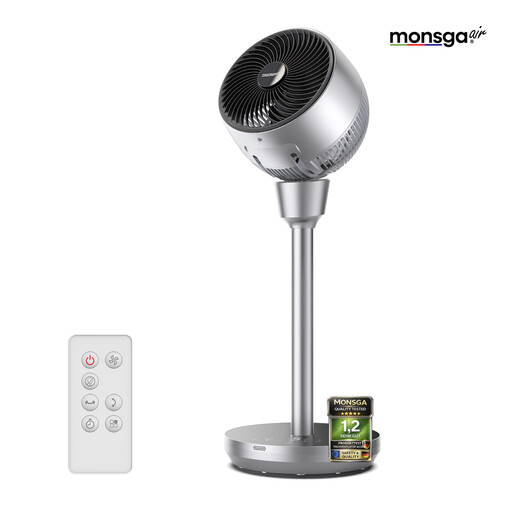
Why this product The MonsgaAir AC300 is designed as a true air circulator. The combination of a DC motor and an aerodynamic design delivers a powerful yet gentle airflow that reaches the entire room. The omni-directional oscillation is a standout feature.
Pros
Who is this for? For users looking for a whole-room solution, not just personal cooling. Ideal for large living rooms or bedrooms where even temperature and air circulation are desired year-round.
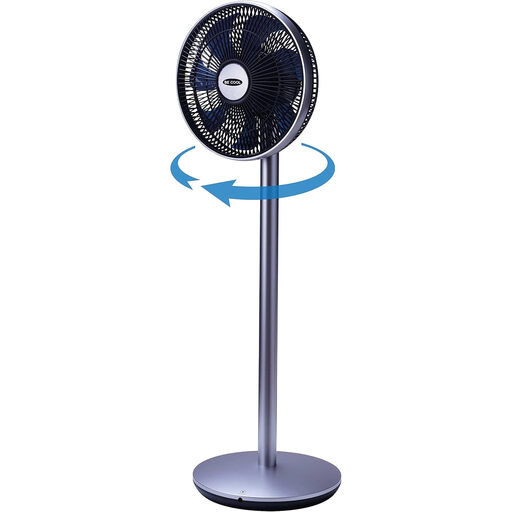
Why this product The Jimmy JF41 Pro is a smart pedestal fan that combines a compact design with wide air distribution. Its 360° oscillation is unique in its class, and app control offers modern convenience.
Pros
Who is this for? For those looking for a compact, smart fan for personal cooling in small to medium-sized spaces, such as a home office or bedroom. The app control is a bonus for tech enthusiasts.
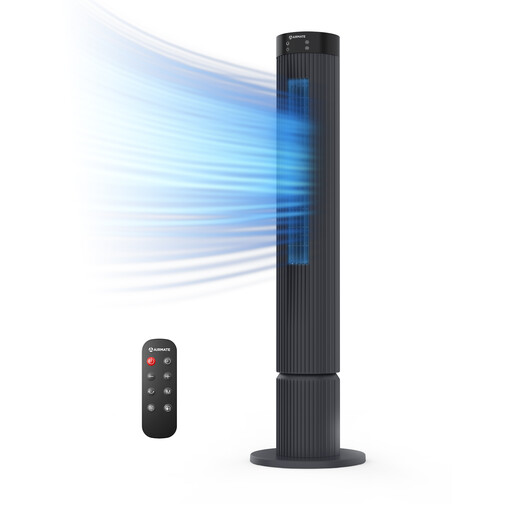
Why this product This tower fan from Airmate combines a slim, space-saving design with quiet operation thanks to its brushless DC motor. With 12 speed levels, this model offers highly precise control over the airflow.
Pros
Who is this for? For users who want a quiet and stylish fan that takes up minimal floor space. The extensive settings make it perfect for those who desire precise control over airflow and noise level.
The models above are geared towards specific needs regarding silence, power, and features. If your ideal fan isn't among them, or if you're looking for a model with different specifications or within a different budget, a wider selection is available.
Explore more options in our Home Appliances Outlet category for a more comprehensive overview.
1. What is the difference between a regular fan and an air circulator? A regular fan creates a direct, tangible breeze in one direction. An air circulator is designed to move all the air in a room. This ensures a more even temperature and can improve the efficiency of your air conditioning or heating.
2. How many dB is a quiet fan for the bedroom? For a quiet bedroom fan, a noise level of under 30 dB on the lowest setting is recommended. This is comparable to a whisper and is not perceived as disruptive by most people during sleep.
3. Does a fan with a DC motor really use less power? Yes, a fan with a DC motor is generally more energy-efficient than a traditional AC fan. According to manufacturers, energy savings can be up to 35% or more, while they also tend to be quieter and offer more speed settings.
Written by: Joybuy Product Recommendation Officer