A fan that gently hums at night can be soothing for some, but for a light sleeper, it's a source of irritation. The search for a quiet fan for the bedroom often ends in disappointment: a model that seemed silent in the store turns out to be a disruptive rattle at home. The result is a disturbed night's sleep—the very thing you wanted to avoid.
This article helps you make an informed decision. We'll discuss the key specifications to look for and highlight several models designed for quiet and effective cooling.
What to Look for When Buying a Quiet Fan?
A good choice is based on verifiable specifications, not just marketing promises. Pay attention to the following parameters to find a model that meets your requirements.
- Noise Level (dB): This is the most important factor. A fan for the bedroom should ideally operate below 30 decibels (dB) on its lowest setting. This is comparable to the sound of a whisper. Models with a DC motor (direct current motor) are typically significantly quieter and more energy-efficient than traditional AC motors.
- Fan Type: The shape affects airflow and noise. A quiet tower fan has a slim design and distributes air over a large vertical area, which is pleasant next to a bed. A quiet pedestal fan model is height-adjustable and can direct the airflow more precisely. An air circulator is designed to circulate the air throughout the entire room, rather than creating a direct breeze.
- Airflow and Range: Quiet operation is useless if the fan doesn't provide any cooling. Look at the airflow, expressed in cubic metres per hour (m³/h), and the wind speed (m/s). These specifications indicate how powerful the fan is and the size of the space it can effectively cool.
- Controls and Features: A fan with a remote control offers convenience, so you don't have to get out of bed. A smart fan with app or voice control (via Google Assistant or Alexa) provides even more control. Useful extras include a timer function, various modes (such as a natural breeze or sleep mode), and oscillation (the fan's rotation) for better air distribution.
- Energy Consumption: An energy-efficient fan, often equipped with a DC motor, consumes significantly less power. This is not only beneficial for your energy bill but also for the environment.
Our Top Picks for 2026
Based on the criteria above, we have selected a range of fans that excel in quiet performance and functionality.
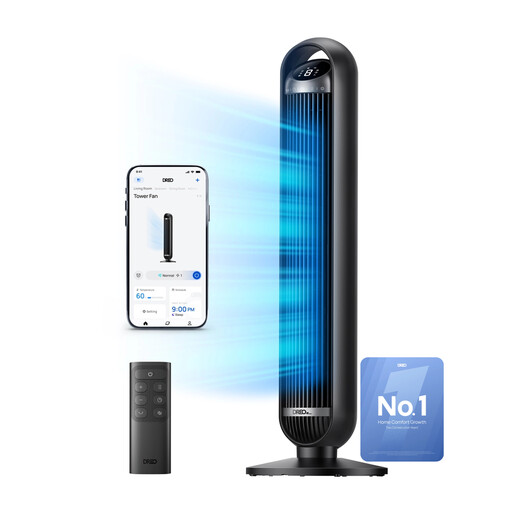
1. DREO Smart Tower Fan

Why We Chose It: This quiet tower fan combines a very low noise level with extensive smart features. Its control via an app and voice assistants makes it a modern choice for the tech-savvy user.
Key Features:
- Ultra-Quiet: Produces a noise level of just 25 dB on its lowest setting, thanks to its brushless DC motor and what the manufacturer calls TurboSilent technology.
- Smart Control: Fully controllable via the Dreo app on your smartphone or with voice commands through Alexa and Google Assistant.
- Customisable Airflow: Choose from 4 modes (Normal, Natural, Sleep, Auto) and 8 speed levels.
- Wide Coverage: The 90° oscillation ensures even distribution of cool air throughout the room.
- Practical Features: Includes a fan with a remote control and a timer that can be set for up to 8 hours.
Best For: Ideal for light sleepers and users who value the convenience of a smart fan that can be fully integrated into their smart home ecosystem. Its sleek design fits well in modern bedrooms and living rooms.
View the DREO Smart Tower Fan
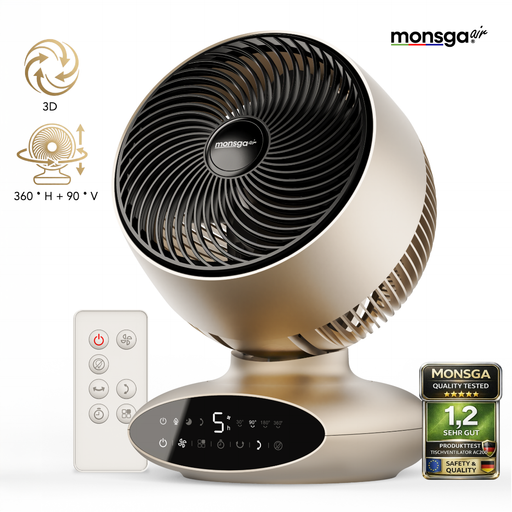
2. Monsga AC200 Turbo Table Fan

Why We Chose It: This model functions as a powerful air circulator with a unique 3D oscillation feature. It's designed to move the air throughout the entire room, ensuring an even temperature without a direct, disruptive airflow.
Key Features:
- 3D Oscillation: Combines 90° vertical oscillation with adjustable horizontal oscillation (30°, 90°, 180°, or 360°) for complete room coverage.
- Quiet Operation: The noise level on the lowest setting is 30 dB, suitable for use as a bedroom fan.
- User-Friendly: Control via an LED touch panel or the included remote control. The display lighting dims automatically.
- Easy Maintenance: The fan can be fully disassembled, making the blades and grilles easy to clean.
- Powerful Circulation: Moves air up to a distance of 25 metres, according to the manufacturer, and helps improve the efficiency of air conditioning or heating.
Best For: Perfect for those seeking a compact solution that circulates air throughout the room instead of providing a direct breeze. The easy cleaning and child lock feature make it a practical choice for households.
View the Monsga AC200 Turbo Table Fan
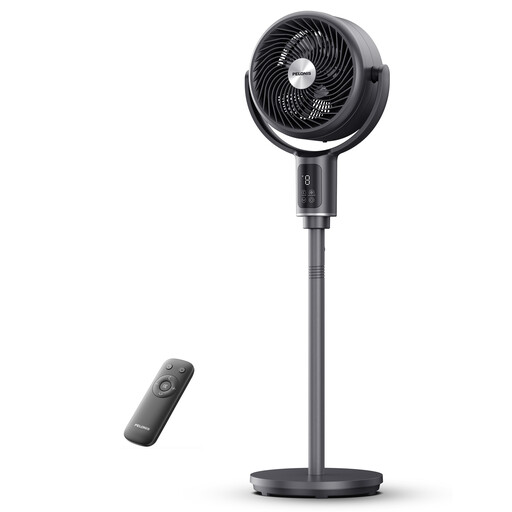
3. PELONIS Pedestal Circulator Fan

Why We Chose It: This quiet pedestal fan is one of the quietest in its class, offering an impressive combination of low noise, powerful air circulation, and very low energy consumption.
Key Features:
- Extremely Quiet: With a noise level of just 20 dB on its lowest setting, this model is virtually inaudible, ideal for the most sensitive sleepers.
- Energy-Efficient Fan: The DC motor consumes up to 65% less energy than conventional fans, according to the manufacturer.
- Wide-Angle Oscillation: Automatic 135° horizontal and 100° vertical oscillation ensure excellent air distribution in the room.
- Flexible and Adjustable: The height is adjustable, and with 9 speed levels plus a turbo mode, the airflow can be set with great precision.
- Convenient Features: Equipped with a 9-hour timer and a remote control for all functions.
Best For: The ultimate choice for those who prioritise absolute silence. This pedestal fan is perfect for the bedroom, living room, or an office where concentration is required.
View the PELONIS Pedestal Circulator Fan
Didn't Find What You Were Looking For? Explore More Options
The choice of a fan is personal and depends on the size of your space, your budget, and your specific needs. The models above are a starting point, but countless other variants are available, from compact table models to bladeless designs.
Explore our full range of bedroom fans for more options.
Frequently Asked Questions About Quiet Fans
1. What is a good dB level for a fan in the bedroom? For an undisturbed night's sleep, a noise level below 30 dB on the lowest setting is recommended. This is comparable to the sound of rustling leaves or a whisper and is not perceived as disruptive by most people.
2. Is an air circulator better than a regular fan? An air circulator isn't necessarily better, but it serves a different purpose. A standard fan creates a direct airflow for personal cooling. An air circulator is designed to move all the air in a room, leading to a more even temperature and better air quality. It is effective when used in conjunction with an air conditioner or heater.
3. How much energy does an energy-efficient fan consume? An energy-efficient fan with a DC motor is significantly more economical than a traditional model with an AC motor. Consumption on the lowest setting can be as little as 2-5 watts, whereas an AC fan can easily consume 30-50 watts. Over a year, this can make a noticeable difference on your energy bill.
Written by: Joybuy Product Recommendation Officer