For a busy school morning, check the ingredients, sugars per 100 g and preparation time. According to the Diabetes Fund, ‘sugar-free’ means no more than 0.5 g of sugars per 100 g. Quaker Oats Express Naturel and Protein, as described by Albert Heijn, contain 1 g and 1.2 g of sugars per 100 g respectively, so they are not sugar-free, even though they contain no added sugars. Before packing porridge for your child, also check the allergens on the packaging and the school’s rules.
Who is this choice relevant to?
Parents facing a rushed school morning
You want to make breakfast quickly at home or pack something simple, without unnecessary added sugar. A single-portion pack can save you measuring it out, but it doesn’t tell you anything about the sugar or allergens by itself.
Label readers looking to avoid added sugar
You want to know whether ‘no added sugars’ or the stricter ‘sugar-free’ claim is right for you. To check, compare the ingredients list with the sugars per 100 g.
Families with gluten or allergy requirements
You need to check whether the specific porridge is suitable for your child and whether the class or school has rules about bringing in allergens.
What should you look for when choosing?
First decide whether you’re looking for strictly sugar-free porridge or mainly want to avoid added sugar. Then compare how it’s prepared and check the allergens before packing it.
| What to look for | What to check before buying | Who it matters to |
|---|
| Sugar claim |
Read the ingredients list and compare ‘of which sugars’ per 100 g. According to the Diabetes Fund, ‘sugar-free’ means no more than 0.5 g of sugars per 100 g. |
If I want to avoid added sugar, I don’t want to assume that a product with no added sugar is also sugar-free. For around 36% of consumers, the sugar claim is the most important factor. |
| Preparation time |
Check how long it takes and whether you need hot water, a microwave or a pan. Albert Heijn gives a preparation time of two minutes for Quaker Oats Express Naturel. |
On a busy school morning, I want to know how much effort breakfast will take. Around 29% of consumers give quick preparation top priority. |
| Allergens and school rules |
Read the current allergen information. If you have coeliac disease, check for the gluten-free certification mark, and ask the school about its rules before packing it. |
If a child or classmate has a relevant allergy, I want to know what can be brought in safely. For around 21% of consumers, allergens and school rules come first. |
| Measuring out portions |
Compare a standard pack with portion sachets, and check the ingredients and nutritional information for both. Jumbo lists sugar as an ingredient in Havermout Porties Original. |
If I want to control the amount and ingredients myself, I don’t mind measuring it out. Around 14% of consumers choose mainly for this control over the basics. |
Common mistakes
-
Reading ‘no added sugars’ as ‘sugar-free’
These claims don’t mean the same thing. For example, Quaker Oats Express Naturel, as described by Albert Heijn, contains 1 g of sugars per 100 g, despite stating that no sugars have been added.
If you’re looking for something strictly sugar-free, compare the nutritional information with the maximum of 0.5 g of sugars per 100 g cited by the Diabetes Fund.
-
Assuming every portion sachet is unsweetened
Jumbo lists sugar as an ingredient and gives 10.7 g of sugars per 100 g for Havermout Porties Original. So the fact that it comes in portions doesn’t tell you whether sugar has been added.
For every variety, check both the ingredients list and the ‘of which sugars’ figure per 100 g.
-
Packing ordinary oats without checking the allergens
According to the Netherlands Nutrition Centre, ordinary oats aren’t automatically suitable for people with coeliac disease. Quaker Oats Express Naturel may also contain soya, barley and wheat; individual rules about allergens may apply in the classroom.
Read the current packaging, look for the official Crossed Grain symbol if you have coeliac disease, and ask the school what’s allowed.
Brands to compare
Quaker
Oats Express includes quick-to-prepare porridge varieties, including Naturel and Protein.
- Albert Heijn gives a preparation time of two minutes and 1 g of sugars per 100 g for Oats Express Naturel.
- The Protein variety contains soya and, according to Albert Heijn, 1.2 g of sugars per 100 g. Neither of these varieties is therefore sugar-free.
Brinta
Porridge made with fine flakes for those who want to measure out their own portions and cook them warm.
- Jumbo lists 100% oat flakes as the ingredient in Brinta Havermout and gives 0.8 g of sugars per 100 g.
- If you have coeliac disease, check the packaging for the gluten-free certification mark; according to the Netherlands Nutrition Centre, ordinary oats aren’t automatically suitable.
Albert Heijn
The range includes fine wholegrain oat flakes and a separate porridge variety labelled gluten-free.
- AH Volkoren havermout fijne vlokken states that it contains 0 g of added sugars and 0.7 g of sugars per 100 g.
- The fine flakes aren’t sugar-free. If you have coeliac disease, check the certification mark on the packaging of the separate gluten-free variety.
Jumbo
Offers porridge in standard packs and individual portions, among other options.
- Portion packs mean you don’t have to measure out each serving yourself.
- According to Jumbo, Havermout Porties Original contains sugar as an ingredient and has 10.7 g of sugars per 100 g. So be sure to compare the specific variety.
Golden Bridge
ALDI Netherlands lists Golden Bridge Fijne volkoren havermout in a 500 g pack.
- Fine porridge is an option if you want to measure out your own portions.
- Check the current packaging for this variety before deciding based on its ingredients, sugars or allergens.
A quick porridge option at Joybuy
This Quaker Protein variety suits a school morning when quick preparation and no added sugars are important. The sugars it contains and soya as an ingredient are still worth bearing in mind.
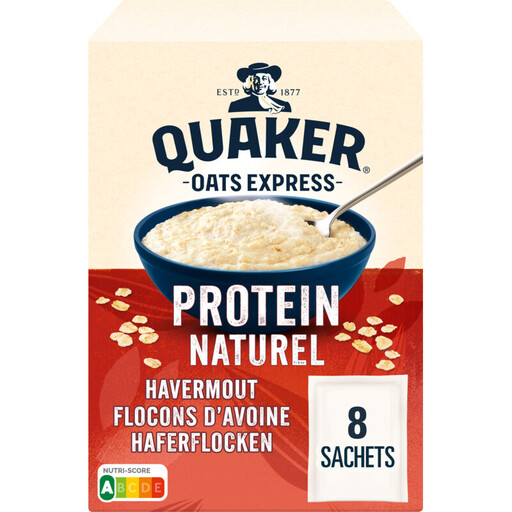 Image unavailable
Quaker Oats Express Protein 302 g
For mornings when you want to prepare porridge in two minutes and avoid added sugars.
Albert Heijn gives 22 g of protein and 1.2 g of sugars per 100 g for this variety. So the porridge isn’t sugar-free. The product contains soya; also check the current allergen information before packing it for your child.
View at Joybuy
Frequently asked questions
Is porridge with 1 g of sugars per 100 g sugar-free?
No. The Diabetes Fund defines ‘sugar-free’ as no more than 0.5 g of sugars per 100 g. Porridge with 1 g of sugars per 100 g may still contain no added sugars; check the ingredients and the claim on the packaging to confirm.
Is ordinary porridge suitable for a child with coeliac disease?
Not necessarily. According to the Netherlands Nutrition Centre, oats are suitable for people with coeliac disease only when the official Crossed Grain symbol appears on the packaging. So check the specific product, even if it’s sold as oats.
Should I ask the school about its rules on allergens?
Yes, if the child or a classmate has a relevant food allergy. Allergie op School explains that schools can agree which allergens must not be brought in. Before packing it, ask what rules apply to the class and check the porridge packaging.


