
The busy BBQ host
Wants to make porridge quickly before getting ready for guests, with a short cooking time and minimal measuring.


For a quick breakfast while you’re getting ready for a BBQ, first compare the fibre per 100 g of dry oats, then check how much one portion provides. Sachets save you measuring time; loose oats give you more flexibility for several bowls or recipes. Check the ingredients and allergens for both, especially if you’re also keeping an eye on sugar or protein.
Wants to make porridge quickly before getting ready for guests, with a short cooking time and minimal measuring.
Wants to compare the nutritional values per 100 g and per portion, rather than choosing based solely on a claim on the front of the pack.
Wants to use porridge oats for several breakfast bowls, overnight oats or bakes, and weigh up whether a larger pack is more convenient than individual sachets.
Start with the nutritional information for the dry product. Then decide which portion size and preparation method suit your plans, and finish by reading the ingredients list.
| What to consider | Check | Who it matters to |
|---|---|---|
| Fibre per portion | Compare the fibre per 100 g of dry product, then check the amount in your portion. Don’t compare values for dry oats with those for prepared porridge. | If fibre is my main priority, I want to know what’s actually in my bowl. For around 27% of consumers, this comparison comes first. |
| Preparation and portions | Check the preparation time, how much liquid you need and whether the amount is already measured out. | When I’m getting ready for guests, I want to be able to make a set portion quickly. This convenience matters most to around 33% of consumers. |
| Ingredients and allergens | As well as fibre, check the ingredients and protein content. Look out for added sugar and soya, for example, if they’re relevant to your choice. | If you’re also considering protein or the ingredients, don’t rely on the product name alone. For around 20% of consumers, this is their first consideration. |
| Pack size | Compare the pack size, number of portions and storage instructions with how often you plan to use the oats. | For several breakfast bowls or recipes, I want to have enough in the cupboard without having to open individual sachets each time. Around 20% of consumers give this priority. |
A claim on the front of the pack doesn’t tell you how much fibre one portion contains. A protein variety may also have different ingredients from regular porridge oats.
Compare the fibre per 100 g and the portion size, then check the ingredients and allergens.
A value for a bowl made with milk has a different basis from a value per 100 g of dry oats. For example, Albert Heijn lists 3,9 g of fibre for a prepared portion of Brinta Porridge Oats made with semi-skimmed milk.
First compare values on the same basis, then check what’s in your usual portion.
Offers both regular porridge oats in larger packs and Oats Express portions for quick preparation.
Brinta Porridge Oats is an option if you want to make your own bowl with fine oat flakes.
The own-brand range includes wholegrain protein porridge oats for anyone who also wants to compare protein content.
The own-brand range includes regular wholegrain porridge oats and pre-portioned varieties.
ALDI lists fine and coarse wholegrain porridge oats from GOLDEN BRIDGE as options you can portion yourself.
These products include two Quaker Express varieties for quick preparation and Brinta porridge oats with fine flakes that you can portion yourself. Choose a variety based on the ingredients and nutritional information on the pack.
 Image unavailable
A good choice if you’d rather use a portion sachet than measure out oats yourself while you’re getting ready.
The product description lists twelve portions and a two-minute preparation time. To compare fibre, check the values per 100 g and per sachet on the pack; also check the allergen information.
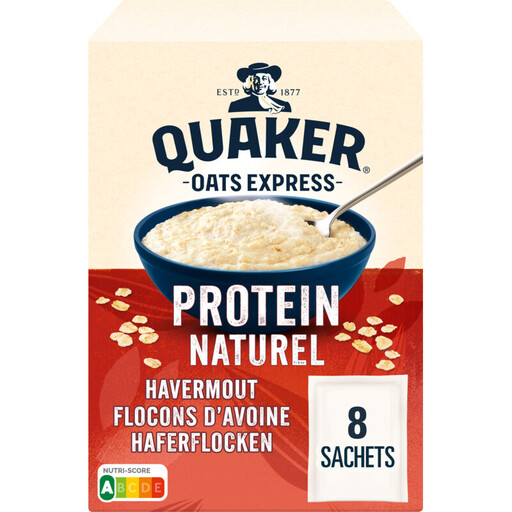 Image unavailable
For anyone who wants to consider protein content as well as fibre in a quick-to-prepare porridge.
This Express Protein variety lists 7,2 g of fibre and 22 g of protein per 100 g. Its ingredients include soya protein; check the pack for fibre per portion and the latest allergen information too.
 Image unavailable
Ideal if you want to measure out your own portions and are looking for a simple base for hot porridge.
According to the product information, Brinta Porridge Oats are made from 100% extra-fine oat flakes. When comparing fibre, only compare nutritional values on the same basis: a value for porridge made with milk isn’t the same as a value per 100 g of dry flakes.
First compare the values per 100 g of dry product, then check the amount in the portion you make. Albert Heijn lists 9 g of fibre per 100 g for Quaker Oats Express Natural, while a 27 g sachet provides 2,4 g of fibre; values for a prepared bowl made with milk are based on something different.
Yes. According to Jumbo’s product information, Quaker Porridge Oats 600 g takes around two minutes to cook after adding it to boiling milk or water. You’ll need to measure out the amount you want yourself, unlike with a portion sachet.
No, compare these nutritional values separately. Quaker Express Protein lists 7,2 g of fibre and 22 g of protein per 100 g, compared with 9 g of fibre per 100 g for Quaker Oats Express Natural. The protein variety also contains soya.