
Vandaag of morgen in huis

Kwaliteit gegarandeerd

Welkomstaanbiedingen ontgrendelen: GRATIS bezorging | Tot 80% korting | Gratis 30 dagen JoyPlus-proefperiode
Download de app
As a serious gamer, you know that every millisecond counts. You're looking for a competitive edge, whether in a competitive shooter or the immersive world of an open-world RPG. Blurry motion, washed-out colours, or slow response times can be the difference between victory and defeat. The rise of the QD-OLED gaming monitor promises to put an end to this. But with terms like 500Hz, 4K, and HDMI 2.1, it's hard to cut through the marketing noise.
This article is intended as a practical guide. We'll explain the most important specifications and highlight several popular choices, so you can make an informed decision that fits your gaming setup and playstyle.
Before we look at specific models, it's helpful to understand a few key specifications. This will help you determine what's important for you.
For competitive gamers, these are the most important numbers. The refresh rate, expressed in Hertz (Hz), indicates how many times the image is updated per second. A higher value results in a smoother image. While 144Hz was the standard for a long time, we now see models with 240Hz and even 500Hz. This provides extremely sharp visuals, even in the fastest action scenes.
The response time (ms) measures how quickly a pixel can change colour. QD-OLED panels have a major advantage here, with response times as low as 0.03ms. This virtually eliminates all 'ghosting' or motion blur, which is essential for an esports monitor where every frame counts.
The choice of resolution and size depends on your preference and the power of your PC or console.
For console gamers with a PlayStation 5 or Xbox Series X, an HDMI 2.1 display is a key consideration. This standard is necessary to unlock the full potential of the consoles: gaming in 4K resolution at 120Hz. Additionally, HDMI 2.1 supports Variable Refresh Rate (VRR), which prevents screen tearing and ensures a smoother picture. It's also a future-proof connection for PC gamers.
Based on specifications and various use cases, we have selected a few interesting MSI OLED monitor models.
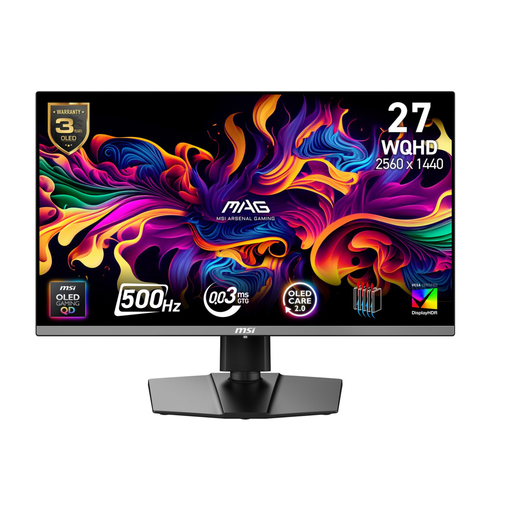
Why This Model Stands Out This monitor is built for pure speed. With a refresh rate of 500Hz and a response time of 0.03ms, this model is aimed at the most competitive esports athletes. According to MSI, the third-generation QD-OLED panel delivers extremely bright and fluid visuals.
Pros
Who is this for? For the serious, competitive gamer who plays fast-paced games like Valorant, CS2, or Apex Legends and seeks every possible performance advantage. Speed is the absolute priority here.
View the MSI MAG 272QP QD-OLED X50
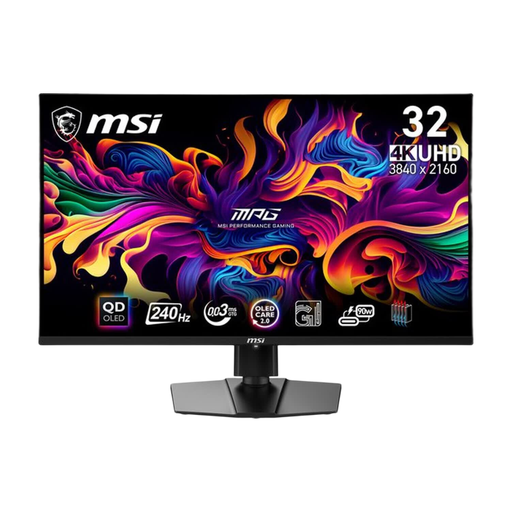
Why This Model Stands Out This model combines a large 31.5-inch screen with a razor-sharp 4K resolution and a fast 240Hz refresh rate. It's an all-rounder for those who want both visual splendour and high performance.
Pros
Who is this for? For the all-round gamer with a powerful PC or next-gen console. Perfect for those who want to enjoy the graphical beauty of single-player adventures in 4K, but also want the speed of a 240Hz screen for multiplayer games.
View the MSI MPG 321URX QD-OLED
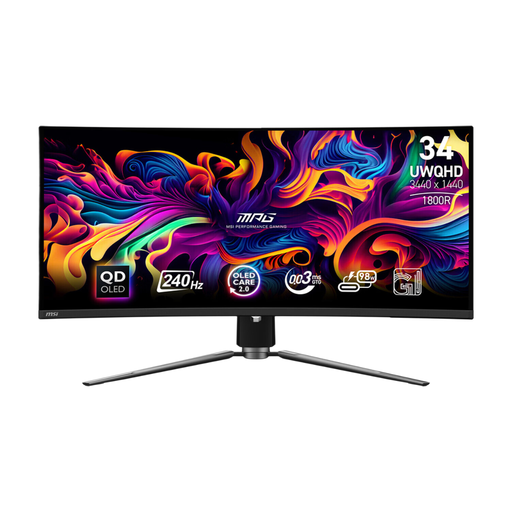
Why This Model Stands Out The MPG 341CQPX is an ultrawide gaming monitor that pulls you completely into your game. The 34-inch curved (1800R) screen with a 21:9 aspect ratio fills your field of view for an immersive experience, combined with the speed of 240Hz.
Pros
Who is this for? For gamers who love immersion. Ideal for racing sims, flight simulators, and open-world RPGs where a wide field of view enhances the experience. Also great for productivity thanks to the extra screen real estate.
View the MSI MPG 341CQPX QD-OLED
If your ideal match isn't listed here, or if you're specifically looking for a different size or brand, the market for high-end monitors is constantly evolving. For a broader overview of screens with comparable image quality, you can browse our full assortment.
? Discover more OLED 4K monitor models
QD-OLED (Quantum Dot Organic Light Emitting Diode) combines the benefits of OLED and Quantum Dot technology. Like OLED, each pixel can be turned off individually, resulting in perfect black levels and an extremely high contrast ratio. According to manufacturers, the Quantum Dot layer provides a wider, more accurate colour gamut and higher peak brightness compared to traditional WOLED panels.
Burn-in is a known risk with OLED technology, where static images (like taskbars or game HUDs) can leave a permanent shadow after prolonged display. Manufacturers are aware of this. Modern screens, such as the MSI OLED monitor models, are equipped with protective features. MSI calls this OLED Care 2.0, which consists of techniques like pixel shifting and periodic 'pixel refresh' cycles to extend the panel's lifespan. It is still advisable to follow the manufacturer's guidelines.
To get the most out of your console, the answer is largely yes. HDMI 2.1 is the only standard that provides the bandwidth for gaming in 4K resolution at a 120Hz refresh rate. It also enables features like Variable Refresh Rate (VRR), which synchronises communication between the console and the display to prevent stuttering and screen tearing. Without HDMI 2.1, you are often limited to 4K 60Hz or 1080p 120Hz.
