
Creator filming their hands and the puzzle together
Wants to show from a fixed angle where the pieces are placed, without moving hands obscuring the relevant area for too long.


An adjustable ring light suits a compact puzzle area and a fixed camera set-up, provided the camera, light and moving hands all fit above the table. For shiny pieces, or when you need to keep the puzzle's texture visible, a movable light beside the camera may be a better choice, though it takes more adjustment. Record a test video with the existing workshop lighting on. If you choose an electric ring light, also check the CE marking on the specific version.
Wants to show from a fixed angle where the pieces are placed, without moving hands obscuring the relevant area for too long.
Wants to keep details and edges clear while limiting distracting reflections on the pieces or work surface.
Needs to position and put away the light, camera and power supply so the puzzle area and walkways remain usable.
Choose this set-up when: you’re filming a compact puzzle area from a fixed angle and even lighting is important.
Consider: front lighting can make texture less visible. Also check for reflections and make sure there’s room for the camera and your hands.
Choose this set-up when: you want to adjust the angle of the light to show shiny pieces or puzzle edges more clearly.
Consider: it takes more adjustment to find the right position, and side lighting can create more noticeable hand shadows. Test the angle with the puzzle itself.
First decide on your preferred camera angle, then check for reflections, mounting options and the space around the shared workbench. Finish by recording a test video with the existing workshop lighting on.
| What to consider | What should you check? | Who prioritises this? |
|---|---|---|
| View of the puzzle and hands | Film the whole puzzle area while moving pieces; check that the edges remain visible. | If I want to show both the process and the puzzle without my hands covering the image for too long, visibility comes first. Around 31% of consumers prioritise being able to see the process. |
| Reflections and details | Film one shiny piece and one matt piece, then compare reflections and edges from your chosen camera angle. | If my puzzle pieces are shiny, I want to show the details without distracting reflections. Around 25% of consumers give reflection control top priority. |
| Mounting and workspace | Check the camera angle, mounting, available space, power supply and exact package contents. | If I share a workbench, the light and camera need to fit without blocking the puzzle area or walkway. Around 25% of consumers prioritise a set-up that fits their space. |
| Colour and video recording | Compare colours in a test video and check the recorded footage for banding or flicker. | If I want to show puzzle colours consistently, I need to assess the lighting and white balance together in the recording. Around 19% of consumers give colour and recording consistency top priority. |
A stated tripod height and phone holder don’t prove that the camera can be suspended securely and straight above the puzzle.
For the exact set, check the phone holder’s position, stability and the space for your hands from your preferred camera angle.
You may need a suitable separate overhead arm or mount.
Even front lighting and controlling reflections are two different aims. A reflection can obscure details.
Record a test video of shiny pieces and their edges. If necessary, move the light and compare different angles.
The list published by 5Top.nl on 29 September 2025 placed the Falcon Eyes DVR-384DVC at number 3. Benel says this model is no longer available, so its previous ranking says nothing about current availability.
Compare the named model only under its own name, and check any other Falcon Eyes model separately.
The Groningen set is an option if you’re looking for a ring light supplied with a floor stand and phone holder.
The RH10B and RL-18 differ in size and how you adjust the light colour, among other things. Compare the set with the space available on your table.
The U200 is a ring-shaped video light for anyone who often moves their set-up or wants to work at the table without a cable.
The LR150 is a ring light with manual light settings and mains power, designed for a fixed filming spot.
The DVR-384DVC is an example of a ring light with adjustable colour temperature and a mounting bracket. Check other models separately.
This selection includes phone ring lights, a clip-on desk lamp and a portable COB video light for filming at a shared workbench. The NVWA states that CE marking is compulsory for electrical consumer products placed on the market in the Netherlands. Check the marking on the specific version.
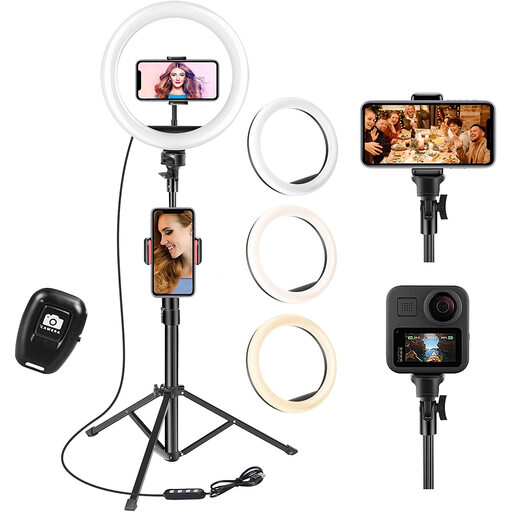 No image available
Could suit phone videos if there’s room for a floor stand at the shared workbench.
The set lists a phone holder, remote control and a tripod adjustable from 44 to 156 cm.
The description lists 3 colour temperatures and 10 brightness levels. Check that the holder allows you to position the camera at your preferred angle above the puzzle.
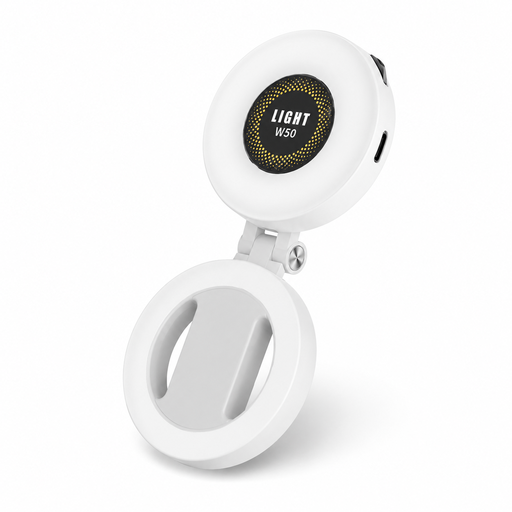 No image available
Could suit phone videos if the magnetic mount is compatible with your phone.
The product description mentions a mirror, CRI 95+, 360° rotation and 3 colour temperatures.
Check compatibility with your phone and the position you want before choosing your set-up.
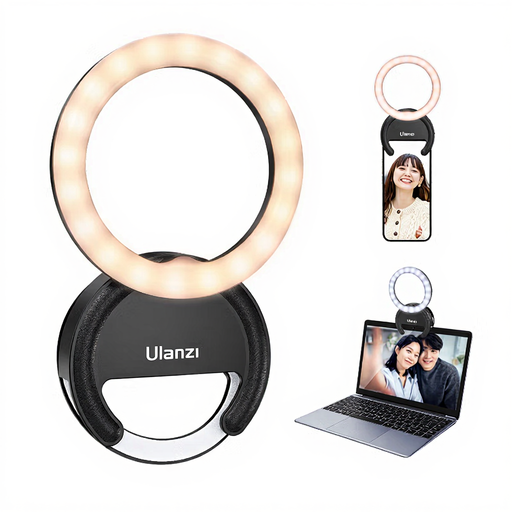 No image available
Could suit phone videos if you want to attach the light directly to a compatible smartphone.
The product name lists 3 colour temperatures from 3000–7000 K and 5 brightness levels.
Check that the clip fits your phone and that the light leaves enough room for your hands from your preferred camera angle.
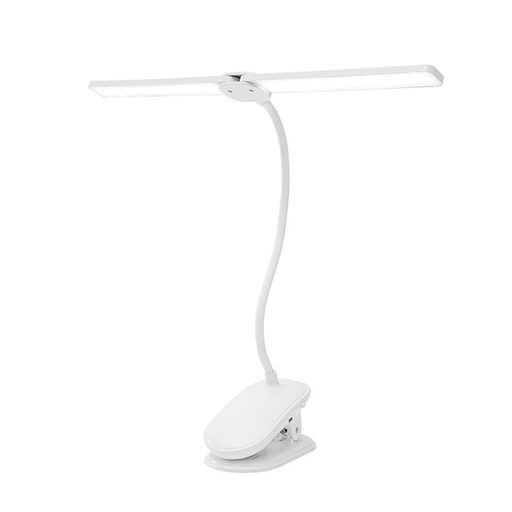 No image available
Could work if you can attach a clip to the shared workbench and want to position each light head separately.
The description lists 3 colour modes, dimming, flexible goosenecks and a rechargeable battery.
The clip is described as suitable for surfaces up to 5 cm thick. Check that it fits your table.
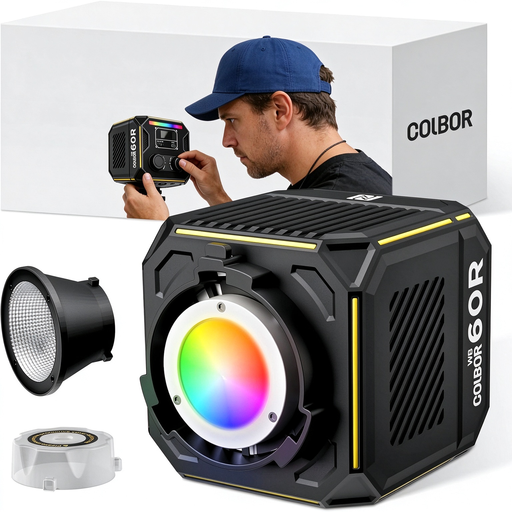 No image available
Could suit you if you’re looking for a portable video light with adjustable colour temperature rather than a ring light.
The product description lists a built-in 59 Wh battery and a range of 2700–6500 K.
When running on battery at 60 W, the description states a runtime of one hour. This requires a 60 W PD charger at 20 V/3 A; the supplied cable is USB-C to USB-C.
The stated tripod height alone won’t tell you. For the exact set, check the phone holder’s position, stability and the space for your hands from your preferred camera angle.
A movable light beside the camera may be more suitable if you want to adjust the angle to reduce reflections or make the edges visible. Test the angle with your own puzzle, as the result depends on the pieces and the camera set-up.
Record a test video with the workshop lighting and your intended lamp on together. Set the white balance for that lighting, then check the colours and the recording for flicker or horizontal banding. A preview on screen alone isn’t enough.
The NVWA states that CE marking is compulsory for electrical consumer products placed on the market in the Netherlands. Check the marking on the specific version. A model specification or a listing in a ranking doesn’t confirm it on its own.
For a distance purchase from a business, consumers generally have a 14-day cooling-off period, according to the Dutch government. Separately, if a product is faulty, you’re entitled to a product that works properly. The Netherlands has no fixed statutory guarantee period, and the retailer is your point of contact.