
Vandaag of morgen in huis

Kwaliteit gegarandeerd

Welkomstaanbiedingen ontgrendelen: GRATIS bezorging | Tot 80% korting | Gratis 30 dagen JoyPlus-proefperiode
Download de app
Puppies grow quickly. That means choosing dog food for puppies is not simply a matter of taste or price. The right choice depends on age, expected adult size, ingredients and daily quantity. At the same time, terms such as “grain-free”, “natural” and “high in meat” do not always make comparison easier.
As a Joybuy Product Recommendation Officer, I filter the most important information from product descriptions so that you can compare products with confidence. Below, you’ll find what to look out for, which pitfalls commonly arise and which puppy foods suit different situations.
Grain-free puppy food contains no grains, but that alone says nothing about its overall nutritional value. Grains may, for example, be replaced with sweet potato, peas, chickpeas or lentils. Always check whether the product is described as complete puppy food and whether a clear nutritional analysis is provided.
A grain-free formula may suit a particular preference or dietary situation, but it is not automatically necessary for every puppy.
A high percentage of crude protein may sound appealing, but you should also look at fat, calcium, phosphorus, fibre and the recommended serving size. Puppies need more than just protein. Controlled growth is particularly important for large breeds; overfeeding can lead to unnecessary weight gain.
Therefore, compare the label per 100 grams as well as the daily feeding guide. A bag with a high protein percentage may still work out more expensive if your puppy needs a large portion.
Puppy food for small breeds, medium breeds and large breeds often differs in kibble size, energy content and feeding guidelines. Kibble suitable for a small jaw is not automatically practical for a large dog. With large breeds, you also need to pay particularly close attention to the feeding guide and expected adult size.
Please note: seeing “puppy” on the front of the pack is not enough. Look for a clear indication such as mini, medium, maxi, large breed or a comparable breed-size category.
Choose food that suits your puppy’s age and expected adult size. Check:
For example, a product for medium- to large-breed puppies is not automatically the right choice for a Chihuahua. Conversely, mini kibble may be less practical for a rapidly growing large dog.
The most important values on the label are:
Farmina N&D Prime Chicken Puppy Mini, for example, lists 36% crude protein, 22% crude fat, 1.10% calcium and 0.91% phosphorus. Farmina N&D Prime Chicken Puppy Medium/Maxi lists 34% protein, 18% fat, a minimum of 0.60% calcium and 0.50% phosphorus. These are verifiable details from the product information, not a guarantee of a particular result.
Review the ingredients list together with the nutritional analysis. “Chicken puppy food” may contain different forms of chicken, such as fresh chicken, dried chicken, chicken fat or chicken meal. This is not necessarily good or bad, but it is relevant when comparing products.
Also check:
According to the product information for several of the brands mentioned, a transition period of approximately one week is recommended. Introduce new food gradually and monitor your dog’s reaction. If symptoms persist or you have concerns about growth or weight, consult a vet.
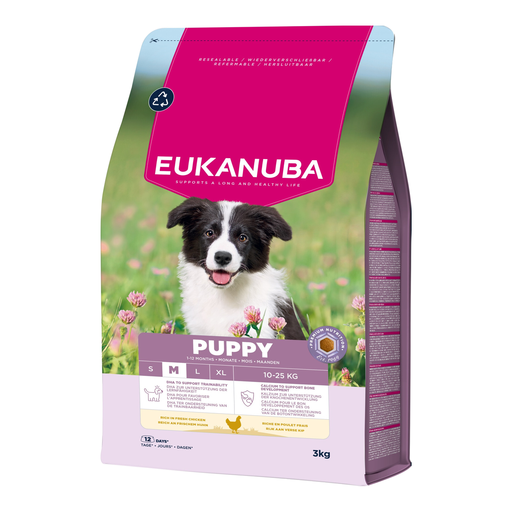
Why it suits this profile: The 3 kg size is practical if you want to see how your puppy responds to a new dry food without buying a large bag straight away. According to the product information, this variant is intended for medium-sized puppies aged 1 to 12 months.
The breed size and life stage are clearly specified. This means you do not have to rely solely on the general term “puppy”.
3 kg pack; chicken listed as a protein source; product information mentions DHA, calcium, omega 3 and omega 6.
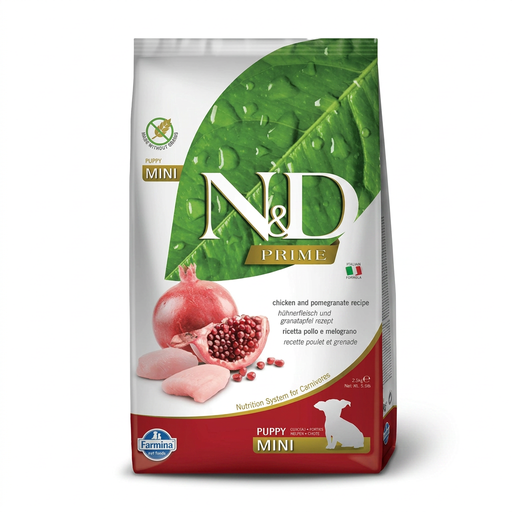
Why it suits this profile: This smaller pack is aimed at small breeds and, according to the label, contains ingredients including chicken, herring, chicken cartilage and nutritional additives. This makes the composition easy to assess for anyone who wants to compare products carefully.
The grain-free claim is supported by specific ingredients and analytical values, including 36% crude protein and 22% crude fat.
For small breeds; 2.5 kg pack; DHA, EPA, calcium, phosphorus and joint-related ingredients are listed.
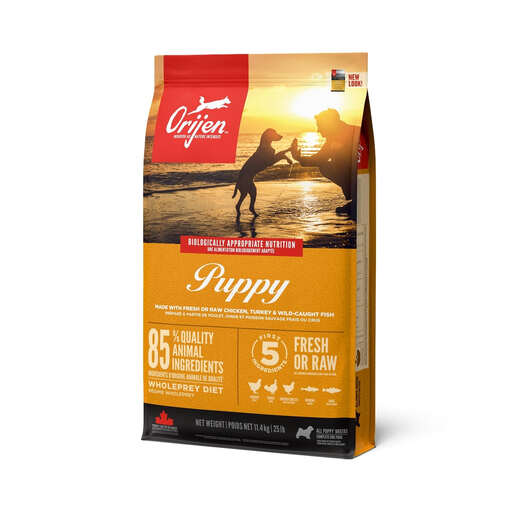
Why it suits this profile: The large bag is particularly practical for households with several dogs or for a puppy that will be eating the same dry food for an extended period. According to the product information, this food is intended for puppies of all breeds.
The product information specifies both the breed coverage and the analysis: 38% crude protein and 18% fat. This allows you to check whether the formula fits your feeding plan.
11.4 kg pack; chicken, turkey, egg and fish listed as ingredients; grain-free composition according to the product description.
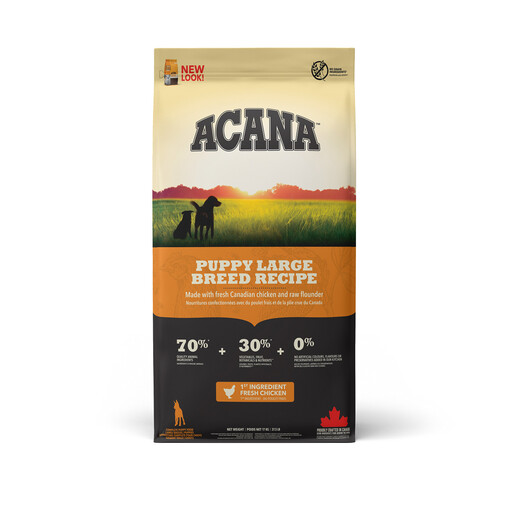
Why it suits this profile: According to the product information, this puppy food for large breeds is intended for dogs expected to weigh approximately 30 kg or more as adults. The large pack is suited to a consistent feeding routine.
The target group is linked to an expected adult weight. This is more specific than simply using a general puppy designation.
Aimed at large breeds; chicken, egg and flatfish are listed; 17 kg pack for regular use.
We’ve put together a complete, up-to-date list of products that fully meet these strict selection criteria and the applicable European safety regulations.
Please note that wet food for adult dogs, dog treats and cat food are not substitutes for complete puppy food. Products such as CESAR Chicken Dog Food 300g are also intended for adult dogs according to the product information and are therefore not suitable as a puppy’s main food.
This depends on the expected adult size. Small dogs may switch to adult food earlier than large breeds, which continue growing for longer. Follow the age guidance on the packaging and, if you are unsure, discuss the changeover with your vet.
Mix the old and new food gradually. A practical schedule is to feed mostly the old food for several days, then progressively increase the amount of new food until you have switched completely after approximately one week. Keep an eye on your puppy’s stools, appetite and weight.
Not automatically. Compare the ingredients, analytical values, pack size and daily feeding quantity. A more expensive product may offer a suitable breed size and a clear feeding guide, but price alone does not prove that it is a better fit for your puppy.
