What should you look for when buying?
Stick blender
Choose this if: you want to blend the prepared soup straight in the pan.
Bear in mind: you’ll need to operate and move the blender yourself; check that the instructions say it can be used with your soup.
Jug blender
Choose this if: you also want to blend other preparations in a jug and the specific model is suitable for hot ingredients.
Bear in mind: you’ll need to transfer the soup, and check the permitted temperature and filling capacity.
Heated blender or soup maker
Choose this if: a soup or keep-warm programme would be a useful extra step for you.
Bear in mind: if you’ve already roasted and cooked the pumpkin, you may not need all the cooking functions.
The percentages below relate to consumers choosing an appliance for this particular way of preparing soup. First choose the method that suits you, then check the temperature, capacity and cleaning instructions for the specific model.
| What matters |
What should you check? |
Who is this important for? |
| Blending without transferring |
Check whether the instructions say the model is suitable for your soup’s temperature. Keep the blending foot below the surface of the soup while blending. |
If the roasted pumpkin and stock are already in the pan, I don’t want to have to transfer hot soup. Around 36% of consumers prioritise blending in the pan. |
| Less washing up |
Check which parts you’ll need for the soup and how the instructions say to clean them. |
After eating, I want to clean as few separate parts as possible. Around 29% of consumers give easy cleaning their highest priority. |
| Hot soup and portion sizes |
Check the permitted temperature and usable capacity of the exact model you’ve chosen, not just the jug’s total capacity. |
If I’m making several bowls, I want to know whether the jug can hold that quantity while hot. Around 21% of consumers focus on a suitable jug and enough capacity for their portions. |
| Automatic preparation |
Check which soup or keep-warm programmes the model has, its filling limits and how to clean the appliance. |
Even if the pumpkin is already roasted, I might want to use a soup or keep-warm programme. Around 14% of consumers prioritise these automatic functions. |
Stick blenders at Joybuy
These Joybuy picks are stick blenders for anyone who wants to blend soup straight in the pan. For each model, check the instructions to make sure your soup’s temperature is permitted.
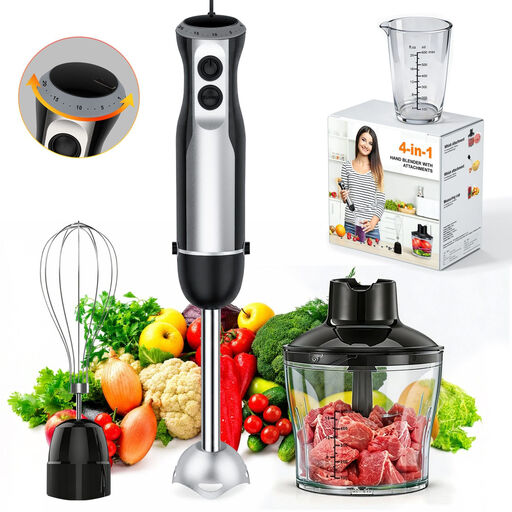 Image unavailable
1000 W stick blender, 4-in-1, with 20 speeds and turbo function
A stick blender is a good choice if you want to blend soup in the pan; check the instructions to make sure the model is suitable for your soup’s temperature.
The product name lists 1000 W, 20 speeds, a turbo function and a 4-in-1 design.
View at Joybuy
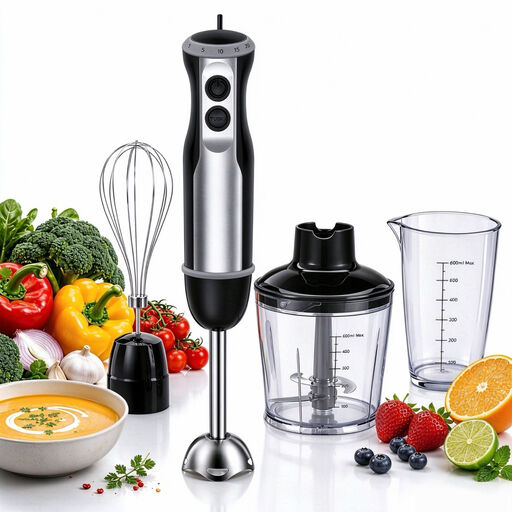 Image unavailable
Stick blender with 6 speeds and turbo function
A stick blender is a good choice if you want to blend soup in the pan; check the instructions to make sure the model is suitable for your soup’s temperature.
The product name lists 6 speeds and a turbo function.
View at Joybuy
 Image unavailable
Braun MultiQuick 5 MQ50001 stick blender, white
This stick blender is a good choice if you want to blend soup in the pan; check the instructions to make sure it can be used with your soup.
View at Joybuy
 Image unavailable
Ochama 600 W stick blender, 4-in-1, with whisk and chopper
A stick blender is a good choice if you want to blend soup in the pan; the extra attachments are useful if you also want to whisk or chop. Check the instructions before using it with hot soup.
The product name lists 600 W, 2 speeds, a 500 ml chopper and an 800 ml measuring beaker.
View at Joybuy
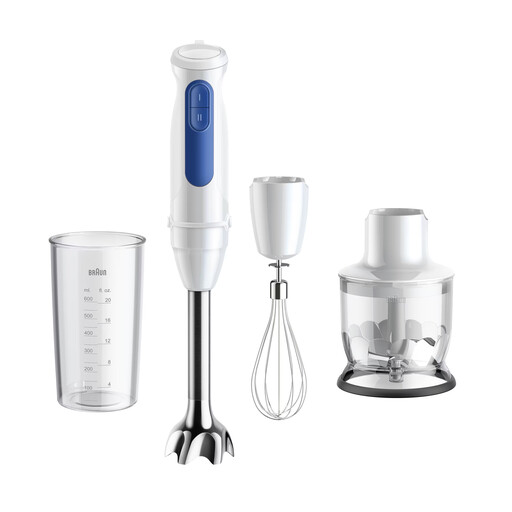 Image unavailable
Braun MultiQuick 5 MQ30202 stick blender, white
This stick blender is a good choice if you want to blend soup in the pan; check the instructions to make sure it can be used with your soup.
View at Joybuy
Frequently asked questions
Do you need to add liquid to roasted pumpkin in a pan before blending?
This isn’t a general requirement for appliances. In a Voedingscentrum recipe, the roasted vegetables go into a soup pan with water and stock, are cooked for a further 5 minutes and are then blended. Follow the instructions for your recipe and appliance.
Can you put boiling-hot pumpkin soup straight into any blender jug?
No. Check the instructions for the exact model. The Consumentenbond distinguishes between blenders with heat-resistant jugs; for some of the models mentioned, Philips recommends cooling ingredients to below 60 °C first, while for other models mentioned it only allows cold or room-temperature ingredients. This Philips guidance doesn’t automatically apply to other models.
How should you clean the appliance after use?
Follow the instructions for removing and cleaning the jug, blade or blending foot. Don’t immerse the motor unit unless the instructions expressly allow it. A cleaning programme, such as the one Kenwood lists for SoupEasy, doesn’t automatically replace all the recommended manual cleaning.
Does a blender sold in the Netherlands need to carry a CE marking?
For electrical kitchen appliances covered by the relevant EU rules, the manufacturer must carry out a conformity assessment, affix the required CE marking and draw up an EU Declaration of Conformity. The Netherlands Food and Consumer Product Safety Authority states that the Low Voltage Directive covers a rated AC voltage of 50–1000 V. Check whether the rules apply to the specific appliance; a CE marking is the manufacturer’s declaration and is not, by itself, an independent quality mark.
Should you buy an extended warranty, and who can help if the appliance is faulty?
In the Netherlands, you’re entitled to a product that works properly; if it’s faulty, the seller must provide a solution. According to the Dutch government, an additional warranty is most relevant when its terms offer something beyond the rights you already have.
How should you store leftover soup?
The Voedingscentrum recommends covering leftovers well and putting them in the fridge or freezer within 2 hours of cooking, once cooled. For your fridge, the Voedingscentrum recommends a temperature of 4 °C.


