
Cooking for a crowd in a large soup pan
You want to blend roasted pumpkin and stock straight in the pan, without transferring the soup. The Consumers' Association describes blending directly in the pan as a practical use for a stick blender.


If you want to blend roasted pumpkin straight in a large pan, a stick blender suits the job. Choose a jug blender if you’d rather blend the soup in a jug and the instructions for the exact model allow hot contents. A soup maker or blender with a heating function is worth considering if you also want to heat the soup in the appliance after roasting. Check the hot-fill limit, though: it may be lower than the capacity for cold ingredients.
You want to blend roasted pumpkin and stock straight in the pan, without transferring the soup. The Consumers' Association describes blending directly in the pan as a practical use for a stick blender.
You want an even texture and need to know how much soup the jug can hold per batch. Compare its usable capacity with the amount you’re making; the Consumers' Association points out that a blender jug must be suitable for hot ingredients.
You’re looking for an appliance that can heat as well as blend. Tefal and Philips list heating functions on specific models, so check the hot-fill limit for the version you’re considering.
A good fit if: you want to blend a large pan of soup directly and avoid transferring it.
The trade-off: hot soup can splatter. Keep the blending foot below the surface and follow the model’s instructions.
A good fit if: you want to blend soup in a jug and its usable capacity suits your portions.
The trade-off: you’ll need to transfer the soup and may have to blend it in batches. Check that the exact model can handle hot soup.
A good fit if: you want to blend and heat the soup in the appliance after roasting.
The trade-off: the hot-fill limit may be lower than the capacity for cold ingredients, so you may need to make several batches.
| What to consider | What to look for | Who should prioritise it? |
|---|---|---|
| Blending straight in a large pan | Check whether the blending foot is detachable, how to adjust the speed and what the manual says about hot soup. | When I’m cooking for several guests, I don’t want to transfer a full pan to a jug first. Around 36% of consumers say blending directly in the pan is their top buying priority. |
| Texture and portions per batch | Compare the usable capacity with the amount of soup you’re making, and check whether the hot-fill limit is lower. | I want smooth soup and enough room for a useful portion in each batch. Around 29% of consumers prioritise texture and portion capacity. |
| Handling hot soup as instructed | For the exact model, check the instructions on temperature, fill level, lid or ventilation, and starting speed. | When blending hot soup, I want to follow the recommended method rather than make assumptions based on the brand. Around 21% of consumers say handling hot soup is their top buying priority. |
| Heating in the appliance too | Check whether the model has a heating function, its hot-fill limit and whether you’ll need to make several batches. | If I want to heat the soup in the appliance after roasting, I look at the hot capacity, not just the jug capacity for cold recipes. Around 14% of consumers prioritise heating in the appliance. |
For the Tefal Blendforce Cook BL5768F0, Tefal lists a capacity of 1.2 L for hot recipes and 1.5 L for cold recipes.
Compare the amount of soup you’re making with the hot-fill limit for the exact model you’re considering.
The ErgoMaster MSM4B610 is a stick blender for blending in the pan, not a jug blender or soup maker.
The MultiQuick 7 MQ7025X combines a stick blender with a separate chopper and whisk.
The PerfectMix+ BL871D31 is a jug blender for hot and cold preparations; the Blendforce Cook BL5768F0 is a different range with a heating function.
Philips describes the Viva SoupMaker HR2204/80R1 as refurbished; it has heating programmes.
These Joybuy picks include stick blenders and jug blenders for blending soup. When making hot soup, always check the instructions and capacity limits for the exact model.
 Image unavailable
A jug blender for anyone who wants to blend soup in a jug; check the model’s instructions before using it with hot soup.
The product name lists a 1,500 ml blending jug, a 600 ml travel bottle and a 300 ml chopper cup. It also lists six stainless steel blades and 24,000 RPM.
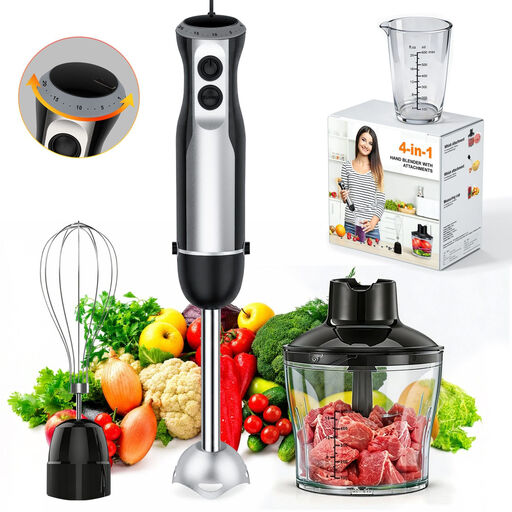 Image unavailable
A hand blender for anyone who wants to blend soup straight in the pan, without transferring it to a jug first.
The product name lists 20 speed settings and a turbo function. Follow the model’s instructions when blending hot soup.
 Image unavailable
A jug blender for anyone who wants to blend soup in a jug; check the BL871A instructions to see whether hot contents are allowed and under what conditions.
The product name lists 1200 W and a capacity of 1.5 L.
 Image unavailable
A jug blender for blending soup in batches; let hot liquids cool before blending them.
The product name lists a 1000 W motor and a 1.5 L jug. The product information states that ingredients must not be hotter than 80 °C.
 Image unavailable
A jug blender for anyone who wants to blend soup in a jug; check the model’s instructions before blending hot soup.
The product name lists a 1.4 L glass jug, five speeds and an ice-crushing function.
No, it depends on the model. For the HR3756/00, HR3752/00 and HR3868/00 vacuum blenders, Philips specifies cold or room-temperature ingredients; Tefal says the PerfectMix+ BL871D31 is suitable for hot preparations. Always follow the instructions for the exact model.
Follow the model-specific instructions before blending hot liquid. For the method described with hot liquid, KitchenAid recommends using a vented cap and starting at a low speed; don’t apply this to another model unless its instructions confirm it. Beko warns that hot soup can spill when using a stick blender. Check your manual to see which parts are dishwasher-safe.
A stick blender is suited to blending directly in the pan, while a jug blender requires you to transfer the soup first. The Consumers' Association describes blending in the pan as a practical use for a stick blender. Choose a jug blender only if its usable capacity and instructions for hot contents suit the way you’re cooking.
It depends on the model and whether you’re using hot or cold ingredients. For the Blendforce Cook BL5768F0, Tefal lists 1.2 L for hot recipes and 1.5 L for cold recipes; for the refurbished SoupMaker HR2204/80R1, Philips lists 1.2 L and four portions. Compare the hot-fill limit with the amount you want to make for your guests.