
Vandaag of morgen in huis

Kwaliteit gegarandeerd

Welkomstaanbiedingen ontgrendelen: GRATIS bezorging | Tot 80% korting | Gratis 30 dagen JoyPlus-proefperiode
Download de app
Pull-up nappies are handy when your baby is very active, finds nappy changes difficult or is moving on from baby nappies to getting dressed and undressed independently. But the range can be more complicated than it first appears. The wrong size can cause leaks, a large monthly box may prove impractical, and terms such as “extra dry” say little about how a product performs in everyday use.
As a Joybuy Product Recommendation Officer, I focus on the product details that matter in practice. This helps you compare pull-up nappies by size, weight, fit, absorbency, skin contact and pack size.
Age guidance is just a guide. Your child’s weight and build matter more. Children of the same age can have very different waist and thigh measurements. Always check the stated weight range, for example:
A nappy that is too tight can leave marks. If it is too loose, it may not fit snugly around the legs and could leak more easily.
Words such as “leak-proof”, “up to 12 hours’ protection” and “super absorbent” are not a guarantee for every situation. According to Pampers’ product information, the Baby-Dry core is designed to provide protection for up to 12 hours. This does not mean every child, every night or every amount of liquid will have the same result.
Claims about skin-friendliness should also be read carefully. Pampers states that several models are dermatologically tested, contain 0% EU fragrance allergens and are OEKO-TEX Standard 100 certified. These are verifiable product details, but they do not rule out individual skin reactions.
A monthly box of pull-up nappies can be convenient, but only if the size is likely to fit for a while. Children sometimes grow out of a size quickly. First work out how many nappies you use on an average day, then compare the price per nappy. A multipack with lots of nappies is not automatically better value if some go unused.
For pull-up nappies for active babies, an elasticated waistband and flexible sides are practical features. They help the nappy move with your baby as they crawl, walk and wriggle. Also check how to change the nappy: most styles are pulled up to put on, then the sides are torn open to take it off.
A good fit means:
An absorbent pull-up nappy usually has a core containing superabsorbent polymer, often referred to as SAP. This material absorbs moisture and holds it in the core. Wider leg cuffs, a flexible waistband and an extra pocket at the back can also help protect against leaks.
The product information for BC Babycare Royal Pants Size 4 states that they have a 460 g/m² composite core with 14.5 grams of SAP and a 360° leak-proof design. The recommended weight range is 9–14 kg. These details are more useful for comparing products than a general claim such as “ultra-dry”.
Parents looking for hypoallergenic pull-up nappies can check for fragrance, lotion, dyes and certifications. According to the product information, Pampers Harmonie Pants Size 4 are described as hypoallergenic, fragrance-free and lotion-free. OEKO-TEX Standard 100 certification is also mentioned.
If your child has sensitive skin, it’s still important to keep an eye on how their skin reacts. Stop using the product if irritation occurs and seek medical advice if needed. No material is automatically right for every child.

Why it suits this profile: A handy pack of 38 lets you try a size or brand without immediately buying a large supply.
The pack clearly states Size 4 and 9–14 kg, so you can check the fit before buying a monthly box.
According to the product description: 360° leak-proof design, a 14.5-gram SAP core and a soft, thermally bonded outer layer.

Why it suits this profile: A large pack is a good fit for families who already know the right size and use pull-up nappies regularly.
The product information gives Size 5 and a weight range of 12–17 kg. Check that this range is right before ordering the monthly box.
According to Pampers: wider leak guards, a Stop & Protect Pocket, a 360° waistband and 0% EU fragrance allergens.
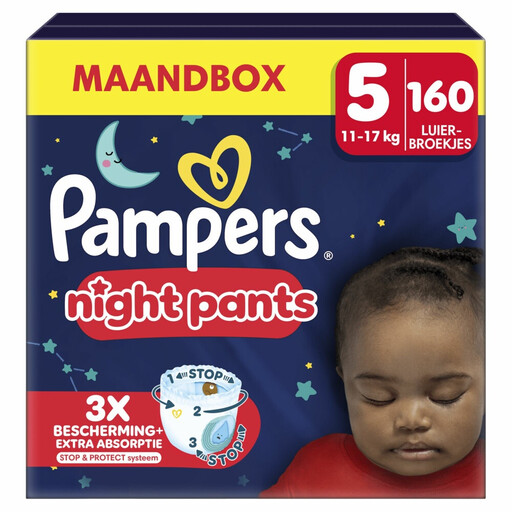
Why it suits this profile: Designed for families looking for extra absorbency at night and a secure fit around the back and legs.
This is a dedicated night-time style, so you don’t have to use a standard daytime version for every sleep.
According to Pampers, this model has an absorbent core, wider leak guards and a 360° waistband to move with your child at night.
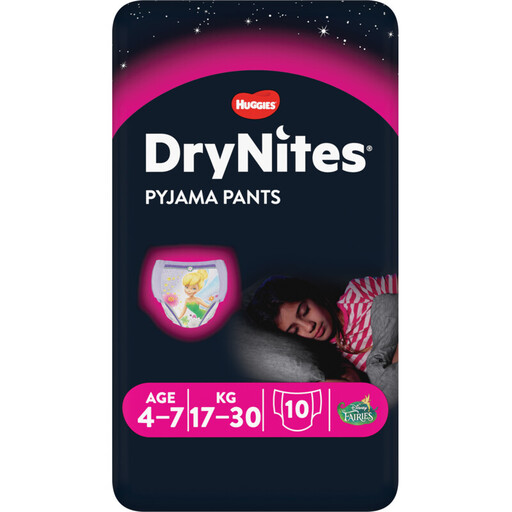
Why it suits this profile: These night-time pull-up nappies are designed for children aged 4–7 years and weighing 17–30 kg who are dry during the day but still need protection at night.
The age and weight range are clearly stated. Don’t choose this type based on age alone; check your child’s build and the fit too.
According to the product description: soft, stretchy outer layer, absorbent inner core, leak guards and an elasticated waistband.
We’ve put together a full, up-to-date list of products that meet these strict selection criteria and the applicable European safety regulations.
Before you check out, make sure you’ve checked:
Switching can be useful once your child is very active, standing or walking, and changing them while they’re lying down becomes difficult. Don’t look at age alone. Fit, weight and how comfortable your child is wearing the nappy are more important.
Pull-up nappies are single-use. Change them when they’re soiled or no longer absorb well enough. Always follow the instructions on the pack. A night-time style may be suitable for longer use while your child sleeps, but always use the product information as your guide.
It depends on the brand, size, pack and how many you use. Work out the price per nappy and compare it with standard nappies. A monthly box may bring down the cost per nappy, but it’s most worthwhile when the size fits well and you use the whole pack.
