
Budget-conscious meal planners
You’d rather start with regular porridge oats and choose what to add yourself. To compare the cost, look at the whole meal, not just the oats: a separate protein source also requires ingredients and preparation.


Choose regular own-brand porridge oats if you want to add your own source of protein and build your meal to suit your preferences. Protein-enriched instant oats are worth comparing when the protein in an actual serving fits with what else you eat; single-serve packs are convenient, but don’t automatically provide more protein.
You’d rather start with regular porridge oats and choose what to add yourself. To compare the cost, look at the whole meal, not just the oats: a separate protein source also requires ingredients and preparation.
You want to know how much a serving of oats contributes to what you eat in a day. The Voedingscentrum distinguishes between the needs of different sportspeople; a specialist protein product isn’t necessary for everyone.
You’re looking for a quick-to-prepare serving for home or work, but you also want to know which allergens it contains. Quaker lists soya in its protein varieties reviewed here, and milk in Pots Protein Naturel; always check the label of the product you buy.
First decide whether you want to build your own bowl, get more protein from the oats themselves, or simply have a consistent serving that’s quick to prepare.
Choose this if: you want to decide the serving size and other ingredients yourself.
Bear in mind: a separate protein source may need extra preparation or refrigeration.
Choose this if: the protein content of an actual serving fits with the rest of what you eat.
Bear in mind: the Quaker protein varieties reviewed here contain soya; Pots Protein Naturel also contains milk.
Choose this if: a set serving size and easy preparation are important to you.
Bear in mind: a pre-portioned pack gives you less flexibility to choose how much oats you have.
| What to consider | What should you check? | Who is this most important for? |
|---|---|---|
| Protein per serving | Compare protein per dry serving and per 100 g; count any ingredients you add separately. | If I’m tracking my protein intake, I want to know how much my usual bowl contributes. Around 36% of consumers put this first. |
| Value of the complete meal | Compare pack sizes and what else you’ll need for the prepared meal. | I like building my own bowl, as long as the extra ingredients fit into my shopping budget. For around 29% of consumers, the overall value of the meal is their main concern. |
| Ease of preparation | Check the serving size, preparation time and whether you’ll need water, milk or equipment. | On a busy morning, I want breakfast without having to weigh anything. This convenience comes first for around 21% of consumers. |
| Ingredients and allergens | Read the current ingredients list, allergen information and any statements about possible traces. | If I need to avoid certain ingredients, the label determines which oats I can consider. For around 14% of consumers, this is their main purchasing concern. |
A product name doesn’t tell you how much protein you’ll get from your own serving. What you mix into the oats also changes the nutritional content of the meal.
Check the nutritional information per serving, and only count milk, yoghurt or other additions if you actually use them.
A bag of regular porridge oats, a single-serve sachet and a cup won’t necessarily provide the same amount or make the same prepared meal.
Compare your usual serving and include any ingredients you’d add yourself.
Protein-enriched varieties may contain different ingredients from regular porridge oats. For example, Quaker lists soya in the protein products reviewed here, and milk in Pots Protein Naturel.
Check the current allergen information and, if you need to eat gluten-free, only choose a product that is explicitly labelled gluten-free.
Jumbo lists products including regular wholegrain porridge oats and single-serve packs. Check the ingredients and serving size for each product.
Albert Heijn lists its own oat products for quick servings and a protein variety, alongside products from other brands.
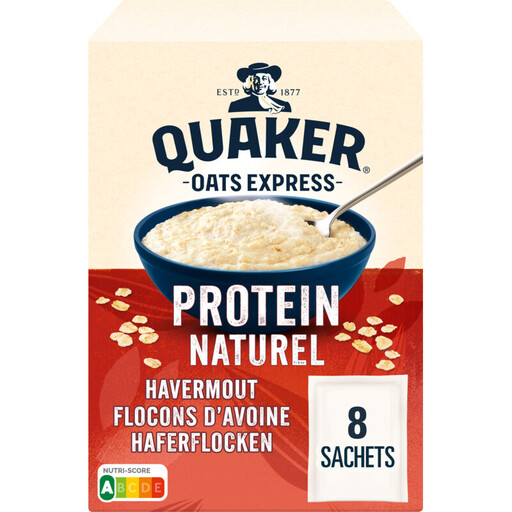
Quaker offers regular Oats Express servings, Oats Express Protein Naturel and Pots Protein Naturel; the format and ingredients vary by product.
Golden Bridge finely milled wholegrain oats are a regular oat base for anyone who wants to put together their own meal.
Lidl lists Healthy Fit Protein porridge oats as an option to compare with other protein-enriched oat products.
This Quaker pack is worth considering if you want to weigh up a protein-enriched oat option against regular porridge oats with your own addition. Check the actual serving size and ingredients before choosing.
 No image available
For anyone who wants to compare the convenience of a protein-enriched oat option with a bowl they put together themselves.
Check the protein per actual serving on the pack. Also read the allergen information for soya and check the statements about wheat and barley.
Not necessarily: consider how much protein you eat over the whole day before choosing a specialist product. The Voedingscentrum says that many sportspeople don’t need specialist protein products if their usual diet already provides enough protein.
First compare the amount of protein in the serving you actually use, then look at the nutritional value per 100 g. Count ingredients such as milk or yoghurt separately; the nutritional value of dry oats doesn’t automatically describe your prepared meal.
Check the current ingredients and allergen information for every product. The Nederlandse Voedsel- en Warenautoriteit explains that allergens must be clearly stated on the label of pre-packed foods; the protein varieties reviewed here include ingredients such as soya or milk.
No, don’t assume so without checking the label. If you need to eat gluten-free, choose a product that is explicitly labelled gluten-free and check the pack of the variety you buy.