
Vandaag of morgen in huis

Kwaliteit gegarandeerd

Welkomstaanbiedingen ontgrendelen: GRATIS bezorging | Tot 80% korting | Gratis 30 dagen JoyPlus-proefperiode
Download de app
A high-protein breakfast might seem easy to pick, but packaging can give an incomplete picture. A striking claim like “protein”, “crunchy” or “0% added sugar” doesn’t tell you everything about the nutritional value, composition or suitability for your daily routine.
When buying protein-rich muesli and granola, you’re most likely to come up against these three pitfalls:
For a fair comparison, start by looking at the values per 100g. Across the range, protein contents vary. Holie products such as Crunchy Muesli Protein Nuts list 22 to 23g of protein per 100g, while Granola Protein Crunch lists 20g. According to the product information, Quaker Oats Express Protein contains 22g of protein per 100g.
Fibre is also relevant if you’re looking for high-fibre breakfast cereals. Holie Crunchy Loops Cookies & Cream lists 26g of fibre per 100g. The Cinnamon variant comes in at 22g and the Crunchy Muesli Protein Nuts at 21g. These figures can be checked against the nutrition table, but they don’t automatically tell you which variant best suits your diet.
Also pay attention to the serving size. A bowl of 60g contains roughly 60% of the values listed per 100g. If you add yoghurt, milk, fruit or nuts, the total nutritional value of your breakfast changes.
Ingredients are usually listed in descending order by weight. For example, Holie Crunchy Muesli Protein Nuts consists of 43% wholemeal oats and 14% wheat protein, according to the product description. The mix also contains sunflower and pumpkin seeds, almonds and hazelnuts.
With Granola Protein Crunch, sunflower seeds (23%) are at the top of the list, followed by wholemeal oats, barley, soya and spelt. This makes this variant interesting if you’re looking for muesli with nuts and seeds, but do check the allergens.
A short ingredients list isn’t necessarily better, and a long list doesn’t automatically mean a product is unsuitable. Look instead at whether the composition matches your preferences: wholegrain cereals, nuts and seeds, chocolate, spices or a gluten-free alternative.
“0% added sugar” means that, according to the product information, no sugar has been added as an ingredient. It doesn’t mean the product contains no sugars. Holie Crunchy Muesli Protein Nuts, for example, lists 2.1 to 2.3g of sugars per 100g, depending on the nutrition table shown. Granola Protein Crunch lists 2.8g.
Also keep an eye on the fat content. Granola Protein Crunch contains 24g of fat per 100g, while Crunchy Muesli Protein Nuts lists 16 to 20g in the product information provided. That difference can matter when you’re comparing calories or portions.
Finally, always check the allergens. Wheat, oats, soya, peanuts, almonds and hazelnuts appear in several variants. Only trust “gluten-free” when it’s clearly stated on the product and matches your personal requirements. If in doubt, the label on the packaging is the deciding factor.
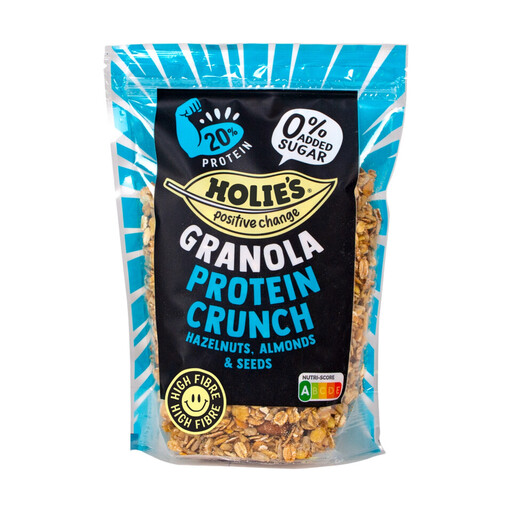
Why this fits the profile: A 350g pack is practical for trying out a flavour and texture first. This variant combines a crunchy bite with 20g of protein per 100g.
The product information lists both 0% added sugar and 2.8g of sugars per 100g. This means you can compare the claim against the table.
20g protein, 15g fibre and a composition with sunflower seeds, grains, soya, almonds and hazelnuts.
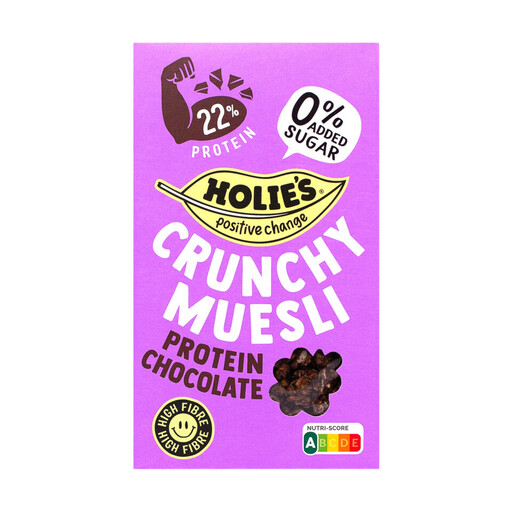
Why this fits the profile: Ideal for anyone who wants a chocolate flavour combined with wholemeal oats and a clearly stated protein value.
The product description mentions 0% added sugar, while the table shows 2.1g of sugar per 100g. So you can see the difference between the two terms.
22g protein, 21g fibre and 16g fat per 100g according to the product information; contains wholemeal oats, wheat protein and cocoa.
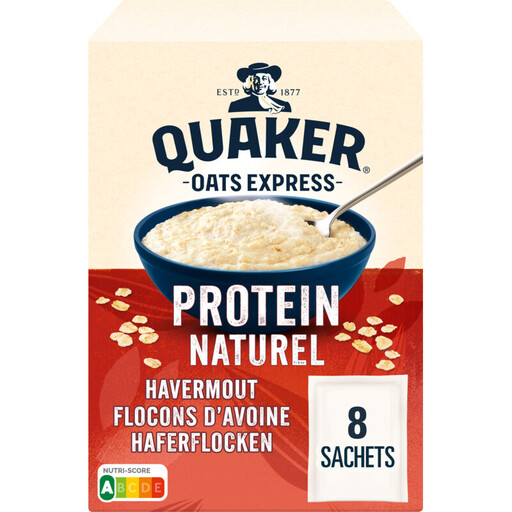
Why this fits the profile: A practical choice for busy mornings: according to the product description, the porridge is ready in around two minutes.
The composition is straightforward: 85% wholemeal porridge oats and 15% soya protein. So you can quickly see what you’re buying.
22g protein, 7.2g fibre and 1.2g sugar per 100g; can be made with hot water or milk.
If you’re mainly choosing crunchy muesli, pay attention to the combination of texture and nutritional values. For a chocolate flavour, a variant with cocoa or cocoa mass makes sense. If nuts and seeds are important to you, use the ingredients list to check how much is actually present.
If you want a granola with no added sugar, still compare the sugar content and total energy. If you have allergies or avoid certain grains, read the allergen information thoroughly. A multipack is handy when you already know the product and use it regularly; a single pack limits the risk of waste if you don’t like the taste.
We’ve put together a full, up-to-date list of products that fully meet these strict selection criteria and comply with current European safety regulations.
Muesli often consists of flakes, seeds and nuts without the mixture being heavily baked. Granola is usually baked, which can make the texture crunchier. Always check the ingredients and nutritional values; the name alone doesn’t determine the protein or sugar content.
No. Nuts, seeds and oil provide energy, even when no sugar has been added. So look at the calories, fats and serving size per eating occasion.
Store the packaging in a dry, cool place, well sealed, away from direct sunlight and moisture. Check the label for the best-before date and storage advice. This helps keep the crunchy texture for longer.
