Who is this buying guide for?

Viewer with limited space for positioning

You want to watch a recorded theatre performance on a large screen, but can only fit a projector on a unit near the wall. Start by checking the available wall width, the depth of the unit and the projection distance. BenQ Netherlands highlights that room size and distance to the screen are key factors.

Fan of dark scenes

You usually watch in the evening and want to make out faces, costumes and scenery, even in dark scenes. Compare picture settings in the lighting conditions you watch in at home.

Viewer with their own playback source

For example, you use a media player or computer for recordings or a streaming service, and want to check in advance how the picture and sound will work through the projector and any speakers.

What should you look for when buying?

Ultra-short throw

Choose this option: if the projector needs to sit on a unit close to the wall and the desired image width will fit there. The Epson EH-LS670B and LG PU615U are examples of models in this category.

Bear in mind: obstacles or an uneven wall can make it harder to adjust the screen. LG specifically notes this for the PU615U.

Short throw

Choose this option: if you can position the projector further from the wall and the calculations for the exact model give you the image size you want. BenQ lists a throw ratio of 0.69–0.83:1 for the TK710STi.

Bear in mind: short throw does not mean the projector can sit right against the wall. Also check whether the built-in sound suits your viewing set-up.

Conventional throw

Choose this option: if the measured distance from the lens to the projection surface and the position behind your viewing area work with a specific model.

Bear in mind: in a narrow living room, the distance required may limit the image width you can achieve. Compare the throw ratio of the exact model with your measurements.

What to consider What should you check? Who is this important for?
Will the image fit in the room? Measure the available wall width and the distance from the lens to the wall. Compare both with the throw ratio and installation details for the exact model. If you have limited space for positioning, you’ll want to know whether you can get the image you want from your unit. Around 29% of consumers say positioning is their main concern.
Dark scenes and stage details Compare the model’s picture modes and supported resolution, and view the image in the lighting you use at home. If you mainly watch in the evening, you’ll want to make out faces, costumes and scenery in dark scenes. Around 23% of consumers prioritise the stage image.
Playback source and sound Check that your source connects to the projector and find out which audio outputs or built-in speakers are available. If you watch recordings through a media player or computer, you’ll want the picture and sound to work together. Around 18% of consumers focus mainly on playback and sound.
Watching with ambient light Think about when you watch and compare brightness specifications on a like-for-like basis. Assess them alongside the image size and the amount of incoming light. If you can’t always darken the living room, you’ll want a comfortable viewing experience in those conditions too. Around 18% of consumers say ambient light is their main concern.
Running costs and service Compare model-specific information about the light source and servicing. Also check the warranty terms and your applicable statutory rights. If you plan to use the projector for a long time, you’ll want to factor in maintenance and support if something goes wrong. Around 12% of consumers prioritise running costs and service.

Buying pitfalls

  • Choosing based on the maximum screen size without measuring the room

    The image width you can achieve depends on the actual distance between the lens and the wall, as well as the exact model.

    Before you buy, measure the available wall width, the position of the unit and the possible projection distance. BenQ Netherlands recommends factoring in room size and projection distance when choosing a projector.

    You may need to change your set-up or use a more suitable projection surface.

  • Assuming an ultra-short-throw projector can be adjusted easily on any wall

    For the PU615U, LG warns that obstacles or uneven surfaces can make it harder to adjust the screen.

    Check the wall and the space around the unit before choosing an ultra-short-throw model.

    You may need to adjust the unit or the projection surface.

  • Assuming smart features give you access to every recorded theatre performance

    Availability may depend on the rights to a recording and how you play it. OperaVision, for example, notes that a performance is no longer available to watch once its temporary streaming rights have expired.

    For the specific recording, check which service or playback source you need and whether it connects to your chosen projector.

    If the recording isn’t available through the built-in software, you may need a separate playback source.

  • Assuming the manufacturer’s warranty covers all your rights after purchase

    A manufacturer’s warranty does not, by itself, determine how long your statutory rights apply if a product is faulty.

    Keep your proof of purchase and contact the retailer if a fault occurs that you wouldn’t reasonably expect during normal use.

Brands worth comparing

Epson

The EH-LS670B is an example of an ultra-short-throw model with built-in sound.

  • According to Epson, the EH-LS670B has 3.600 lumens and a 20 W 2.1-channel sound system.
  • These are manufacturer specifications for this model, not an independent assessment of all Epson projectors. Check that the wall and playback source suit your set-up.

BenQ

The TK710STi is an example of a short-throw projector for a set-up with more space between the projector and the wall.

  • BenQ specifies a throw ratio of 0.69–0.83:1, two HDMI inputs and one 5 W speaker for the TK710STi.
  • Check the stated throw ratio against your room measurements. Gaming features alone don’t indicate whether a projector is suitable for recorded theatre performances.

Optoma

The GT3500HDR is an ultra-short-throw example with Full HD as its stated resolution.

  • Optoma specifies a throw ratio of 0.253:1 and two HDMI 2.0 inputs for the GT3500HDR.
  • Optoma lists a noise level of 27 dB minimum and 34 dB maximum for this model. These are manufacturer specifications, not independent measurements or statements about the brand as a whole.

LG

The CineBeam S PU615U is a compact ultra-short-throw option that LG shows positioned close to the wall.

  • LG states that the PU615U can project a 100-inch image from 39,3 cm.
  • According to LG, this model has no built-in battery. Obstacles and uneven surfaces can make it harder to adjust the screen. The stated distance is not a general positioning measurement for other LG projectors.

Projectors at Joybuy

These are home projectors with different positioning and playback options. Compare the stated features with your room, check that the projector connects to your playback source, and consult the product safety information and applicable CE marking for the exact model.
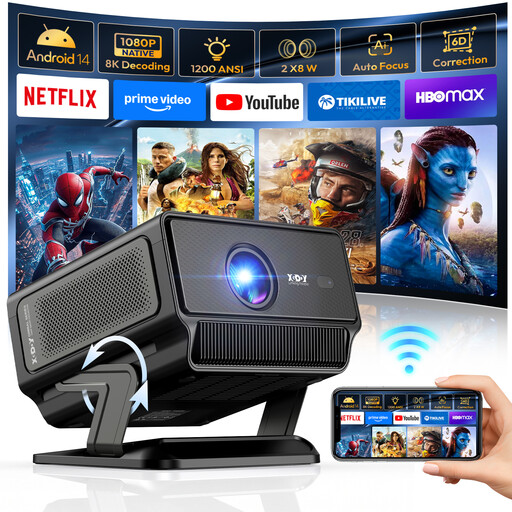
XGODY Gimbal A8 projector, native 1080P and 1.200 ANSI

XGODY Gimbal A8, native 1080P, 1.200 ANSI

The stated throw ratio can help you work out whether the projector will suit the space you have available.

Native 1080P; throw ratio 1.08:1; the product name states support for 4K/8K video decoding.

The product information mentions autofocus, automatic keystone correction and screen alignment.

View at Joybuy
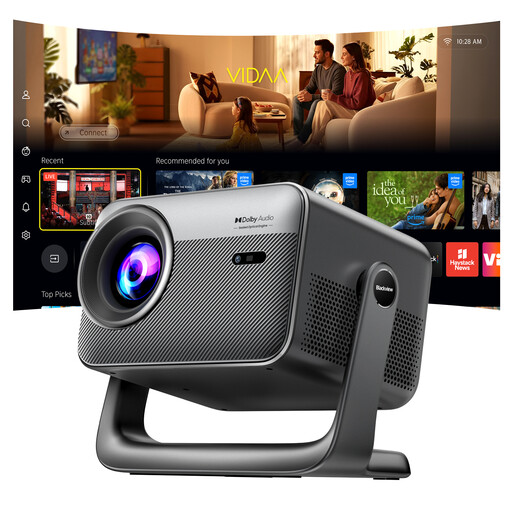
Blackview Smart Projector PV1000 Max Grey, 1.000 ANSI lumens, native 1080P

Blackview PV1000 Max Grey, native 1080P

The product title mentions a rotating design and autofocus, which may be useful if you’re considering different projection directions.

1.000 ANSI lumens; native 1080P; stated image size 40–150 inches; 360° rotating design.

The product name mentions 4K decoding and autofocus.

View at Joybuy
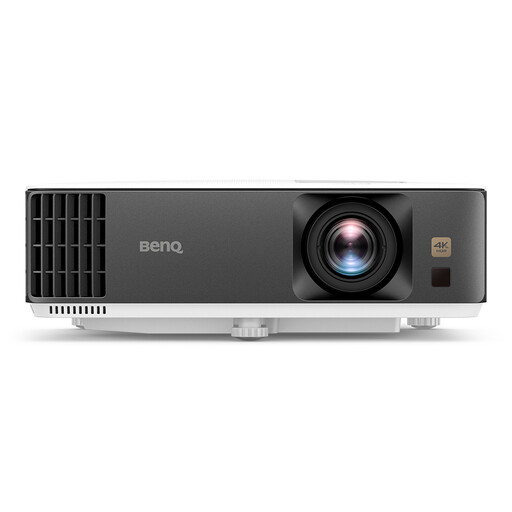
BenQ TK700 standard-throw projector, UHD 4K and 3.200 ANSI lumens

BenQ TK700, UHD 4K, 3.200 ANSI lumens

This model is worth comparing if you have enough distance from the projection surface.

UHD 4K (3840 × 2160); 3.200 ANSI lumens; the product description mentions two HDMI inputs and 1.3× zoom.

The user guide specifies a minimum projection distance of 1.5 m, so bear this in mind when positioning the projector.

View at Joybuy
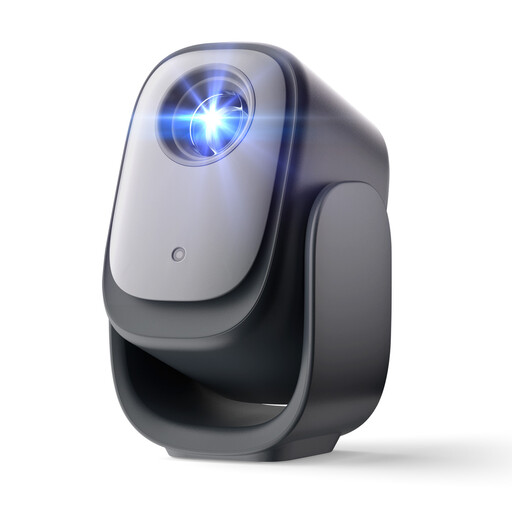
Dangbei N2 Mini projector with Wi-Fi and Bluetooth, 1080P

Dangbei N2 Mini, 1080P

The product information mentions automatic picture adjustment, which may be useful if you want to use these features in your set-up.

1080P; Wi-Fi and Bluetooth; autofocus, automatic keystone correction and obstacle avoidance are listed.

Check that the recording or streaming service you use is available through your chosen playback method.

View at Joybuy
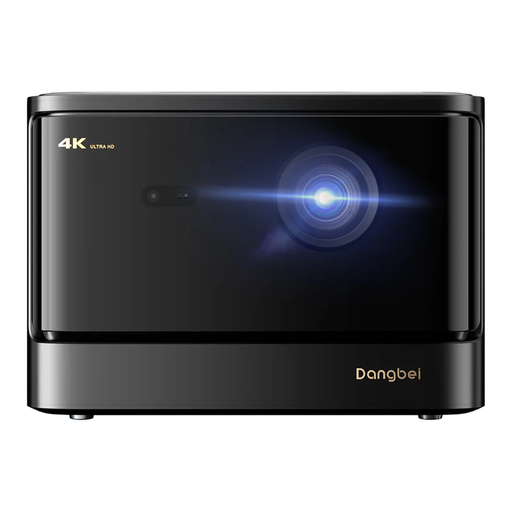
Dangbei DBOX02 laser projector, 4K, 2.450 ISO lumens

Dangbei DBOX02, 4K, 2.450 ISO lumens

The product information mentions built-in speakers, an option to consider if you’d rather not use separate speakers.

4K; 2.450 ISO lumens; two built-in 12 W speakers; Wi-Fi and Bluetooth are listed.

Autofocus and keystone correction are mentioned in the product description.

View at Joybuy

Frequently asked questions

How can I check before buying whether the image will fit on my wall?

Measure the available wall width and the possible distance between the lens and the wall. Then check the image size that the exact model can project from that distance. The maximum screen size alone won’t tell you this.

Can I play any recorded theatre performance I find online through a built-in app?

No. Having smart features doesn’t guarantee this. Check how you’re allowed to access and play the specific recording, and whether that playback method works with the projector. Availability can change when temporary streaming rights expire.

Does the statutory guarantee in the Netherlands always end after two years?

No. ACM ConsuWijzer explains that the law doesn’t set a fixed duration for the statutory guarantee. It depends in part on what you can reasonably expect from the product during normal use. The retailer is your point of contact for this statutory guarantee.

Which product safety rules are relevant when buying in the Netherlands?

Electrical and electronic equipment placed on the market in the Netherlands must comply with the applicable European safety rules and, where required, CE marking requirements. The rules that apply depend in part on the product’s features, such as Wi-Fi or Bluetooth. Ondernemersplein and Business.gov.nl stress that CE marking is not a quality mark.

Should I expect a TV energy label for a projector?

Not under the EU rules for electronic displays: the European Commission explicitly excludes projectors from this product group. This doesn’t tell you anything about the power consumption of an individual model.
