
For viewers with limited projection distance
You want to know what image size will work for the distance between the projector position and the wall. BenQ and Epson offer tools to help you assess the setup and projection distance.


First measure the distance from the intended projector position to the wall and work out what image width will fit. Then choose between a short-throw projector, an ultra-short-throw model or a portable projector. Also check that the image will be easy to see with your room’s lighting, and that your playback source and audio setup are compatible with your chosen model. Automatic image correction is no substitute for the right projection distance.
You want to know what image size will work for the distance between the projector position and the wall. BenQ and Epson offer tools to help you assess the setup and projection distance.
You want to watch theatre recordings without a permanent installation, so you’re comparing a table or shelf setup with minor changes that can be reversed. The Dutch government distinguishes between small, reversible changes and renovation when it comes to alterations to a rented home.
You’re looking beyond the stated resolution to consider how your playback source connects to the projector and speaker or soundbar. BenQ Netherlands explains which devices need ARC or eARC for this audio connection.
First measure the space and the image width you want. Then assess picture quality in your room’s lighting, the connection to your playback source and how easy it will be to pack the setup away.
| What to consider | What to look for when buying | Who is this important for? |
|---|---|---|
| Projection distance | Measure the usable distance and wall width, then check the projection table for the exact model and the image size you want. | If the lens can only be placed a limited distance from the wall, I want to know in advance what image width is possible. Around 31% of consumers put a suitable projection distance first. |
| Picture quality in your room’s lighting | Consider the conditions you’ll be watching in, and only compare brightness figures when they use the same unit. | If I want to follow the performance in my usual room lighting, I look at how the image appears in those conditions. Around 25% of consumers give image visibility top priority. |
| Dialogue and playback | Check that your playback source works with the connections or supported apps on the exact model, and find out how to route the sound to your audio setup. | If I want to follow the dialogue clearly, I need to know whether my recording will play and whether the audio connection will work with my speaker or soundbar. Around 25% of consumers prioritise playback and sound. |
| A setup you can pack away | Check that a table, shelf, cables and, if needed, a separate screen will fit in the room. Digital keystone correction can crop the image. | If I want to put the projector away after watching, I look for a setup that doesn’t need a permanent installation. Around 19% of consumers give stowable placement top priority. |
The image width you can achieve depends on the distance between the lens and the wall, as well as the throw ratio of the model you choose.
Measure the distance and the available wall width, then check the projection table for the exact model variant.
You may need a different position for the projector or a separate screen, so check before choosing a model.
A similar brand or family name doesn’t prove that it’s the same model. The ‘Elfin Flip Laser’ listed with 1080p is not the same product as the Elfin Flip 4K.
Compare the full model name and key specifications before choosing one version over another.
Digital correction can crop the image, slightly reduce picture quality and create grey borders.
First find a suitable position that’s as straight as possible, then use correction only to fix any remaining distortion.
An HDMI connection, app or audio feature doesn’t, by itself, tell you whether your playback source will work or whether the sound will be transmitted in the way you want.
Make a note in advance of how you’ll play the recordings and which video and audio connections you’ll need.
Depending on your setup, you may also need a separate playback device or a different audio connection.
The GV50 is a portable option, while the TK710STi is designed for short-throw projection.
The M2 Pro is a 4K laser projector with optical zoom. It’s worth comparing if you’d like some flexibility when positioning it.
The Elfin Flip 4K is a compact model worth comparing if you’re looking for a portable projector with some flexibility on image size.
The EH-LS800B is an example of an ultra-short-throw model designed to sit close to the wall.
The Freestyle+ is a portable option worth comparing if automatic picture adjustment for different setups is important to you.
These models include short-throw and ultra-short-throw projectors, as well as portable options. For each model, measure the available distance and check that it connects to your playback source.
 No image available
This short-throw model could be a good option if there’s limited space between the projector position and the wall. Check the image size you want for your setup.
Throw ratio 0.52:1; WXGA resolution; 3,800 ANSI lumens; HDMI; built-in 10 W speaker; vertical keystone correction.
 No image available
This portable model with a rotating gimbal is an option if you want to move or put the projector away after use. Check that the projection distance works for your image size.
Native 1080p; 520 ISO lumens; throw ratio 1.17:1; Google TV built in; dual 5 W speakers; 360° gimbal.
 No image available
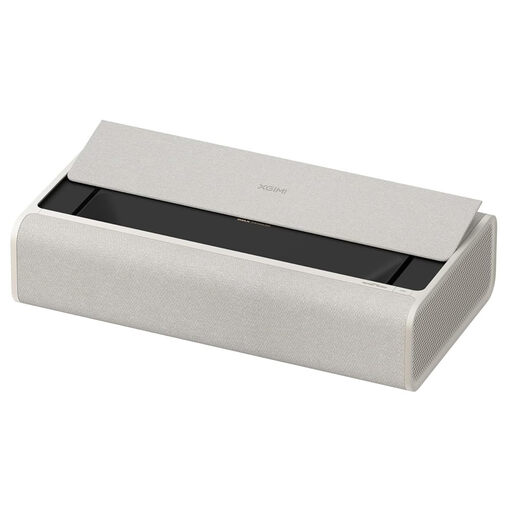
The ultra-short-throw range suits a setup close to the wall. Before choosing a position, check the distance needed for your preferred image size.
4K; 2,300 ISO lumens; 60 W Harman Kardon speaker.
 No image available
This model is designed to sit close to the wall. As the zoom is fixed, the stated projection distance needs to suit your preferred image size.
Native 1080p; throw ratio 0.18:1; stated projection distance 0.26–0.40 m; HDMI 2.0; two built-in 10 W speakers.
 No image available
This compact model comes with a carry case, making it a good option if you want to put the projector away after use. Check the image size you can achieve at the distance available in your room.
WXGA resolution (1280 × 800); 3,000 ANSI lumens; 3LCD; HDMI; automatic vertical and horizontal keystone correction.
Measure the distance from the planned lens position to the projection wall, along with the available image width. Compare these measurements with the throw ratio or projection table for the exact model. The throw ratio is the projection distance divided by the image width. The maximum image diagonal alone doesn’t tell you whether that size will work in your room.
According to the Dutch government, you don’t need permission for minor alterations that can be reversed without much expense; a small hole in the wall is given as an example. You do need permission for renovation or home improvements. Consider the proposed fixture and the terms of your tenancy.
Check which audio outputs and inputs are available on the exact projector model and the soundbar, and whether both support the connection you’ve chosen. BenQ lists a 3.5 mm audio output and HDMI ARC for the GV50. This doesn’t tell you which connections other models have or whether your soundbar is compatible.
For online purchases from a business in the Netherlands, there is generally a statutory 14-day cooling-off period from delivery, with some exceptions. Separately, the seller is responsible for the statutory guarantee if the product doesn’t meet what you could reasonably expect. ACM ConsuWijzer explains this cooling-off period; check the terms that apply to your purchase.
That depends on the rights to the recording and the context in which it’s shown. The Dutch government states that a private copy for personal use must not be distributed or made available to the public. You may need permission from the rights holders to show copyrighted work outside a strictly domestic setting; personal use doesn’t automatically grant that permission.