Start by considering the light falling on the screen, your preferred image size and the available projection distance. A high quoted lumen figure alone won’t guarantee good contrast in daylight. Then choose between a standard projector and an ultra-short-throw model, and check the motion handling and connections for your TV or streaming source. Manufacturer figures aren’t measurements of the picture in your living room.
Who is this buying guide for?
Daylight viewers
If you want to watch tennis during the day without completely darkening the living room, assess the projector, screen and incoming light as a complete setup. ProjectorCentral describes ambient light, screen material and reflective surfaces as factors that work together to affect the picture.
Viewers with limited space
If you want a large picture but have little space between the projector and screen, compare standard, short-throw and ultra-short-throw models. BenQ recommends checking the screen size and distance required for your chosen model.
Sports fans with an existing TV source
If you want to connect an existing receiver or streaming device and follow rallies clearly, check the connections and motion features of the exact model. Epson and BenQ list model-specific features, but these alone don’t provide a picture measurement for a tennis broadcast.
What should you look for when buying?
First decide where the screen will go and how much light will fall on it. Then measure the projection distance and check the picture performance and connections.
| What to consider |
What should you check? |
Who is this important for? |
| Picture in daylight |
Check the screen location in the light conditions you usually watch in. Compare lumen figures and how they were measured, and check the screen size and material. |
If I want to watch tennis during the day, I need to know how much light falls on the screen and whether the setup is suitable. Around 36% of consumers say daylight visibility is their main buying concern. |
| Distance and positioning |
Measure your preferred picture width and the distance from the lens to the screen. Check the throw ratio and positioning options for the exact model. |
If there’s little space between the seating area and the screen, I need to know whether a standard projector will fit or whether a short-throw or ultra-short-throw model would be more practical. Around 29% of consumers say positioning is their main buying concern. |
| Fast-moving sports |
Check whether the model has frame interpolation or a sports mode. Gaming input lag isn’t a measure of how a tennis broadcast is displayed. |
If I want to follow fast rallies and camera movements clearly, I look at the picture features of the specific model. Sports picture performance is a priority for around 21% of consumers. |
| Connections |
Check the output on your TV or streaming source and the projector’s HDMI and audio connections. |
If you want to keep using an existing receiver or audio equipment, check that it can connect to the projector. Around 14% of consumers say the source and connections are their main buying concern. |
Common buying mistakes
-
Focusing only on the lumen figure
The light falling on the screen, the picture size and the screen material all affect how visible the picture is. A quoted brightness figure doesn’t guarantee good contrast in your living room.
First decide where the screen will go, how large you want the picture to be and how much light will fall on it. Then compare brightness figures and how they were measured, and assess the setup as a whole.
-
Pairing any ALR screen with an ultra-short-throw projector
ALR screens vary in the direction of light they’re designed for, as well as in viewing angle, mounting requirements and potential picture artefacts.
Check that the screen suits the projector’s throw ratio and position, and consider where viewers will be sitting.
-
Treating gaming input lag as proof of smooth sports pictures
Input lag and the way fast motion in a TV broadcast is displayed are different things.
Check the picture-processing features of the exact model and, if possible, assess sports footage in similar conditions.
-
Confusing the manufacturer’s warranty with all your warranty rights
A manufacturer’s warranty is an additional commercial guarantee and is separate from your statutory rights. The Dutch government states that if you have a problem with a product, you should contact the seller.
Read exactly what any additional warranty covers, and contact the seller if a product is faulty.
Brands to consider
Epson
The EH-TW7000 and EH-LS800B suit different positioning options: a standard projector and an ultra-short-throw model.
- For the EH-TW7000, Epson lists 3000 lumens of white and colour light output, lens shift and frame interpolation.
- For the EH-LS800B, Epson lists 4000 lumens and a laser light source.
- These model-specific figures aren’t an independent comparison in daylight. Check the screen, distance and incoming light in your setup.
BenQ
The TK710 is a standard-throw laser projector, while the TK860i features a sports picture mode.
- BenQ lists 3200 lm and 10% vertical lens shift for the TK710.
- The TK860i specifications include a sports picture mode.
- Gaming input lag doesn’t indicate how smoothly a tennis broadcast will be displayed. Check the screen size, distance and incoming light separately.
ViewSonic
The LX700-4K is a standard-throw laser projector with adjustable positioning options.
- ViewSonic specifies 3500 ANSI lumens, vertical lens shift and 1,36× optical zoom for this model.
- The quoted brightness isn’t a measurement in a specific bright living room. Check the picture size and projection distance you need.
Optoma
The UHZ66 is a laser projector for setups with enough room for a standard projector.
- Optoma lists 4000 lumens and 1,6× zoom for the UHZ66.
- The manufacturer’s claim about watching with the lights on doesn’t prove how the picture will look in your living room. Check the screen size and actual light levels.
Projectors at Joybuy
These Joybuy models offer different options for positioning, picture size and connecting a match source. Before choosing, check that the quoted brightness and projection distance suit your screen and the light in your living room.
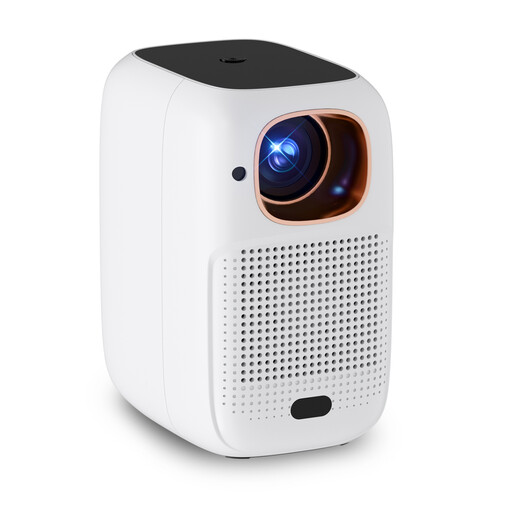 No image available
V1 Outdoor Mini Projector, 720P, 4K Support
A compact option if you want to connect a match source using one of the listed inputs. Check that it suits the light levels and picture size you have in mind.
The product details list 720P, 4K support and a 10400mAh battery. The description mentions 3000 lm and HDMI, USB and AV; check how the brightness is measured before comparing it with other models.
View at Joybuy
 No image available
ETOE Dolphin 2 RGB Laser Projector, 1080P
Worth considering if you want to connect an HDMI source. Check the picture size and light levels for your intended viewing location.
The product name lists native 1080P, 800 ANSI lumens, HDMI 2.1, USB-C and a built-in battery. Visibility also depends on the screen and ambient light.
View at Joybuy
 No image available
XGIMI Vibe One Portable Projector, Full HD 1080p, with screen and stand
The included projector, screen and stand may be useful if you want to use these items together. Check that the setup suits the location you have in mind for the screen.
The product name lists Full HD 1080p and 250 ISO lumens, and mentions a projection screen with stand. The description lists HDMI; check that your match source can connect to it.
View at Joybuy
 No image available
Optoma UZ38X 4K UHD Dual-Laser Projector
Standard throw distance and optical zoom are worth comparing with the space available where you plan to position the projector.
The product details list 4K UHD, 3800 lumens, 1,3× optical zoom, two HDMI inputs and PureMotion MEMC. The feature name isn’t an independent assessment of tennis footage.
View at Joybuy
 No image available
Optoma H117ST Short Throw DLP Projector, WXGA
Short-throw projection may be useful if space between the projector and screen is limited. Check your preferred picture size and the exact setup.
The product name lists WXGA and 3800 ANSI lumens. The description mentions a 0,52:1 throw ratio, a sports mode and HDMI 1.4a.
View at Joybuy
Frequently asked questions
Is a higher lumen figure enough to watch tennis during the day?
No, not on its own. Light falling on the screen, picture size and screen material all affect visibility. Assess the screen location in the light you’ll be watching in, and don’t treat quoted lumen figures as measurements of your setup.
How do I know whether a projector will fit in my living room?
Measure your preferred picture width and the distance from the lens to the screen. Compare these with the throw ratio and positioning options of the exact model before deciding where to place it on furniture or mount it on the ceiling.
Do I need built-in streaming apps to watch tennis?
Not necessarily, if you can connect a suitable external device via HDMI. Epson describes this option for the EH-TW7000; also check that your service or receiver offers the match and works with your source device.
Which features matter for fast-moving tennis footage?
Check the picture-processing features of the exact model, such as frame interpolation or a sports picture mode. Epson describes frame interpolation for the EH-TW7000, and the BenQ TK860i specifications list a sports mode. These features aren’t a comparative measurement of tennis footage.
What should I look for in the light source and maintenance?
Check the lifespan conditions and maintenance requirements for the specific projector and picture mode. Epson lists 5000 hours for the EH-TW7000 lamp in eco mode; according to Epson, the EH-LS800B has a laser light source. These details alone don’t determine fixed replacement costs or operating life in other modes.


