
Daylight viewers
If you want to watch silent films during the day while light comes in through tall windows, readable intertitles and good contrast are key. Epson Netherlands and BenQ Netherlands explain how light from windows can affect visibility.


First, limit the light falling on the screen, then work out the throw distance and screen you need. A bright projector can help, but it won’t guarantee good contrast in dark scenes. With an ultra-short-throw projector, the screen must also be suited to that projection direction.
If you want to watch silent films during the day while light comes in through tall windows, readable intertitles and good contrast are key. Epson Netherlands and BenQ Netherlands explain how light from windows can affect visibility.
If you want a large picture but have limited space, you’ll need to match the projector’s throw distance to the space available for the screen. BenQ Netherlands highlights throw distance and image size as key factors when planning your set-up.
If you play films from your own collection or an external device, check in advance that you can connect your source and find out how your specific edition will play. The British Film Institute points out that silent films were not always intended to be played at the same speed.
First, check where the light from your windows falls on the screen. Then work out the throw distance and screen type you need, and finally check that you can connect your film source.
| What to consider | What should you check? | Who is this important for? |
|---|---|---|
| Visibility in daylight | Compare the stated light output and check where light from the windows falls on your intended screen position. | I want to be able to read intertitles and follow dark scenes during the day, even with light coming in through the windows. Around 36% of consumers give visibility in daylight top priority. |
| Contrast and screen choice | Check that the screen suits the projection direction and your seating position. | If I’m considering an ALR screen, I want to know whether it suits my projector and seating position. Around 29% of consumers prioritise contrast and screen choice. |
| Positioning the projector and screen | Measure the space available and check what image size the exact model can produce from that position. | There’s little space between the projector and screen in my room, so I want to know in advance what image size will fit. Around 14% of consumers give positioning top priority. |
| Own film source | Check your player’s connections and test the film edition and playback speed you want to use. | I want to use my own source for silent films and know how my specific edition will play. Around 14% of consumers prioritise their film source. |
| Total cost | As well as the projector, include any suitable screen and the connections you’ll need in your comparison. | I want to understand the cost of a complete, usable set-up, not just the projector. Around 7% of consumers give total cost top priority. |
A high stated light output doesn’t prove that dark scenes will remain easy to see with tall windows nearby. Image size and the amount of light falling on the screen also matter.
Look at both the light output and the screen position, and consider the projector, window coverings and screen as one complete set-up.
A screen may be designed for a particular projection direction or specific models. So not every ALR screen will suit every ultra-short-throw projector.
Before buying, check that the exact screen is suitable for your chosen model and intended set-up.
An unsuitable screen could mean an extra purchase or replacement.
The image size you can achieve depends on the throw distance. A larger projected image also calls for careful consideration of visibility in ambient light.
Measure your room and check the throw distance and image size for the exact model before choosing a screen size.
The Epson EB-W55 and EH-LS800B have different things to consider: the EB-W55 offers conventional throw distance and WXGA, while the EH-LS800B has an ultra-short throw.
The TK710 is a laser projector for conventional placement, with zoom and lens adjustment options to help you work around your room.
The LX700-4K is a laser option for conventional throw distances, with adjustment features to help with positioning.
The PX3-PRO is an ultra-short-throw option if you need to place the projector close to the screen wall.
This Joybuy selection includes projectors for short and conventional throw distances. Compare the set-up with the light from your windows and check that you can connect your film source.
 Image unavailable
Worth comparing if the projector needs to sit close to the screen; check that your preferred image size works with the space available.
WXGA (1280 × 800), 3,800 ANSI lumens, 3D and white.
 Image unavailable
The listed apps may be useful if you want to watch without a separate source; check that your film or service is supported.
Listed features include a 50–200-inch projection size, Wi-Fi 6, Bluetooth, automatic image correction, 180° rotation and HDMI compatibility.
 Image unavailable
Worth considering if you want to compare projectors with a conventional throw distance; measure the space available first and check that the connections suit your film source.
 Image unavailable
Its short throw makes this model worth considering if the projector needs to sit close to the screen; check the image size for your room.
XGA (1024 × 768), 3,600 ANSI lumens, DLP and white.
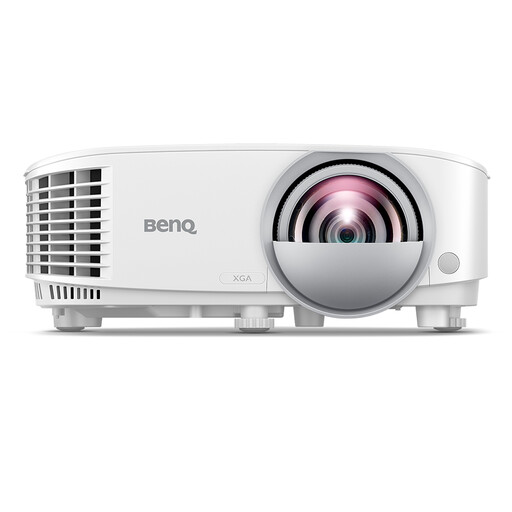 Image unavailable
This short-throw model is worth comparing if the projector needs to sit close to the screen; measure the space available first.
XGA (1024 × 768), 3,500 ANSI lumens and DLP.
No, an ALR screen won’t automatically solve the problem of light from windows. Epson Netherlands explains that these screens direct projector light towards the viewer and reject light from other directions. The projection direction, incoming light and seating position all still matter. If you have an ultra-short-throw projector, check that the screen is suitable for your set-up.
Measure your preferred image width and the available distance between the projector lens and the screen. Check these measurements against the exact model and work out where the light from your windows falls on the screen.
Not for that reason alone. The British Film Institute says that 24 frames per second only became standard in the sound era. Check the playback speed and format of your specific film edition on the source device.
If a product is faulty, contact the seller to discuss a solution. According to the Dutch government, Dutch statutory consumer protection entitles you to a product that works properly; there is no fixed statutory guarantee period of two years.
When you buy from a business at a distance, you’ll often have a 14-day cooling-off period. Check which terms apply to your purchase. According to the Dutch government, an online purchase from a private seller doesn’t count as a distance sale in this sense.