First, measure the distance from the lens to the screen and decide how wide you want the picture to be. Then choose a short-throw, ultra-short-throw or portable projector that suits the space. For 4:3 films, your source device must also be able to preserve the original aspect ratio, so the picture isn’t stretched or cropped. Match the brightness to the light in the room, and compare fan noise in the viewing mode you plan to use.
Who is this relevant to?
Viewer with limited projection space
You want a picture that fits without having to position the projector far from the wall. The available distance determines which throw ratio is practical; BenQ Europe explains how to use the ratio to work out the required distance for a chosen picture width.
Fan of original film framing
You want to preserve the original framing and be able to read intertitles. The British Film Institute describes 4:3 as the standard aspect ratio of the Academy format; Eye Filmmuseum explains the role of intertitles in silent films.
Viewer in a shared living room
You sometimes watch with ambient light, or want to hear musical accompaniment without the projector noise overpowering it. Epson Netherlands highlights how the viewing environment affects your choice of brightness; Eye Filmmuseum describes musical accompaniment at film screenings.
What should you look for when choosing?
| What to consider |
What should you check? |
Who is this important for? |
| Will the picture fit at the available distance? |
Measure the desired picture width and the distance from the lens to the screen. BenQ Europe gives this calculation: throw ratio × picture width = distance. |
If I have limited space between the projector and the wall, I want to know whether I can achieve my preferred picture size. Around 26% of consumers in this decision-making process prioritise placement most. |
| Will black-and-white details remain visible? |
Check focus across the whole picture and assess light and dark scenes at your intended picture size and with the room lighting you plan to use. |
If I want to make out both light and dark details, I focus on how the picture looks in my own room. Around 21% of consumers in this decision-making process prioritise black-and-white details. |
| Will the framing and intertitles be preserved? |
Check whether the film source can display 4:3 without stretching or cropping, and whether the intertitles are sharp and legible at your chosen picture size. |
If I want to preserve the original composition and on-screen text, I don’t want a distorted or cropped picture. Around 21% of consumers in this decision-making process prioritise film framing and intertitles. |
| How much light is there in the room? |
Decide whether you’ll be watching in a darkened room, and check the brightness figures alongside the measurement method and light mode used. |
If I can’t always close the curtains, I want to know in advance how my viewing environment will affect my choice of picture. Around 16% of consumers in this decision-making process prioritise watching with ambient light. |
| Can you hear the projector or musical accompaniment? |
Compare the quoted noise levels for each viewing mode and check that the connections are suitable for your film source and any audio equipment. |
If I’m watching in a small room, I don’t want the sound of the device to distract unnecessarily from the film or musical accompaniment. Around 16% of consumers in this decision-making process prioritise quiet operation and connectivity. |
Common buying mistakes
-
Looking only at the maximum picture size
A quoted maximum size doesn’t tell you whether the picture will fit at the available distance. The required lens-to-screen distance also depends on the picture width and throw ratio.
Measure the space and use the exact model’s throw ratio to calculate the lens-to-screen distance before choosing.
-
Stretching a 4:3 film to 16:9
Stretching changes the original framing, while cropping can remove picture information and intertitles.
Check your film source settings and choose a display mode that preserves the framing. Not every release or restoration is presented in the same way.
-
Confusing an older ultra-short-throw model with a current version
Epson Netherlands lists the EH-LS650B as discontinued. The specifications for that model don’t automatically apply to the EH-LS670B.
Check the full model number and product status before comparing specifications or placement information.
A discontinued model can take extra time to distinguish from a current version.
-
Checking fan noise and connections only after buying
Noise figures can vary between modes, and silent films may also have musical accompaniment. The connections also affect how you can use your chosen film source.
Check the noise figure for the mode you plan to use, and compare the connections with your playback equipment.
Relevant brands
BenQ
The TH671ST is a short-throw model for anyone who can position the projector in front of the wall.
- BenQ specifies a 0.69–0.83:1 throw ratio, 1080p resolution and two HDMI inputs for the TH671ST.
- The quoted noise levels are 33 dB in Normal mode and 29 dB in Eco mode. These are manufacturer specifications, not measurements taken while watching a film. It uses a lamp.
Epson
The Lifestudio Grand EH-LS670B is designed for a fixed setup with ultra-short-throw projection next to the wall.
- Epson lists a picture size of up to 120 inches, 3,600 lumens, built-in Bose sound and Google TV for the EH-LS670B.
- These features alone don’t show how silent films will look. Epson lists the EH-LS650B as discontinued, so check the exact model.
XGIMI
The HORIZON S Max is worth considering if a portable setup matters more to you than a short projection distance.
- XGIMI lists a built-in adjustable stand. The manufacturer gives a 1.2:1 throw ratio for the HORIZON S series.
- For the same picture width, 1.2:1 requires more distance than the 0.69–0.83:1 quoted by BenQ for the TH671ST. This compares throw ratios, not the overall performance of the models.
Projectors at Joybuy
This product selection includes short-throw models for a fixed position and portable projectors. Check the required distance for each model, as well as the display settings for your film source.
 No image available
Optoma H117ST Short Throw DLP Projector, WXGA
The 0.52:1 throw ratio is useful if you want to position the projector close to the screen.
Native WXGA 1280 × 800; 3,800 ANSI lumens; supports 4:3 display. Quoted noise level: 26 dB typical, 28 dB maximum.
The quoted native resolution is WXGA, not native Full HD. Place the projector on a stable, flat surface and keep the ventilation openings clear.
Joybuy
 No image available
BenQ MW809STH Short Throw Projector, XGA
The quoted short-throw ratio may be useful when there’s limited space between the projector and screen.
Native XGA 1024 × 768; 3,600 ANSI lumens; the stated aspect ratio is 4:3 and the throw ratio is 0.49.
Check that the resolution and connections are suitable for your film source and preferred picture size.
Joybuy
 No image available
XGIMI Vibe One Match Night EU Edition
The built-in battery, supplied projection screen and stand are useful if you want to move your setup around.
Full HD 1080p; 250 ISO lumens; 1.3:1 throw ratio; Google TV and JBL audio.
For the same picture width, 1.3:1 requires more distance than a shorter throw ratio. Check the positioning and original film framing with your own playback source.
Joybuy
 No image available
Yaber L2
The 360° gimbal offers different positioning options; check whether your room has enough space for the required projection distance.
Native 1080p; 520 ISO lumens; 1.17:1 throw ratio; Google TV and two 5 W speakers.
Keep the ventilation openings clear and, after switching off, wait for the cooling fan to stop before unplugging the projector.
Joybuy
 No image available
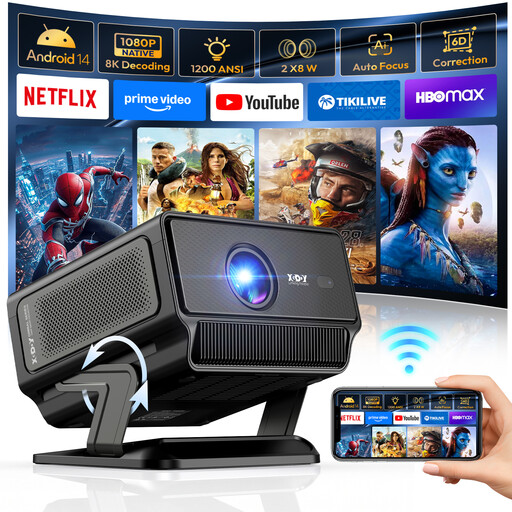
XGODY Gimbal A8
The gimbal rotates through 0–90° and is designed for projection onto a wall or ceiling; check in advance which positioning works best in your room.
Native 1080p; 1,200 ANSI lumens; 1.08:1 throw ratio; autofocus and HDMI, USB and Wi-Fi 6 connectivity.
For the same picture width, this throw ratio requires more distance than a shorter one. Keep the ventilation openings clear.
Joybuy
Frequently asked questions
Can a 16:9 projector show a silent film in a 4:3 frame?
Yes, as long as the film source and display settings preserve the original framing. Don’t stretch or crop the picture to fill the screen; also check the aspect ratio of the specific film release.
How do I work out the right distance between the projector and screen?
Multiply the throw ratio of the exact model by your preferred picture width to calculate the distance from the lens to the screen. Then check that the picture size is within the model’s range and follow the positioning instructions.
How can I avoid distracting noise or overheating in a small room?
Compare the quoted noise level in the mode you plan to use and keep the ventilation openings clear. BenQ’s general projector advice warns against placing a projector in a poorly ventilated or enclosed space; check the manual for the exact model to find out how much clearance it needs.
What can I do if the projector is faulty after I buy it?
If a product is faulty in the Netherlands, you can ask the seller to put things right. According to the Dutch government, you’re entitled to a product that meets expectations; a manufacturer’s guarantee is an extra, and there is no single fixed statutory guarantee period for all products.
Can I return a projector bought online if I’m not happy with where it fits?
For a standard online consumer purchase from a business, the Dutch government says you generally have a statutory 14-day cooling-off period. Check the applicable terms and conditions; a purchase from a private seller isn’t automatically covered by the same rules.


