Who is this choice relevant to?

Viewers with limited space for positioning

If you don’t want a projector in a walkway, it’s worth checking in advance whether the available position can produce the image width you need. BenQ Netherlands, Optoma Europe and Epson Netherlands publish model-specific throw-distance information.

Viewers who notice fan noise easily

Active cooling can be noticeable during quiet film scenes. Compare the manufacturer’s figures for each operating mode, and bear in mind where the unit will be positioned; these figures aren’t a listening test in your living room. BenQ Netherlands identifies active cooling as a source of noise.

Fans of historical films

If intertitles and the original composition matter to you, check the aspect ratio of your film copy and the playback source settings. The British Film Institute describes 4:3 as an early film format.

What should you look for when buying?

Ultra-short throw

Choose this option if: there’s no suitable clear space further from the wall and the desired image size works with your setup.

Bear in mind: check the exact model’s positioning dimensions and make sure the projection surface is flat. Epson Netherlands lists the EH-LS670W as an ultra-short-throw model.

Short throw in a clear space

Choose this option if: the calculated lens distance and the viewers’ positions leave enough room for a unit further into the room.

Bear in mind: consider furniture, walkways and noise from your seat. BenQ Netherlands gives the TH671ST a throw ratio of 0,69–0,83; Optoma Europe lists 0,496:1 for the GT2000HDR.

Compact model with a longer throw distance

Choose this option if: portability matters and the image width from the available distance is sufficient.

Bear in mind: according to XGIMI, the MoGo Pro has a throw ratio of 1,2:1 and 300 ANSI lumens. Consider the image size you want and the ambient light in your setup.

Consideration What should you check? Who is this more important for?
Image size and positioning Measure the distance from the lens to the wall and calculate the image width; also check furniture and walkway space. If I only have one suitable spot, I want to know in advance whether the image will fit there. Around 36% of consumers put positioning first.
Fan noise Compare the stated noise levels for each mode and, if possible, listen from the intended viewing position. During quiet scenes, I don’t want the cooling system to distract me. Around 29% of consumers are mainly looking for a quiet listening spot.
Aspect ratio and intertitles Check the film copy’s aspect ratio and display it without stretching the image horizontally. When watching historical films, I want to preserve the composition and intertitles. Around 21% of consumers prioritise how the image is displayed.
Connections and ongoing use Check that your playback source is compatible with the inputs, and compare the light source, stated lifespan and warranty terms. I want to connect my own films and know in advance what controls and maintenance are involved. Around 14% of consumers consider this the most important factor.

Common pitfalls

  • Assuming the maximum image diagonal is a fixed size

    Image width depends on the distance between the lens and the projection surface, as well as the throw ratio. So a stated maximum diagonal doesn’t automatically tell you what size image you’ll get in your available space.

    Measure the intended lens position and calculate the image width before choosing a model or mount.

    You may need a different setup or projection surface if the calculated size doesn’t fit.

  • Taking a dB rating as a guarantee of a quiet film night

    The stated noise level applies to a particular operating mode; the unit’s position and your listening position also matter. BenQ Netherlands identifies active cooling as a source of noise.

    Compare the modes and, if possible, listen during a quiet scene from where you’ll be watching.

  • Stretching a 4:3 film to fill a widescreen

    Changing the aspect ratio alters the composition when you stretch the image. The British Film Institute describes 4:3 as an early film format, but the aspect ratio of an individual film copy may differ.

    Check the aspect ratio of your file and set the source or projector to display it without stretching; black bars may remain visible.

  • Confusing a 4K input with the displayed resolution

    For the Optoma GT2000HDR, Optoma Europe distinguishes the projector’s Full HD 1080p resolution from its ability to accept a 4K signal.

    For your film, compare the resolution of the copy, the player output and the projector’s display resolution separately.

Brands to consider

Epson

Epson’s Netherlands page lists the Lifestudio Grand EH-LS670W as an ultra-short-throw model.

  • Epson lists laser projection and Google TV for this model.
  • Check the exact positioning dimensions and image size you want for your wall; the ‘ultra-short-throw’ label doesn’t guarantee that every room layout will work.

BenQ

The BenQ TH671ST is an example of a short-throw model with a lamp as its light source.

  • BenQ Netherlands lists a throw ratio of 0,69–0,83 for the TH671ST.
  • The stated noise levels are 33 dB in Normal mode and 29 dB in Eco mode. These are manufacturer figures, not a listening test in your living room.

Optoma

The European GT2000HDR specifications describe a short-throw laser projector with a fixed lens.

  • Optoma Europe lists a throw ratio of 0,496:1 and two HDMI inputs for this model.
  • The fixed lens limits optical flexibility when positioning the projector. The stated noise levels of 27–34 dB aren’t a measurement in your room.

XGIMI

The EU specifications for the compact MoGo Pro are worth considering if portability and a more modest image size are priorities.

  • XGIMI lists a throw ratio of 1,2:1, 300 ANSI lumens and an HDMI input for this model.
  • At the same distance, this throw ratio produces a narrower image than the short-throw ratios listed above. This compares stated figures; it isn’t a joint hands-on test.

Projectors at Joybuy

This selection includes projectors labelled as short throw, as well as models for anyone considering a more compact option or a longer throw distance.

BenQ MW809STH short-throw projector

BenQ MW809STH Short Throw Projector

An option to compare if you’re looking for a short-throw model; measure the lens distance and desired image width for your setup.

The product name lists 3.600 ANSI lumens, DLP, XGA (1024 × 768) and white.

View at Joybuy
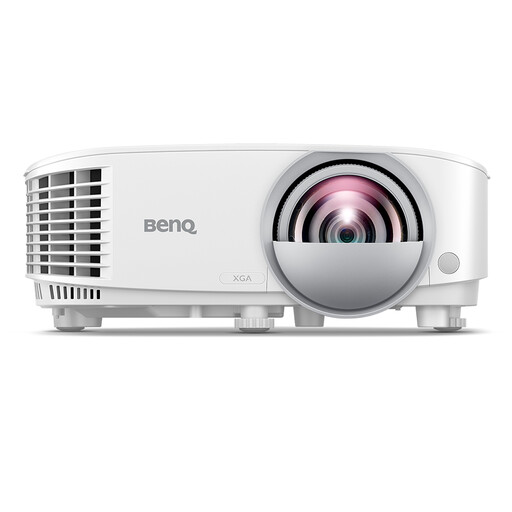
BenQ MX825STH short-throw projector

BenQ MX825STH Short Throw Projector

A short-throw option to compare with your available distance and wall width; check the positioning details for this version.

The product name lists 3.500 ANSI lumens, DLP, XGA (1024 × 768) and white.

View at Joybuy

Epson EB-1780W short-throw projector

Epson EB-1780W Short Throw Projector

A model to consider if you’re looking at a short-throw projector; compare its specifications with your intended distance and viewing position.

The product name lists 3.000 ANSI lumens, 3LCD, WXGA (1280 × 800) and white/grey.

View at Joybuy

Optoma Photon Beam PK52 projector

Optoma Photon Beam PK52

Compare this model with your desired image size and available distance; also check that its connections suit your playback source.

View at Joybuy
Dangbei Atom portable laser projector

Dangbei Atom Portable Laser Projector

A portable model to consider if portability matters; check whether the image size works with the available distance.

The product name lists 1.200 ISO lumens, 1080p HD and a 4K HDR input. According to the product information, this model has no built-in battery and needs a power adapter.

View at Joybuy

Frequently asked questions

Do I need to buy a 4:3 projector for silent films?

Not necessarily. First, check the aspect ratio of the film copy and whether the playback source and projector can display it without stretching. The British Film Institute describes 4:3 as an early film format, but not every restoration or film file has exactly the same crop.

How do I decide where to put a projector before fitting a mount?

Measure from the intended lens position to the projection surface and compare that distance with the throw ratio and positioning specifications for the exact model. Also check the image width and height, furniture and walkway space with a temporary setup.

How can I stop the fan from being audible during quiet scenes?

Compare the stated noise levels for each operating mode and, if possible, listen from your own seat. Manufacturer figures aren’t a listening test in your room; the unit’s position and the mode you choose also make a difference.

Is CE marking compulsory for every projector?

CE marking is required when a particular product falls under EU rules that require it. The European Union lists electrical and electronic equipment as a relevant category, but the applicable rules and conformity need to be established for the specific product; CE is not an independent quality mark.

Does a 4K input mean the projector displays 4K?

No. An input that accepts a 4K signal doesn’t, by itself, tell you the projector’s display resolution. For the GT2000HDR, Optoma Europe distinguishes the projector’s Full HD 1080p resolution from its support for a 4K signal.
