
Viewers seated to the side
You watch alone or with others from a seat away from the screen’s central axis and want the image to remain visible from there. So consider not just the projector, but also the screen’s viewing angle.


First, choose a projector screen with a stated viewing angle that suits the seating; the projector’s lens shift and keystone correction won’t widen that angle. Then choose a projector to suit the throw distance, intended position, room lighting and audio connection you want. A portable model can make setup easier, but digital keystone correction may affect the image.
You watch alone or with others from a seat away from the screen’s central axis and want the image to remain visible from there. So consider not just the projector, but also the screen’s viewing angle.
You want to follow the performers and see dark stage scenes clearly. Match the screen size and throw distance to your room, and take into account any lighting that will remain on while you watch.
You care about music playback and want to check in advance how the projector or video source can connect to your existing sound system.
Suited to: a projector that usually stays in the same place but can’t be positioned directly in front of the screen.
Bear in mind: the available space, and whether the lens-shift range and throw distance are sufficient for your room. Lens shift changes the position of the image, not the screen’s viewing angle.
Suited to: watching a recital in different places or rooms.
Bear in mind: automatic alignment won’t widen an unsuitable screen viewing angle. BenQ notes that digital keystone correction can affect image sharpness and size, among other things.
| Consideration | What to look for | Who is this relevant to? |
|---|---|---|
| Image from a side seat | Measure where the furthest seat is and compare it with the stated viewing angle of the specific screen material. Elite Screens lists a 180° viewing angle for CineWhite; check that the material is suitable for your type of projector. | If I’m watching from the side, I want to know whether the screen will keep the image visible from there too. Around 33% of consumers say visibility from a side seat is their main purchasing concern. |
| Watching a recital in your room | Measure the available throw distance and desired image width, then compare them with the throw ratio of the exact model. Also consider the lighting while you watch. | If I want to follow performers and stage scenes clearly, I need an image size that suits my viewing distance and room lighting. Around 27% of consumers prioritise the recital image. |
| Music playback and connections | Check the connections on the video source, projector and audio system. For each model, see which audio connections and built-in speakers are listed. | If music playback matters to me, I want to know whether my source and preferred speakers can connect to the projector. Around 20% of consumers put connectivity and music playback first. |
| Projector positioning | Measure the distance and the horizontal and vertical offset from the intended projector position. Compare these with the lens-shift range of the exact model and consider a test setup if possible. | If the projector is off-centre from the screen or the setup changes frequently, I want to know how to align the image correctly. Around 20% of consumers say projector positioning is their main purchasing concern. |
Lens shift moves the projected image so the projector can be positioned elsewhere. It doesn’t change how the screen reflects light towards viewers seated to the side.
First, work out where the furthest seat is, then compare screen materials. Next, choose a projector position and lens-shift range that suit the room.
If the screen material you choose doesn’t suit your seating, you may need a different one.
BenQ notes that digital correction can affect image sharpness and size, among other things.
Position the projector as straight as possible. Use optical lens shift if the model and setup allow it, and check the image from the intended position.
Listed speakers and audio connections don’t automatically tell you whether the playback will sound right for a recital.
Decide which source and speakers you want to use, then check the connections on every component before you buy.
An external sound setup may require additional speakers, cables or a suitable connection.
The EH-TW7000 is an example of a home cinema projector for a fixed setup, with lens shift and optical zoom.
The W4000i is worth considering if you want to compare a fixed projector position with optical alignment.
The HORIZON Ultra is an example of a setup with automatic alignment, optical zoom and built-in sound.
These Joybuy products suit a portable projector setup with automatic alignment. For visibility from a side seat, your choice of screen is still important too.
 No image available
A portable option if you’re looking for a projector supplied with a screen and stand for a setup you can move around.
The product name lists Full HD 1080p, 250 ISO Lumens, Google TV, JBL audio and a built-in battery. The description lists autofocus, automatic keystone correction and two 3 W JBL speakers.
For visibility from a side seat, the viewing angle of the screen material is still key.
 No image available
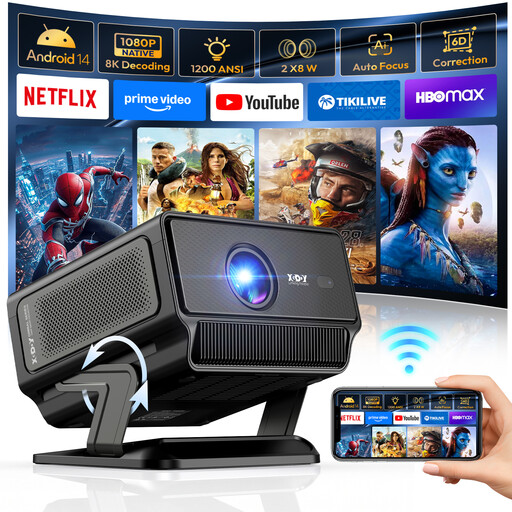
An option to compare if you’re looking for a projector with autofocus and correction features for a more flexible setup.
The product name lists native 1080p, 1200 ANSI, Android 14.0, Wi-Fi 6 and Bluetooth 5.4. The description lists automatic focus, automatic keystone correction and two 8 W speakers.
The projector itself can’t confirm that the screen will be clearly visible from a side seat.
 No image available
A model to consider if the stated short-throw setup and automatic correction features suit your room.
The product name lists native 1080p, 1000 ANSI, autofocus and automatic keystone correction. The description mentions a short-throw setup and two 8 W speakers.
Check the throw distance for your desired image width. For side seating, the screen’s viewing angle matters too.
 No image available
A portable gimbal projector to compare if you’re looking for a setup with autofocus and image correction.
The product name lists native 1080p, 700 ANSI, WhaleOS 3.0, Wi-Fi 6 and Bluetooth 5.4. The description mentions automatic focus, automatic keystone correction and 5 W stereo speakers.
The stated features don’t tell you whether the screen will be clearly visible from your side seat.
 No image available
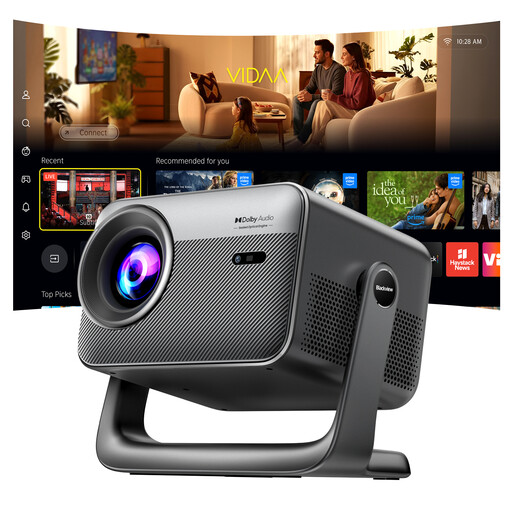
A model to compare if you’re looking for flexible projection angles and the stated image size suits your setup.
The product name lists native 1080p, 1000 ANSI, an image size of 40–150 inches, a 360° rotating design, TOF autofocus and Dolby Audio.
Check the throw distance and the screen’s viewing angle for the seats you plan to use.
No. Lens shift moves the image on the screen so the projector can be positioned elsewhere. To see the image from your seat, compare the viewing angles of the screen materials.
Measure the distance from the intended lens position to the screen and decide on your desired image width. Compare these with the throw ratio and zoom of the exact model; also check how much lens shift you’ll need if the projector isn’t centred in front of the screen.
Check the light source, stated lifespan and any replacement parts for each model, and factor in the screen and any external audio equipment. According to the Dutch government, the statutory guarantee in the Netherlands is the right to a product that works as it should, with no fixed statutory guarantee period; if there’s a problem, contact the seller.
Applicable European product rules apply to electrical equipment. The Dutch government’s Ondernemersplein website explains, among other things, CE marking and the EU declaration of conformity. For a distance purchase from a business, consumers generally have 14 days to change their mind, according to the Dutch government. Check the terms and any exceptions that apply to your specific purchase.