
Film crews with side seating
You’re showing a film to a group, and not everyone can sit directly in front of the screen. celexon and Elite Screens Europe explain how screen material and light diffusion affect the view from different angles.


For viewers sitting away from the centre line, a suitable setup starts with a screen that diffuses light across a wide viewing angle. Keystone correction and lens shift adjust the position or shape of the image, but they do not increase the screen’s viewing angle. celexon and Elite Screens Europe explain how screen gain affects the view from the side. Then choose a projector based on the measured throw distance, the light in the room and the available connections, and keep digital keystone correction to a minimum: BenQ warns that it can affect image quality.
You’re showing a film to a group, and not everyone can sit directly in front of the screen. celexon and Elite Screens Europe explain how screen material and light diffusion affect the view from different angles.
You take the projector with you and set it up again in each room. So measure the throw distance and check the position and connection of your film source in every room.
You can’t always darken the room, or dialogue needs to be clear at the back as well. Assess the picture and sound in the room and from the intended seating positions.
Choose this when: the projector can be positioned centrally, but viewers will be sitting at an angle to the screen.
Trade-off: the screen’s light diffusion helps with side viewing, but you still need to check ambient light and throw distance.
Choose this when: the projector will stay in the same place for a long time and can’t be positioned exactly in the centre.
Trade-off: check that the adjustment range of the exact model suits your measured room; flexibility in positioning does not increase the screen’s viewing angle.
Choose this when: you move the projector between rooms and can’t always position it centrally.
Trade-off: digital correction can affect image quality. Also check the throw distance, lighting and connection to your film source.
| What to consider | What to look for | Who is this important for? |
|---|---|---|
| Viewing from the side | Check the screen’s light diffusion and view a test image from the seat furthest to the side. celexon and Elite Screens Europe explain that diffuse light distribution can suit a wider viewing angle. | If I want everyone to be able to follow the film from their seat, I focus on the viewing angle and the screen. Around 29% of consumers give group viewing the highest priority. |
| Flexible positioning | Measure the distance to the screen and the horizontal offset. Compare lens shift and optical zoom with horizontal keystone correction on the exact model. | If the projector can’t always be positioned centrally in different rooms, I want to know which adjustment suits that setup. Around 29% of consumers put flexible positioning first. |
| Picture in ambient light | Test using the lighting and screen size you expect during the screening. Only compare brightness figures when the measurement units and test conditions match. | If I can’t darken the room properly, I want to assess the picture in the available light. Around 21% of consumers make visibility in ambient light their top priority. |
| Film source and sound | Check that your playback device’s connections are compatible with the projector, and listen from the rearmost seat. | If I want to be sure the film source works and dialogue is easy to follow, I test the complete setup in advance. Around 21% of consumers put film playback and audio at the top of their list. |
Keystone correction adjusts the image geometry when the projector is at an angle. It doesn’t determine how well the screen diffuses light towards viewers sitting to the side.
First check the screen and the view from the seat furthest to the side, then decide which projector adjustments you need.
You may still need to choose a different screen or adjust the setup.
BenQ says that keystone adjustments can affect sharpness, image edges and picture size.
Position the projector as straight as possible. If it has to sit off to one side, check that the lens shift covers the required range.
The runtime quoted by XGIMI for the MoGo 4 applies in Eco mode. Having built-in speakers doesn’t, by itself, guarantee that dialogue will be clear from every seat.
Play the full film in advance using the intended picture mode, power supply and audio setup.
Depending on the setup, you may need an external power source or a separate audio solution.
The EH-TW7100 is worth considering if you’re looking into a repeatable setup with room for adjustment.
The GV50 is worth considering if you’re looking into a portable projector with horizontal image correction.
The MoGo 4 range is worth considering if you want to take a compact projector between screening locations.
The M2e is an example of a portable Full HD projector with horizontal and vertical image correction.
These Joybuy products are suited to portable projection, flexible positioning or connecting an external film source. Check that each model’s specifications and throw distance suit your room.
 No image available
A good choice if you’re looking for a portable projector with a built-in battery and HDMI-in for a flexible film setup.
Product information lists Full HD 1080p, 250 ISO lumens and JBL Audio. The quoted battery life is up to 1.2 hours in Eco mode.
 No image available
A good choice if you’re looking for a projector with HDMI and flexible positioning for different setups.
Product information lists Google TV, automatic focus and automatic keystone correction. The projector has a 360° rotating gimbal and two 5 W speakers.
 No image available
A good choice if you want to connect an HDMI source and adjust the projector using automatic focus and keystone correction.
Product information lists Whale TV OS, 90° rotatable projection and two built-in 8 W speakers.
 No image available
A good choice if you’re considering a portable projector with HDMI and automatic image correction.
Product information lists automatic focus, automatic keystone correction and a projection range of 40–200 inches. The model has a 5 W speaker.
 No image available
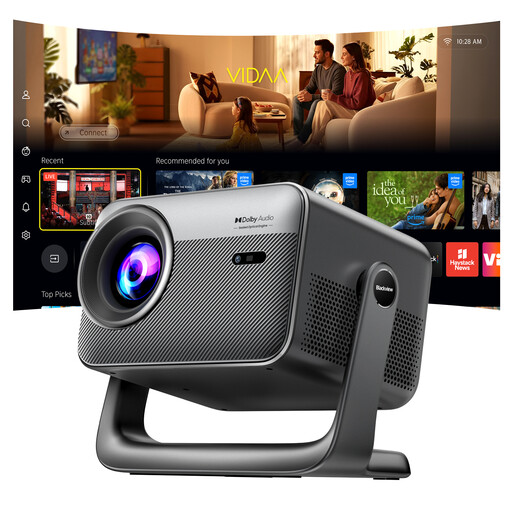
A good choice if you’re looking for a projector with a rotating projection direction and automatic autofocus.
Product information lists a projection range of 40–150 inches and a 360° rotating design.
No. Keystone correction adjusts the shape of the image when the projector is at an angle. To assess side viewing, check the screen and the seats furthest to the side; too much digital correction can also affect image quality.
Measure the available distance from the lens to the screen, decide on your preferred picture size and check the sightlines from the seats. Then compare these measurements with the throw distance of the exact model.
Check which mode the manufacturer uses to quote battery life, and listen to dialogue from the rearmost seat. Before the screening, also test the entire film file using the intended connection and audio setup.
According to the Dutch government, you need permission from the creator to use someone else’s copyright-protected work. Whether an exception or licence applies to your specific educational screening depends on the circumstances; check before showing it outside a private setting.