
Viewers seated to the side
You don't sit directly in front of the image and want to assess the screen material from the seats you actually use. Elite Screens publishes different viewing angles for its screen materials.


Start with your seating: choose screen material that suits the seats you watch from, then assess the projector position separately. If the projector is off-centre, check the throw distance and lens shift range for the exact model. Automatic keystone correction can make alignment easier, but it is not optical lens shift and can affect the image.
You don't sit directly in front of the image and want to assess the screen material from the seats you actually use. Elite Screens publishes different viewing angles for its screen materials.
You can't place the projector in the centre and want to match the throw distance to the horizontal lens shift. Epson and BenQ publish model-specific lens shift figures; check the combined vertical range for your chosen model too.
You often move the projector and want to start short films without having to spend ages realigning it each time. Autofocus and automatic keystone correction are features to check on the exact model, along with the room's lighting conditions.
First assess your seating and screen material, then measure the projector position and its distance from the screen. Elite Screens lists different viewing angles and properties for CineWhite and CineGrey 3D; also check that the material is suitable for your chosen projector.
| What to consider | What should you check? | Who is this important for? |
|---|---|---|
| Viewing from side seats | Identify the furthest seats and check the viewing angle and projector compatibility of the exact screen material variant. | If I'm watching from an angled seat, I want to know whether the screen material is suitable for that position. Around 33% of consumers prioritise viewing from side seats. |
| Projector off-centre | Measure the distance from the lens to the screen and the horizontal offset; check the throw ratio and the combined horizontal and vertical lens shift range. | If the projector can't sit directly in front of the screen, I want to know whether the lens and distance are within the model's range. Around 27% of consumers prioritise off-centre projector placement. |
| Quick to set up again | Check whether the exact model has autofocus and automatic keystone correction, and consider where you can place the projector. | If I often move the projector to watch a short film, I want to realign the image quickly. Around 20% of consumers make frequent repositioning their top priority when choosing. |
| Image in room lighting | Compare the stated brightness and screen material properties with the lighting conditions when you watch; only compare lumen figures when they are based on the same measurement standard. | If I'm watching with the lights on, I want my screen choice to suit those conditions without overlooking the seating positions. Around 20% of consumers prioritise image quality in their room's lighting. |
Keystone correction adjusts the shape of an image when the projector isn't pointing straight at the screen. It doesn't change the viewing angle of the screen material.
Check the seating positions and screen material variant first. Use keystone correction only when assessing projector alignment.
For the BenQ W4100i, the stated horizontal maximum is linked to a vertical position. So you can't assume the maximum horizontal and vertical shifts are available at the same time without checking.
Mark the lens and screen positions on a plan, then check the combined range for the exact model.
Elite Screens lists different viewing angles for CineWhite and CineGrey 3D. The material table states that CineWhite does not reject ambient light.
For the exact material variant you want, compare the viewing angle, lighting conditions and compatibility with your projector.
If the chosen material variant doesn't suit both your seating positions and lighting conditions, you may need a different screen variant or setup.
Epson offers a choice of placement options here: a home cinema projector with lens shift and an ultra-short-throw model.
The W4100i is a fixed home cinema option with lens shift, while the GV50 is a portable option with an adjustable base.
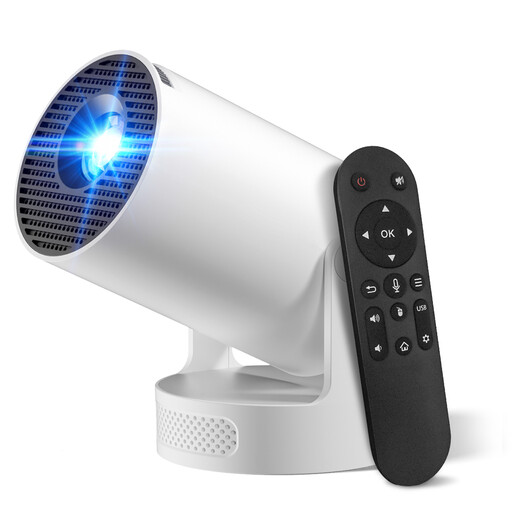
The Freestyle 2nd Gen is a compact option for anyone who regularly changes the projection direction.
The T2 Plus GTV is a portable projector with a built-in stand function in the handle and Google TV.
This selection includes models designed for short throw distances or flexible positioning. Assess the viewing angle of your screen material and its suitability for your side seats separately.
 No image available
The stated throw ratio of 0,52:1 is useful if the projector needs to be close to the screen.
WXGA 1280 × 800; 3800 ANSI lumens; vertical keystone correction; built-in 10 W speaker.
 No image available
Autofocus, automatic keystone correction and a 360° gimbal are useful if you often change your setup; digital correction is no substitute for optical lens shift.
520 ISO lumens; native 1080P; Google TV; stated projection size of 40–150 inches.
 No image available
The stated 180° rotation and automatic screen correction may be useful if you want to adjust the projection direction; check the final image position in your room.
Built-in Android and Google Play Store; stated image size of 50–200 inches; Wi-Fi 6 and Bluetooth.
 No image available
The stated 180° rotation and automatic image correction may be useful if you want to adjust the projection direction; check the final image position in your room.
Built-in Android system with Google Play Store; stated image size of 50–200 inches; Wi-Fi 6 and Bluetooth.
 No image available
Check the throw ratio and the distance from the lens to the screen to see whether this model will fit in your chosen position. The stated vertical keystone correction is not horizontal lens shift.
Native 4K UHD; DuraCore laser light source; manual zoom; throw ratio of 1,21:1–1,59:1; stated throw distance of 1–8 m; weight 3,4 kg.
No. Keystone correction adjusts the shape of the projected image when the projector isn't pointing straight at the screen; it doesn't change the viewing angle of the screen material. For side seating, check the material specifications and use keystone correction only to assess projector alignment.
Measure the desired image width and the distance from the lens to the screen, then compare them with the throw ratio of the exact model. Also check how much horizontal and vertical lens shift is possible at the same time.
For your chosen model, check the type of light source, its stated lifespan and the maintenance instructions. Epson specifies a lamp for the EH-TW7000; BenQ lists a 4LED light source for the W4100i. A stated lifespan is no guarantee that every unit will last that long without maintenance.
According to ACM ConsuWijzer, if a product breaks sooner than you could reasonably expect under normal use, the seller must provide an appropriate free remedy under the statutory guarantee. This is separate from any additional manufacturer or seller’s guarantee.
According to the Government of the Netherlands, you need the creator's permission to show copyright-protected films in public. Buying a projector doesn't give you screening rights; check permission for a specific screening separately from watching privately at home.