
Host with side seating
Wants guests sitting off-centre to see the screen clearly, so compares screen materials by their stated viewing angle.


Start with the seat furthest to the side: choose a screen material with a viewing angle that suits it, and darken the room where possible. Then measure the throw distance and desired image width. Use lens shift if the projector can’t be positioned centrally, or weigh the convenience of digital keystone correction against the potential loss of image quality.
Wants guests sitting off-centre to see the screen clearly, so compares screen materials by their stated viewing angle.
Can’t place the projector directly in front of the screen, so weighs up throw distance, lens shift and digital correction.
Can’t fully darken the room, so needs to balance lighting conditions and screen material with visibility from the side seats.
First check the viewing angle from the seat furthest to the side, then measure the projector position and image size. Finally, assess ambient light, playback and sound.
| What to consider | What should you check? | Who is this important for? |
|---|---|---|
| Visibility from the side seats | Work out the angle from the seat furthest to the side and compare it with the viewing angle of the exact screen material. | If I’m watching from the seat furthest to the side, I want to know whether the screen material is suitable. Around 36% of consumers say side-seat visibility is their top purchasing priority. |
| Projector position and image size | Measure the distance from the lens to the screen, the desired image width and how far the projector is from the centre line. Check the model’s throw ratio and lens shift or keystone range. | If the room layout means the projector can’t be positioned centrally, I want to know in advance whether the distance and correction options will work. Projector placement is the top purchasing priority for around 29% of consumers. |
| Visibility in ambient light | Work out how much light will be left on during the screening, then compare the stated light output and viewing angle of the chosen screen material. | If the room can’t be darkened properly, I want to take the lighting conditions into account without overlooking visibility from the side. Around 21% of consumers prioritise visibility in ambient light above all else. |
| Playback and sound | Check the connection for your playback source, the audio options and the requirements for your planned screening. | For consumers whose main concern is making sure the documentary source and sound work for the group, this is the top priority. It’s the leading purchasing priority for around 14%. |
Lens shift and keystone correction change the position or shape of the projected image. They don’t widen the screen material’s viewing angle.
First check visibility from the seat furthest to the side and the screen’s stated viewing angle, then assess the projector position.
For CineGrey 3D, Elite Screens specifies a viewing angle of 90° and a minimum throw ratio of 1.5 times the image width. The manufacturer says the material isn’t suitable for short-throw or ultra-short-throw projectors.
Check the viewing angle, throw ratio and compatibility of the exact screen material with your projector.
BenQ warns that digital keystone correction can reduce image quality and cause grey borders.
Position the projector as squarely as possible. If you can’t move it, compare the corrected image with the placement options offered by a model with suitable optical correction.
According to the Dutch government, you need the creator’s permission to show copyrighted films in public. FilmService describes licences for public screenings outside the home.
Before announcing a public screening, check which screening and advertising rights apply to the documentary and planned event.
The EH-TW7000 is a home projector worth considering if the projector can’t be positioned on the centre line.
BenQ positions the TK860i as a home cinema model for brighter rooms.
The PX728-4K is a model to compare for a temporary set-up that uses digital correction.
The HORIZON is worth comparing if you set up the projector afresh for every screening.
CineWhite UHD-B and CineGrey 3D screen materials are useful references to compare when guests will be sitting off-centre.
Projector options on Joybuy for a documentary night, with placement, playback and sound in mind.
 No image available
The short throw ratio may work if the projector needs to be close to the screen; separately check whether the screen material is suitable for side seating.
The product description lists WXGA 1280 × 800, 3800 ANSI lumens, a throw ratio of 0,52:1, vertical keystone correction, an HDMI input and a built-in 10 W speaker.
 No image available
The rotating gimbal and stated correction features may be useful if you want to set up the projector in different places; they don’t change the screen’s viewing angle.
The title lists native 1080P FHD, built-in Google TV and a 360° rotating gimbal. The product description lists 520 ISO lumens, automatic focus and keystone correction, and two 5 W speakers.
 No image available
The stated automatic keystone correction may be useful when aligning the projector during set-up; also assess the picture from where your guests will be sitting.
The title lists native 1080P and automatic keystone correction. The product description lists 1000 ANSI lumens, Whale OS and two 8 W speakers.
 No image available
The stated rotation and automatic screen correction may suit a set-up where you want to adjust the projection direction; check that your playback source can connect.
The title lists an image size of 50–200 inches, digital zoom of 50–100%, 180° rotation and compatibility with HDMI and USB drives.
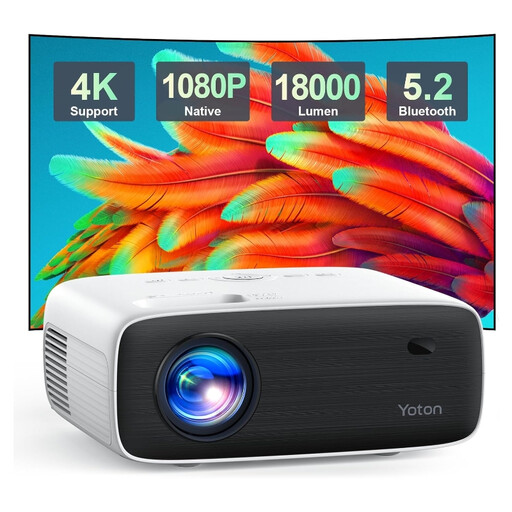 No image available
The description mentions a compact, portable design; check the connections you need and the sound from the seats before choosing this model for your set-up.
The title lists native 1080P, 4K support and Bluetooth 5.2. The product description lists HDMI, USB and AV connections, along with a built-in speaker.
Not directly: lens shift moves the projected image if the projector isn’t ideally positioned. For side seating, check the screen material’s stated viewing angle separately.
Measure the distance from the intended lens position to the screen and the desired image width. Compare these with the throw ratio or the manufacturer’s stated distance for that image size, and check any sideways offset against the lens shift range.
No. For CineGrey 3D, Elite Screens states a minimum throw ratio of 1.5 times the image width and says it isn’t compatible with short-throw or ultra-short-throw projectors. Check the guidance for the exact screen material and projector model.
Before the evening, test your chosen playback source and check the sound from the seats at the back. For maintenance, consult the manual for the exact model: Epson gives the EH-TW7000 a lamp life of 5,000 hours in Eco mode, not in every usage mode.
Check the rights for the documentary and the conditions for your planned screening. According to the Dutch government, you need the creator’s permission to show copyrighted films in public; FilmService describes licences for public screenings outside the home. This information doesn’t give a definitive answer for every private gathering at home.