
Organisers of events in a bright shared space
You want the film to remain visible from different seats, even if you can’t darken the room completely. So pay attention to the light falling on the screen and your chosen image size.


Start by considering the light falling on the screen, your preferred image size and the available distance; then choose a projector. A standard projector is suitable if you have enough projection distance, while ultra-short-throw projection can help in a tight setup. A compact projector is worth considering if you can darken the room and want to move the device around. Also check the connections and sound. If you’re showing a film outside the home, you may need permission from the rights holders.
You want the film to remain visible from different seats, even if you can’t darken the room completely. So pay attention to the light falling on the screen and your chosen image size.
If there’s little distance to the screen or people will be walking through the projection path, measure the available space and screen size in advance.
You move the projector between screenings and may be able to darken the screen area. Weigh up how easy it is to move against the stated light output of the exact model.
Choose this option: if you have enough distance between the projector and the screen. BenQ lists Full HD and 3500 lumens for the TH585P; check the distance needed for your screen size.
Bear in mind: a higher stated light output doesn’t mean you can skip darkening the room. An integrated speaker alone doesn’t tell you whether the sound will be clear from every seat.
Choose this option: if you need to keep the projection path clear or there’s little space at the back of the room. Epson describes the EB-770F as a Full HD projector with ultra-short-throw projection.
Bear in mind: measure your screen and setup for the exact model; projection distance varies between projectors.
Choose this option: if you regularly move the projector between rooms and can keep the screen out of direct light. Philips lists a rotating stand and Full HD for the NeoPix 444.
Bear in mind: Philips specifies 500 ANSI lumens for this model; consider that alongside the lighting conditions and image size.
| What to consider | What should you check? | Who is this important for? |
|---|---|---|
| Visibility in ambient light | See where daylight and lamps fall on the screen, then compare the stated light output of the exact model with your preferred image size. | If I want to keep dark details in the film visible in a room that can’t be completely darkened, I focus on the light falling on the screen. Visibility is the main priority for around 31% of consumers. |
| Positioning and walking space | Measure the distance from the lens to the screen and the available screen width, then compare these with the projection details for your intended image size. | If there’s little space behind the viewers or a walkway crosses the projection path, I look for a position that won’t obstruct the setup. Positioning is the main priority for around 25% of consumers. |
| Film source and sound | Check that the connections are compatible with your playback device and whether you need an audio output or external sound. | If the film needs to play from my own device and be clearly audible from several seats, I check both the connection and the sound. Playback and sound are the main priorities for around 19% of consumers. |
| Moving between rooms | Check the dimensions and power requirements, and consider whether you can darken each of the different rooms enough. | I move the projector regularly and want to set it up again easily, without losing sight of visibility at my chosen image size. Portability is the main priority for around 13% of consumers. |
| Maintenance with repeated use | Read the model-specific information about the light source, operating mode, maintenance and warranty. | For regular screenings, I want to know in advance what maintenance the projector needs and what service comes with the model. Maintenance is the top priority for around 12% of consumers. |
Light falling on the screen can make dark details in a film look washed out, even with a projector that has a higher stated light output. Specifications also apply to the exact model.
First assess the light falling on the screen and your preferred image size. Then compare the model specifications without assuming different models will perform the same way in your room.
Depending on the room, you may need to darken it or change the screen setup.
A standard projector and an ultra-short-throw projector produce a given image size from different distances. If the position doesn’t work, you may need a different projector or screen setup.
Measure the distance from the lens to the screen and the available screen width before choosing a model. Compare these measurements with the projection details for that exact model.
Bear in mind that you may need to adjust the projector position, mount or screen setup.
Buying a projector doesn’t give you the right to screen films. According to Auteursrecht.nl, permission from the rights holders is required to show copyrighted material outside the home; a private club event or recreation room in a care home doesn’t automatically fall under that exception.
Before the screening, check what rights you have for the film and who will make up the audience. Get permission from the rights holders if necessary.
Arranging permission in advance may require extra preparation.
The CO-FH02 is an example of Full HD projection at a standard distance, while the EB-770F demonstrates an ultra-short-throw setup.
The TH585P is a Full HD option for standard projection distances. Check in advance that the position and connections suit your film source.
The NeoPix 444 is an example of a compact Full HD projector with a rotating stand, suited to a portable setup.
The CineBeam S PU615U is an example of a compact ultra-short-throw projector for situations where positioning it close to the screen is important.
These projectors are intended for watching films in a shared space. Check the required distance, lighting conditions, connections and sound setup for each model.
 No image available
An option to consider if you can match the image size and projection distance to the room in advance.
Native 1080P; stated 1000 ANSI lumens; 60 inches from 1,33 m according to the product description.
The description lists HDMI and USB, along with two built-in 8 W speakers.
 No image available
A candidate for a standard-throw setup; measure the position and screen size before choosing.
The product description lists 4K UHD and 3500 lumens. The stated throw ratio is 1.21:1–1.59:1.
Two HDMI inputs, a 3.5 mm audio output and two built-in 15 W speakers are listed.
 No image available
An option to consider if you want to position the projector close to the screen; check that the stated distance suits your setup.
The product description lists Full HD 1080p, 650 lumens and a throw ratio of 0.18:1.
For 60–100 inches, the description gives a projection distance of 0,26–0,4 m. It also lists HDMI 2.0 and two built-in 10 W speakers.
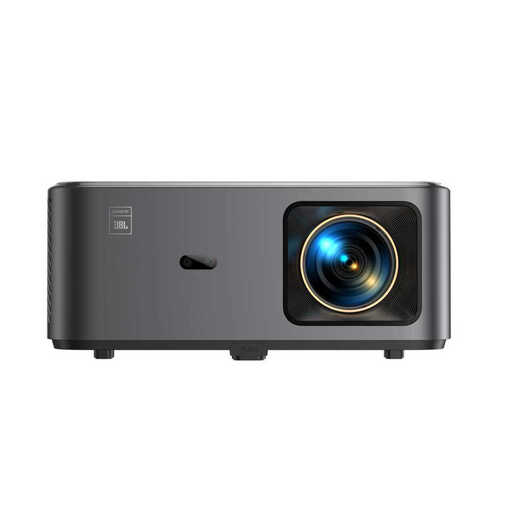 No image available
A film projector to compare if autofocus and automatic keystone correction are useful for your setup.
Native 1080p; the product information lists two HDMI 2.0 inputs and two 10 W speakers.
The product information states that this model isn’t waterproof. Protect it from rain, dew and moisture.
 No image available
A portable option to compare if you can assess the screen size, distance and ambient light in advance.
Native 1080p; the product description lists 900 ANSI lumens and a projection distance from 1,35 m.
The stated throw ratio is 1:1. HDMI, USB and a built-in 15 W speaker are listed.
If the material is copyrighted and the screening takes place outside the home, you need permission from the rights holders. Auteursrecht.nl doesn’t automatically consider a private club event or recreation room in a care home to be a screening covered by that exception. Check what rights you have for the film and who will make up the audience; buying a projector doesn’t give you the right to screen films.
Measure the distance from the lens to the screen and the available screen width. Compare these with the projection details or calculator for the exact model; standard and ultra-short-throw projection require different distances.
It depends on the room and seating, so check the model’s audio options and test the sound from the furthest seat. BenQ lists a 10 W speaker and a 3.5 mm audio output for the TH585P; those specifications alone don’t tell you whether you’ll need external sound.
No. The Dutch government states that the Netherlands has no fixed statutory warranty period; you’re entitled to a product that does what you can reasonably expect it to do. Any manufacturer’s warranty is separate. When buying, ask what service applies to the exact model.