
Presenter with viewers seated to the side
You want all the reviewers to be able to see your portfolio, including those seated at an angle. Look separately at the screen’s viewing angle and the projector’s position.


For a portfolio presentation with viewers seated at an angle to the screen, first choose a screen whose stated viewing angle suits the seats furthest to the side. Lens shift moves the image, but it does not widen the screen’s viewing angle. Then compare colour and detail, the amount of ambient light in the room and the available projection distance. Epson explains that lens shift positions the image, while Elite Screens Europe and ProjectorCentral explain how screen material and gain affect the picture.
You want all the reviewers to be able to see your portfolio, including those seated at an angle. Look separately at the screen’s viewing angle and the projector’s position.
You’re presenting illustrations, photography or other graphic slides where colour and detail matter. Treat stated colour specifications as model-specific claims and, if possible, see how your own work looks in the room.
You need to set up the projector in a limited space and want to avoid people walking through the beam. Measure the distance to the screen before choosing a model.
Assess visibility from the seats furthest to the side separately from the projector’s position. Then compare the picture specifications with your portfolio, the room lighting and the available distance.
| What to consider | What should you check? | Who is this important for? |
|---|---|---|
| Visibility from seats at an angle | Compare the screen material and stated viewing angle; Elite Screens Europe gives CineWhite a 180° viewing angle. | If reviewers are seated at an angle to the screen, I want the picture to remain clearly visible from the seats at either side. Around 31% of consumers say side viewing is their main concern when buying. |
| Colour and fine detail | Compare the picture resolution, available picture modes and connections; if possible, view slides from your own portfolio. | When presenting blocks of colour and fine lines, I want to know how my slides will look on the model I choose. Around 25% of consumers prioritise colour and detail. |
| Legibility in ambient light | Note the image size you want and whether the room can be darkened; compare the stated brightness of the models. | If you’re presenting in a lit room, I want to be able to assess image size and ambient light together. Around 25% of consumers say legibility in ambient light is their main concern when buying. |
| Projector position and distance | Measure the distance and position relative to the screen; check the throw ratio, zoom and any lens shift for the exact model. | In a small or shared room, I want to be able to set up the projector in the space available. Positioning is the main concern for around 19% of consumers. |
Lens shift changes the position of the projected image. The screen’s viewing angle also affects what viewers can see from the side.
Assess the seats furthest to the side and the screen specifications separately from the projector’s position.
You may find that the final set-up calls for a different screen or a revised seating arrangement.
ProjectorCentral explains that high-gain screens can direct light more strongly, which may make viewing less favourable from an angle.
Compare gain with the stated viewing angle and assess the screen from the seats people will actually use.
BenQ specifies the LH730 as a 1080p projector and also states that it supports a 4K UHD input signal. These are different features.
For small text and fine lines, compare the exact model’s native resolution rather than looking only at the input it supports.
The EH-TW7100 and EB-L210SF may suit different positioning needs; their installation features are not interchangeable.
The business-focused LH730 is a model to compare for graphic portfolio slides in a presentation room.
The ZH450 is a Full HD laser projector to compare if its stated brightness and zoom are relevant to your needs.
This selection includes projectors for portfolio presentations, with a range of stated resolutions, brightness levels and positioning features to compare with your room and slides.
 No image available
Its stated 4K UHD specification makes this a model to compare if fine portfolio details are important.
4K UHD; dual laser; DLP; 3,800 lumens; 1.3× zoom; 15 W speaker.
 No image available
Its stated 4K UHD specification is worth comparing if your portfolio slides include fine detail.
4K UHD; triple laser.
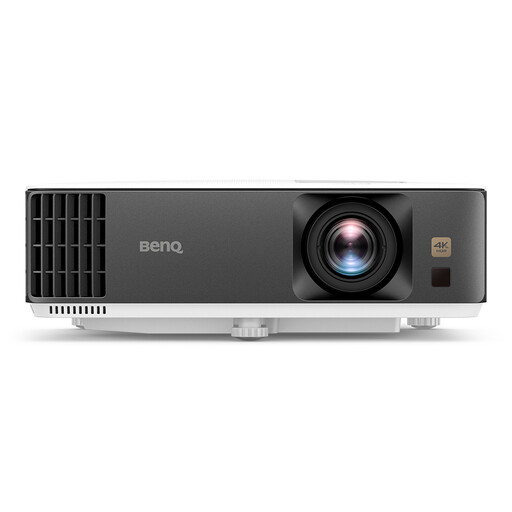 No image available
Compare the stated UHD 4K resolution and standard throw distance with your preferred image size and available space.
UHD 4K (3840 × 2160); 3,200 ANSI lumens; DLP; 1.3× zoom; automatic vertical keystone correction.
 No image available
The stated 1080p resolution is worth considering if your portfolio includes lots of fine lines; compare it with the resolution you need for your work.
1080p; 800 ANSI lumens; 110% BT.2020 colour gamut; 2-hour battery life; HDMI 2.1; USB-C.
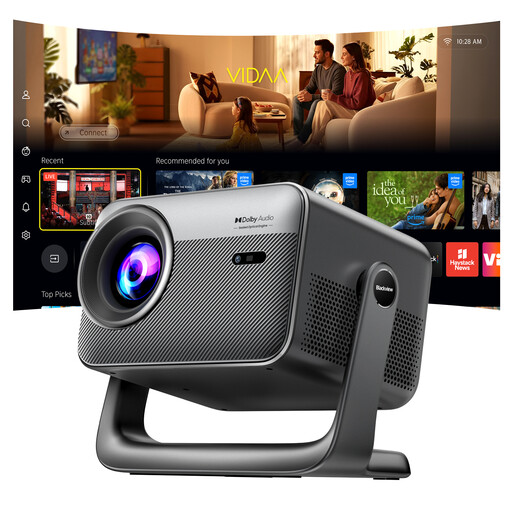 No image available
The stated image size and rotating design are useful points of comparison for your preferred set-up; check that the positioning works in your room.
Native 1080p; 1,000 ANSI lumens; 40–150-inch image size; 360° rotation; TOF autofocus.
No. Horizontal lens shift moves the projected image when the projector isn’t centred in front of the screen. You also need to assess the screen’s viewing angle for viewers seated to the side.
Measure the available distance between the projector and the screen, and decide on your preferred image size. A short-throw model can be positioned close to the screen, but the positioning range of the exact model must suit your space.
Compare your laptop’s output with the inputs on the exact projector model and test your slides in advance. BenQ says the LH730 has two HDMI inputs; that doesn’t tell you which port or adapter your laptop needs.
According to ACM ConsuWijzer, the statutory cancellation period for an online purchase generally ends 14 days after delivery; check whether a legal exception applies. You’re also entitled to a legal guarantee if a product doesn’t meet what you could reasonably expect when used normally.
Not unless the applicable product rules have been followed. Electrical equipment covered by the Low Voltage Directive must meet requirements including safety, CE marking and clear instructions. The EU rules that apply to a particular projector, power supply or wireless version must be assessed for each product; a general product description does not prove compliance.