
Opera viewers seated to the side
You watch with others seated in different positions and want to know whether the image will still be easy to see from the side. Stewart Filmscreen explains how brightness can decrease when you sit further off-centre.


Start with the seating and the screen: lens shift moves the projected image, but it won’t automatically make the screen easier to see from the side. If seats are spread out, choose screen material with a viewing angle suited to the seats furthest from the centre. Also check the projection distance, projector position, ambient light and connection to your sound system. Stewart Filmscreen explains that image brightness can decrease when viewers sit further off-centre.
You watch with others seated in different positions and want to know whether the image will still be easy to see from the side. Stewart Filmscreen explains how brightness can decrease when you sit further off-centre.
You can’t position the projector directly opposite the screen, so you need to match the projection distance and any horizontal image shift to the room. Epson and XGIMI describe lens shift as a way to adjust the position of the projected image.
You want to play opera recordings through an external player or sound system, so you’ll need to compare the projector’s connections with those on your existing equipment. Check the complete connection between player, projector and sound system.
First assess where the projector can go and where people will sit. Then consider the screen material, the room’s lighting and the connections for picture and sound.
| What to consider | What to look for | Who is this important for? |
|---|---|---|
| Viewing from seats to the side | Map out the seats furthest from the centre and compare them with the screen material’s viewing angle and, if specified, its half-gain value. | If I’m sitting off-centre with others, I want the image to remain easy to see from there too. Around 36% of consumers put visibility first. |
| Installation position and image placement | Measure the available projection distance and how far the projector will be from the centre line. Check the lens shift on the exact model and how its adjustment ranges work together. | If the projector can’t be positioned on the centre line, I want to know whether the position will work in my room. Around 29% of consumers prioritise installation flexibility. |
| Picture in the available light | Work out whether you can darken the room while watching. Compare brightness specifications only when their units of measurement match, and consider a light-rejecting screen’s viewing angle too. | If I can’t fully darken the room, I want the projector and screen combination to suit the available light. Picture quality in those lighting conditions is the top priority for around 21% of consumers. |
| Sound and connections | Make a note of your player’s outputs, your sound system’s inputs and the projector’s connections. Check the entire signal chain. | For opera recordings, I want to connect my chosen sound system without making assumptions about the connections. Around 14% of consumers put connectivity first. |
Lens shift helps align the projected image when the projector isn’t directly in front of the screen. On its own, it says nothing about how the screen distributes light to viewers sitting to the side.
Mark both the projector position and the seats furthest from the centre, and assess the projector and screen separately.
According to XGIMI, the HORIZON 20 offers horizontal shift of up to ±45% only when vertical shift is set to zero. XGIMI also states that certain automatic picture features aren’t supported after using lens shift.
Check the adjustment range available for your installation when both directions are used together, rather than adding two separate maximum values.
You may need to move the projector or adjust the mounting position.
How screen material distributes light and blocks ambient light are separate considerations. A stated viewing angle doesn’t guarantee that every seat will have an equally bright picture.
Check the viewing angle and gain of the specific screen material, and, where possible, assess the combination from the seat furthest from the centre.
The EH-TW7100 is worth comparing if horizontal lens shift and connections for an external player are important to you.
The HORIZON 20 is worth considering if you want to compare optical zoom and lens shift.
The W2720i is worth considering for a largely centred installation where the connections suit the buyer’s equipment.
These projectors are designed for home entertainment. Compare the resolution, projection distance and connections listed for each model. If some viewers will sit off-centre, assess the screen material separately too.
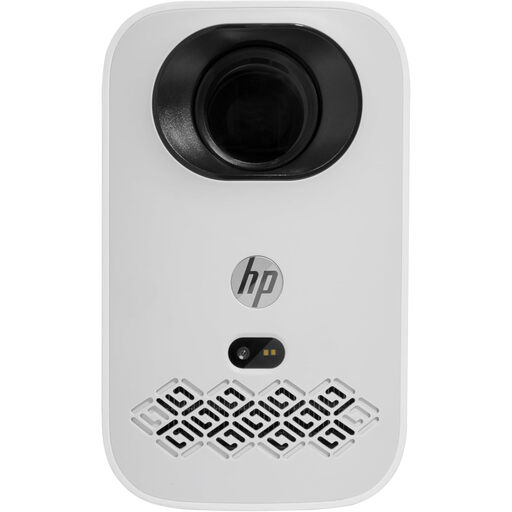 Image unavailable
For Full HD recordings from an external source, the stated resolution and HDMI connection are relevant. The description also mentions pre-installed streaming apps.
Native 1080p; stated light output: 500 LED lumens and 220 ANSI lumens. These are different units of measurement.
 Image unavailable
For an external 4K UHD source, the stated resolution and two HDMI 2.0 inputs are relevant. Also check that the projection distance suits your room.
Stated throw ratio: 1,21:1–1,59:1; manual zoom: 1,3×. The description also mentions a DuraCore laser light source.
 Image unavailable
For Full HD at short range, the stated 1080p resolution and projection distance are relevant. Check the distances needed for your preferred picture size.
Stated projection distance: 0,26–0,4 m; throw ratio: 0,18:1. The description lists an HDMI 2.0 input, built-in speakers and an S/PDIF output.
 Image unavailable
For a compact set-up, check that the stated projection distance and image position suit the space available.
Native 1080p; stated light output: 900 ANSI lumens. The title mentions Android 14; the description lists a throw ratio of 1:1 and a projection distance starting at 1,35 m.
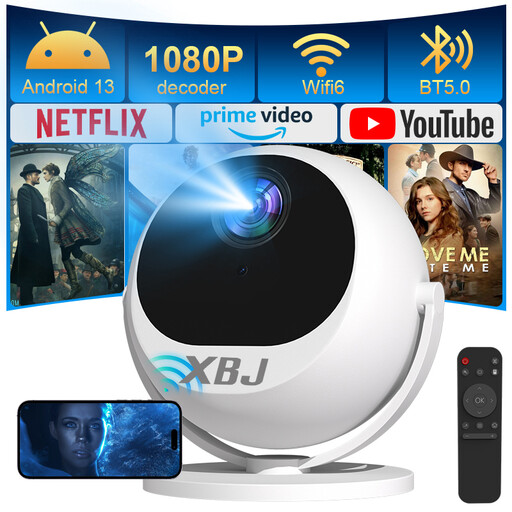 Image unavailable
For Full HD viewing from an external source, the stated resolution and HDMI compatibility are relevant. Check that the rotating placement suits your projection position.
The title lists Full HD 1080P, 360° rotation and 500 lumens. The description mentions built-in speakers and Bluetooth audio.
Not directly. Lens shift moves the projected image to align it with the projector’s position. For viewers sitting to the side, you should focus on the screen material and how it distributes light. Stewart Filmscreen explains that brightness can decrease when viewers sit further off-centre.
Measure your preferred screen width and the available distance, check the throw ratio for the exact model, then work out the horizontal and vertical image shift required. Epson has a projection distance calculator that can also show lens shift, depending on the model selected.
Follow the manual for your chosen model. For projectors with an air filter, Epson recommends checking the filter and air intake if you see an overheating or filter warning. Follow the model-specific instructions for cleaning and maintenance.
According to the Dutch government, online purchases often come with a 14-day cooling-off period. If a product is faulty on delivery, the Dutch government explains that you may have the right to a repair or replacement; the exact rules depend on the circumstances.
CE marking is relevant when applicable harmonised EU rules require it for the product in question. According to the European Commission, it indicates that the manufacturer considers the product to meet the applicable requirements; it isn’t an independent quality mark for picture or sound. Check the information for the specific product you’re buying.