
Off-centre viewers
If you position the projector directly opposite the screen but watch from an off-centre seat, first compare the viewing angle of the specific screen material. Elite Screens lists different viewing angles for different materials.


If only your seats are off-centre, first check the viewing angle of the screen material: lens shift does not change it. If the projector itself is off-centre, compare the horizontal lens shift you need with the model’s specifications. For a fixed installation, optical lens shift can be an alternative to digital keystone correction, which BenQ says can affect sharpness, edges or image size. Check the original aspect ratio for each film release so you don’t stretch the picture unintentionally.
If you position the projector directly opposite the screen but watch from an off-centre seat, first compare the viewing angle of the specific screen material. Elite Screens lists different viewing angles for different materials.
If the projector needs to sit off-centre, measure the horizontal shift required and compare it with the model’s lens shift or correction features. Epson and XGIMI describe these features for specific models.
If you want to watch classic films without stretching the picture, check the aspect ratio of the specific film release. The Criterion Collection lists different aspect ratios for one film title.
When: Choose this approach if only the viewing positions are off to the side. Compare the viewing angle of your chosen screen material with that of the furthest seat.
Consider: A viewing angle specified for one screen material does not automatically apply to another.
When: First check the horizontal lens shift required, the projection distance and the zoom range of the specific model. Epson lists ±24% horizontal lens shift for the EH-TW7100; XGIMI lists up to ±45% for the HORIZON 20, but only when vertical shift is set to zero.
Consider: These figures apply to the models and conditions specified; they are not a general benchmark for projectors.
When: Check whether digital correction is needed after positioning the projector as well as you can.
Consider: BenQ warns that keystone correction can affect image edges, sharpness or image size; it does not change the screen’s viewing angle.
| What to consider | What to look for | Who it matters most to |
|---|---|---|
| Viewing from the side | Compare the viewing angle of the exact screen material with your seating positions. For example, Elite Screens lists 180° for CineWhite and 80° for a CineGrey 5D version. | If I’m watching from a seat off-centre, I want to know whether the picture still looks right from there. Around 36% of consumers prioritise off-axis viewing. |
| Projector off-centre | Measure the horizontal offset and projection distance; check the horizontal lens shift and any conditions for simultaneous vertical shift. | If the projector can’t sit directly in front of the screen, I want to know whether its optical placement is within the model’s range. Around 29% of consumers prioritise projector placement. |
| Original aspect ratio | Check the aspect ratio of the specific film release and whether the source and projector can display the picture without stretching it. | When watching a classic film, I want to preserve the chosen presentation rather than stretch the picture to fill the screen. Around 21% of consumers prioritise the original film framing. |
| Lighting and maintenance | Only compare brightness figures when they use the same measurement basis. For lamp models, check the stated lamp life for each operating mode and whether the lamp is replaceable. | If I watch in a partly lit room or play films often, I want to factor in lighting conditions and maintenance. Around 14% of consumers name these as their main concerns. |
Lens shift moves the projected image, but it does not change the viewing angle of the screen material.
Mark the screen position, projector position and furthest seat separately before comparing models.
BenQ warns that digital correction can affect edges, sharpness or image size.
First check the projection distance and optical placement. Then assess the corrected image from the seats you use.
Elite Screens lists different viewing angles for different screen materials. The stated angle for one version does not automatically apply to other materials.
Compare the exact screen material with the furthest seat, and take the room’s lighting into account too.
Philips lists native Full HD for the NeoPix 230, while a Joybuy product listing also gives 320 × 240 as the native resolution.
Check the full model code and the resolution of the exact version before making your choice.
The EH-TW7100 is an example of a projector for a fixed home cinema setup, where horizontal lens shift and optical zoom may be useful.
According to XGIMI, the HORIZON 20 combines home cinema features with flexible placement and automatic image adjustment.
The TK710 is an example of a model with digital horizontal keystone correction; check each model’s placement options.
The NeoPix 230 Smart is a compact projector with automatic horizontal and vertical keystone correction.
These projectors are options to consider for a home setup. Check that each model’s placement and picture settings suit your screen and how you watch films.
 Image unavailable
The listed 1.3× manual zoom may be useful if you want to adjust the image size in a fixed setup.
The product name lists 4K UHD, 3800 Lumens and 1.3× zoom.
 Image unavailable
Autofocus and keystone correction may be useful if you’re looking for a projector with image adjustment features.
The product name lists Native 1080P, 1000 ANSI Lumens, autofocus and automatic keystone correction.
 Image unavailable
The listed rotation may be useful if you’re considering a ceiling setup; check whether the projector can be positioned where you want it.
The product name lists 50%–100% digital zoom, automatic screen correction and an HDMI connection.
 Image unavailable
Optical zoom may be useful if you want to adjust the image size in a fixed setup.
The product name lists 1080P, 1600 ISO Lumens and optical zoom.
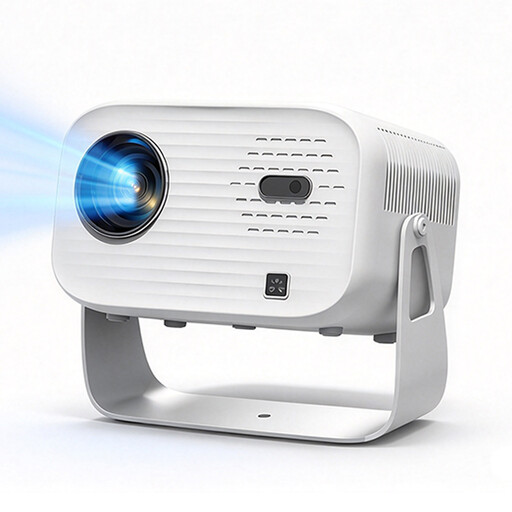 Image unavailable
The rotating stand may be useful if you regularly need to point the projector in a different direction; check the position you need for your screen.
The product name lists Native 1080P, automatic keystone correction and a 360° rotating stand.
No. Sitting off to one side and placing the projector off-centre are two different situations. For an off-centre seat, first compare the viewing angle of your chosen screen material. Only consider lens shift if the projector itself can’t sit directly in front of the screen.
Keystone correction digitally adjusts the shape of the picture, but it can also affect how it looks. BenQ notes possible effects on jagged edges, sharpness and image size. Position the projector as well as you can first, then assess the correction.
Check the specific film release, as not every classic film has the same aspect ratio. The Criterion Collection lists presentations in 1,33:1, 1,66:1 and 1,85:1 for one film title. Preserve the chosen presentation without stretching the picture.
For a lamp model, check the stated lamp life for each operating mode and whether the lamp can be replaced. According to the Dutch government, the Netherlands has no fixed statutory warranty period; if a product is faulty, contact the seller.
The party placing a projector on the Dutch market must comply with the applicable European product rules. The manufacturer must apply the required CE marking and draw up an EU declaration of conformity; wireless features may also be subject to radio equipment rules. These general requirements do not, on their own, confirm that a specific unit is compliant.