
Viewers with a shallow room
If you only have one suitable spot on a shelf, the distance to the wall and the achievable image width are key. Optoma Europe lists a throw ratio of 0,496:1 for the GT2000HDR.


First, measure the distance from the shelf to the wall and decide how wide you want the image to be: a compact design doesn’t guarantee that the projection will fit. Then choose a suitable native resolution and position the projector as straight as possible. BenQ warns that strong digital keystone correction can affect sharpness.
If you only have one suitable spot on a shelf, the distance to the wall and the achievable image width are key. Optoma Europe lists a throw ratio of 0,496:1 for the GT2000HDR.
When you’re watching dialogue-heavy shows, you’ll want to read the subtitles clearly from your seat. BenQ warns that digital keystone correction can affect sharpness, among other things.
If you want to put the projector away after use, it’s not just its dimensions that matter. You’ll also need to consider the connections you need and how easy it is to set up again. Epson Nederland lists portability as a factor to consider when choosing.
Best suited to: situations where the distance between the shelf and wall is the limiting factor. Optoma Europe specifies a throw ratio of 0,496:1 for the GT2000HDR.
Bear in mind: you’ll still need to allow enough room for the shelf position and ventilation.
Best suited to: situations where you want to put the projector away and the shelf is far enough from the wall. The adjustable base on the BenQ GV50 can help you position it.
Bear in mind: the projector’s footprint and throw distance need to work independently. According to BenQ, significant digital correction can affect sharpness.
Best suited to: situations where you want to cut down on separate streaming devices. Epson Nederland lists Google TV and Full HD for the EF-61R; XGIMI also lists these features for the MoGo 4 Laser.
Bear in mind: built-in streaming doesn’t guarantee that a particular title has the subtitles you want. You’ll also need to check the required throw distance.
Start by measuring the distance from the shelf to the wall and deciding how wide you want the image to be. Then compare subtitle clarity, the light in the room and how many separate devices you want to use.
| Concern | What to look for | Who is this more important for? |
|---|---|---|
| Getting the right image size | Measure the distance from the lens to the wall and compare it with the throw ratio or distance chart for the exact model. | If I only have one suitable spot on a shelf, I want to know in advance whether I can achieve the image width I want from there; around 34% of consumers say throw distance is their main buying concern. |
| Readable subtitles | Check the native output resolution and try the image from your viewing position, using as little keystone correction as possible. | When watching dialogue-heavy shows, I want to read small subtitles comfortably, without unnecessary digital correction; around 33% of consumers prioritise subtitle clarity. |
| Picture quality in ambient light | Decide whether you’ll watch in a darkened room or with the lights on. Only compare brightness using the same unit of measurement and similar conditions. | If I don’t want to keep darkening the room, I want to know how the image looks in the available light; around 20% of consumers prioritise watching with ambient light. |
| Connecting and putting it away | Check that you can use the app or HDMI source you want and find out what power supply the set-up needs. | I want to have as few separate items as possible to put away afterwards, so features, power supply and portability all matter; around 13% of consumers prioritise easy connection and tidying away. |
Even a compact projector may need to be placed too far from the wall to produce the image width you want. Measure your set-up and check the throw ratio for the exact model before comparing its shape and size.
You may need a different position or mount if the throw distance isn’t suitable.
A supported input signal isn’t the same as native output resolution. Check the output resolution in the product specifications and assess the text from the viewing distance you intend to use.
BenQ says that stronger keystone correction can affect sharpness and image size, among other things. Position the projector as straight as possible, then use correction only to compensate for any remaining misalignment.
BenQ has issued a recall for the GV31 because its battery may overheat. If you own a GV31, stop using it and contact BenQ about the remedy being offered. This notice applies specifically to the GV31.
BenQ describes the GV50 as a portable projector with an adjustable base.
Epson presents the Lifestudio Pop EF-61R as a portable Full HD smart projector.
The MoGo 4 Laser is a portable projector with a built-in battery and streaming features.
The GT2000HDR is an example of a short-throw set-up for a small gap between the projector and the wall.
This selection includes short-throw and portable projectors for set-ups with limited shelf space. For the specific model, check which EU conformity information and CE marking apply.
 No image available
An option to consider if your shelf is close to the wall; check that the throw distance suits the image width you want.
 No image available
The listed native Full HD output may be useful if you want to read small subtitles. Also check that the projector will fit in your chosen position.
Native 1080p; 8K support; 900 ANSI.
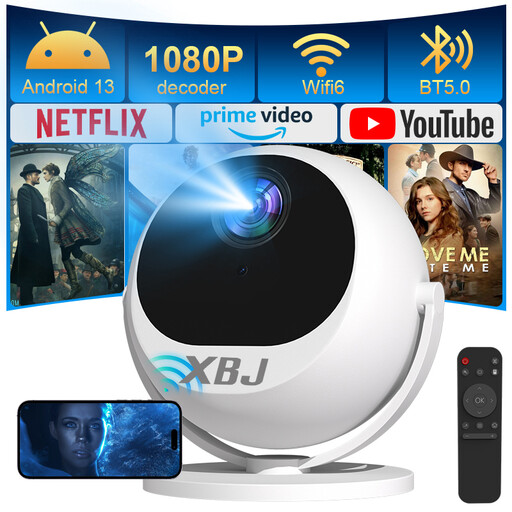 No image available
The rotating design may suit you if you want to point the projector in different directions. Check the position and throw distance you need before buying.
Native Full HD 1080p; 360° rotating design.
 No image available
A short-throw model for when you need a small projection distance. Its native resolution is lower than Full HD, which may make it less suitable for small subtitles.
WXGA, 1280 × 800; 3800 ANSI-lumen.
 No image available
A short-throw model for projecting from close to the wall. Its native resolution is below Full HD, so it has fewer pixels for displaying small subtitles.
Native XGA, 1024 × 768; 3600 ANSI-lumen.
Measure the distance from the lens to the wall and decide how wide you want the image to be. Compare both with the throw ratio or distance chart for the exact model. A short-throw label or compact design alone isn’t enough.
Keystone correction can make the image rectangular, but BenQ warns that it can affect sharpness, among other things. Start by positioning the projector as straight as possible, then adjust the focus.
No, and it doesn’t depend on the projector alone. Netflix says that the languages available vary by title and supported device, so check the title you want to watch and your playback source.
Products covered by harmonised EU rules that require CE marking must carry it. Check which rules and conformity information apply to the specific model on offer; a general product description doesn’t confirm this.
BenQ has issued a recall for the GV31 because its battery may overheat. Owners are instructed to stop using it immediately and contact BenQ about the remedy being offered. This notice applies specifically to the GV31 and not automatically to other BenQ models.