
Viewer with limited space for placement
You want a large picture without putting the projector in the middle of your narrow living room. Compare ultra-short-throw projection with the space you actually have available by the screen wall.


First, measure the available wall width and the distance at which you can place the projector. Then choose a model and screen size. An ultra-short-throw projector sits close to the screen wall, while a short-throw model needs a position further into the room. Also consider ambient light, the projection surface and the aspect ratio of classic films.
You want a large picture without putting the projector in the middle of your narrow living room. Compare ultra-short-throw projection with the space you actually have available by the screen wall.
You’d like to watch films sometimes without completely darkening the living room. Consider the stated brightness alongside the projection surface; a lumen rating on its own doesn’t tell you how the picture will look in your room.
You want to watch classic comedies in their original aspect ratio. Check how the projector and playback source handle films with an aspect ratio that differs from a 16:9 projector.
Choose this if: you don’t have a suitable spot further back in the room, but do have a stable place close to a flat screen wall.
Bear in mind: the available wall width and where you place the device; a suitable screen may require extra space and cost more.
Choose this if: you can place the projector on a piece of furniture or a suitable mount further from the screen wall.
Bear in mind: the distance required varies by model; measure the space and compare it with the device’s throw ratio.
First, measure the wall and the available distance for placing the projector. Then check the picture size, the light in the room and how you want to watch films with a different aspect ratio.
| What to consider | What should you check? | Who is this important for? |
|---|---|---|
| Picture size and placement | Measure the available wall width and the distance between the projector’s position and the screen surface. Then check the throw ratio and installation instructions for the exact model. | If the projector mustn’t be in the way, I want to know whether it will fit near the wall and produce the picture size I want. Around 40% of consumers give placement space top priority. |
| Picture in ambient light | Consider how much light you can block out while watching, which projection surface you’ll use and which unit of measurement the manufacturer gives for brightness. BenQ lists 3000 ANSI lumens for the TK705STi; Epson lists 3600 lumens for the EH-LS670B. | If I can’t darken the living room every time, I want to factor in the light and projection surface beforehand. Around 30% of consumers prioritise watching in ambient light. |
| Film aspect ratio | Check the projector and playback source settings and, if possible, try a film in the aspect ratio you want. BenQ lists a native aspect ratio of 16:9 for the TK705STi. | If I want to watch classic comedies without stretching the picture, I pay attention to how the source and projector display the original aspect ratio. Around 20% of consumers prioritise this. |
| Sound and connections | Check the connections on your playback source and any sound system, what’s included and whether you need a separate screen. BenQ lists HDMI eARC for the TK705STi; Optoma lists two HDMI inputs and a 3.5mm audio output for the GT2000HDR. | If I want to keep my film set-up neat, I want to know whether the sound and connections will work with the devices I already own. Around 10% of consumers prioritise a simple, complete set-up. |
The picture size you can achieve also depends on the exact model’s throw ratio and the available wall width.
Measure your room and check the model’s installation details before choosing a screen size.
Optoma lists native Full HD for the GT2000HDR and also says that the model accepts a 4K signal. These are different features.
When buying, compare the displayed resolution with the signals the device can accept.
Depending on your set-up, you may also need a suitable screen or additional playback and sound equipment.
Check what you already own, what comes with the projector and which connections your set-up requires.
The Lifestudio Grand EH-LS670B is an ultra-short-throw model designed to sit close to the screen wall. Epson lists Google TV and built-in 20 W sound.
The TK705STi is a short-throw model that needs to be placed some distance from the screen surface. BenQ lists Google TV and HDMI eARC.
The Premiere 7 LPU7D is an ultra-short-throw model with built-in speakers and smart features.
The GT2000HDR is a compact short-throw model for anyone who wants Full HD display and HDMI connections.
This selection includes short-throw models and compact projectors for watching films. Check the throw distance, resolution and connections for each model before comparing it with your room and playback equipment.
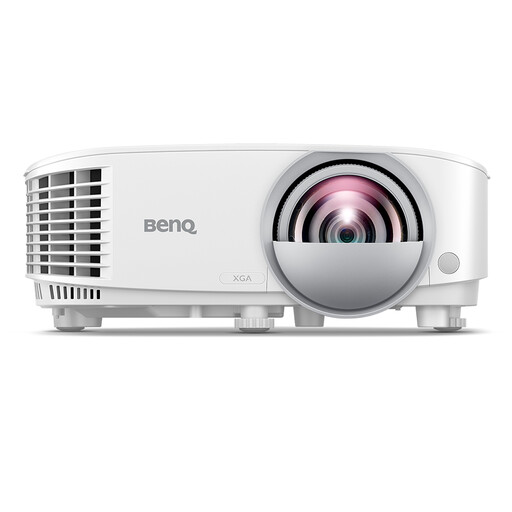 No image available
The short throw and built-in speaker may suit a film set-up where space is limited.
The product name lists 3500 ANSI lumens, DLP, XGA (1024 × 768) and the colour White. The product description lists a built-in 10 W speaker.
 No image available
This short-throw model could be an option if you have a suitable spot further from the screen wall.
The product name lists 3600 ANSI lumens, DLP, XGA (1024 × 768) and the colour White. The product description lists a throw ratio of 0,49.
 No image available
The product name describes this model as short throw; check the distance required for your desired picture size.
The product name lists 3000 ANSI lumens, 3LCD and WXGA (1280 × 800).
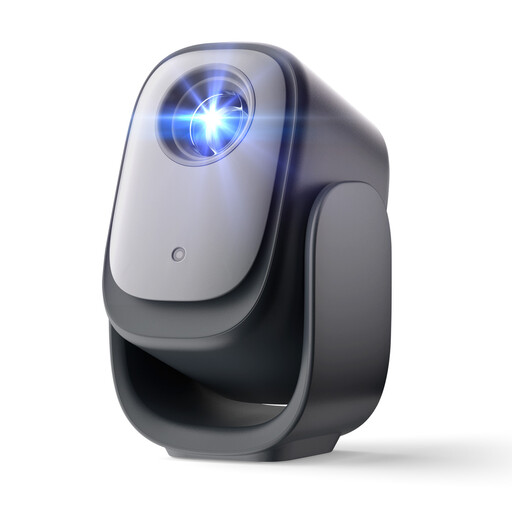 No image available
The product name describes a portable smart projector; check the available space and connections for your film set-up.
The product name lists native 1080P, Wi-Fi and Bluetooth, Dolby Audio, autofocus and automatic keystone correction. Netflix is described as officially licensed.
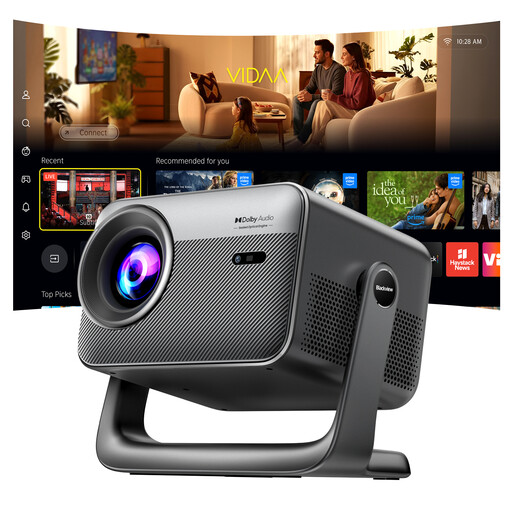 No image available
The product description says short throw; check the stated distance and picture size against the space you have available in your living room.
The product name lists native 1080P, 4K decoding, a picture size of 40–150 inches and a 360° rotatable design.
Measure the available width of the screen wall and the position where the lens can go. Then check the throw ratio and installation instructions for the exact model to find out whether it can produce your desired picture size; don’t rely on the maximum screen diagonal alone.
For the Premiere 7 LPU7D, Samsung says that it can project onto a flat, plain wall, but recommends a dedicated ultra-short-throw screen for the best viewing experience. Check the guidance for the model you’re considering; this is the manufacturer’s recommendation, not a general requirement.
No. Optoma lists native Full HD (1920 × 1080) for the GT2000HDR and separately states that the model accepts a 4K signal. So compare the displayed resolution with the accepted input signals.
According to ACM ConsuWijzer, online purchases generally come with a cooling-off period of up to 14 days after delivery, subject to legal exceptions. You’re also entitled to a statutory guarantee: if a product doesn’t perform as you could reasonably expect under normal use, the seller is responsible for providing an appropriate solution. A manufacturer’s warranty doesn’t replace this right.
Electrical and electronic devices placed on the market in the Netherlands must meet the applicable European safety requirements. According to information from the Dutch government, manufacturers must affix the required CE marking and draw up an EU declaration of conformity when a product conforms. For a specific offer, check the information for the exact version.